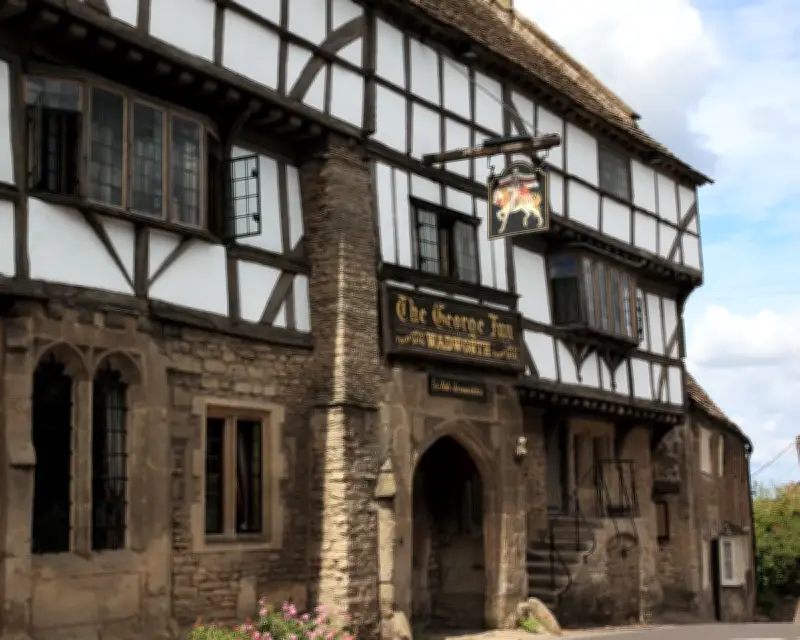
After years of competing claims, tree-ring dating has settled the debate over England's oldest pub. Dr James Wright, a buildings archaeologist working on behalf of Historic England, has named the George Inn in Norton St Philip, Somerset, as the oldest pub in the country, with fabric dating from the late 14th century.
Wright's investigation found that none of the more than two dozen pubs claiming to be the oldest are accurate. Many inns boast origins dating back 1,000 years and visits from Vikings and Saxons, but Wright said it was difficult to verify whether any pubs were built and used as inns or ale houses and kept in continuous use prior to the 1400s.
Scientific Dating Method
Using dendrochronology, or tree-ring dating on wooden beams, Wright established the age of the George Inn. He told the Guardian: "Not one of the claimants to be the oldest pub (and there are over two dozen of them) are even vaguely close to being so in reality."
Of the George, he said: "The architectural history of the George Inn's stone and timber suggests that this building has been in continuous service for over 600 years." The pub was set up in the 14th century by the monks of nearby Hinton Priory.
Tree-ring dating helped "to understand scientifically exactly how old the timbers are," he said. "Because we know medieval carpenters didn't muck around at all and they would fell the timber when it was green and build almost immediately afterwards, the actual date of felling gives us the near date of construction."
Debunking Historical Claims
Several pubs make claims that Wright dismissed as "modern marketing strategies." Ye Olde Fighting Cocks in St Albans, Hertfordshire, claims to have been established around AD800, while the Bingley Arms in Bardsey, West Yorkshire, declares it is "the original English pub – officially the oldest in Britain – dating back over 1,000 years to a time when Vikings were conquering parts of the country." The Royal Standard in Beaconsfield, Buckinghamshire, boasts it was a favoured watering hole of King Alfred the Great's West Saxons in around AD880.
Wright said of the Fighting Cocks: "The Fighting Cocks is often said to date to AD793. This date was probably not arrived at until 1926 when it appeared on a postcard. Prior to that, it was speculated to date to 1030, 770 and 672. There does not seem to be a basis in reality for any of those claims. Instead, the building started as a monastic dovecote, built around 1400. The earliest date when we can say for sure it was active as a public house is the first decade of the 19th century."
Many pubs claiming to be the oldest say they were mentioned in the Domesday Book, but Wright said: "There are no pubs mentioned – at all – in the Domesday Book, so any pub claiming to be in it is having you on."
Genuine Contenders
Wright added: "The claims are likely to originate less in folklore and more in canny marketing strategies by landlords, tenants, breweries and pub companies. The claims potentially rely upon the public not being aware of how to accurately date historic buildings."
His methodology required that a pub was purpose-built as a public house, had been in continuous service, and had archaeological, archival or dendrochronological evidence of significant primary fabric from the original construction. "I did consider buildings which had been converted and others which had periodically changed in land use," he said. "Even with those taken into consideration, there are only about 12 to 16 genuine contenders which have been doing trade since the medieval period. Of these, the oldest date to the 14th and 15th centuries."
Wright's list of the oldest pubs includes the George Inn (late 14th century and 1430-32), Bull Hotel in Ludlow (14th and 15th centuries), King's Head in Shrewsbury (1426, 1430-31), New Inn in Gloucester (1432), White Hart Inn in Hook (1419-51), George Hotel in Dorchester-on-Thames (mid 15th century), Angel Inn in Andover (1445-55), Kings Head in Aylesbury (1445-55), Angel in Grantham (circa 1450), George and Pilgrims Inn in Glastonbury (1461-83), Saracen's Head in Southwell (1460s), and George Hotel in Odiham (1486-87).