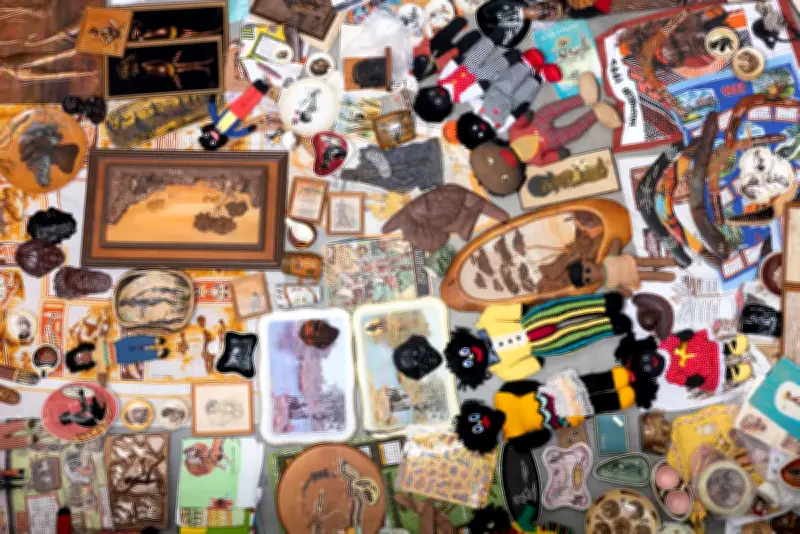
Artist Tony Albert has received more than 2,000 public donations of Aboriginalia – souvenirs, homewares and other objects depicting Aboriginal people and designs, often as caricatures – during his Museum of Contemporary Art (MCA) exhibition Not a Souvenir in Sydney. The items, including tea towels, ashtrays, crockery and clothing, have been hand-delivered or posted daily after Albert made a public call-out five months ago.
The exhibition features 4,400 objects from Albert's own collection, which he started in the 1980s as a child. In the exhibition's closing days, the MCA is packaging and shipping the 2,000 donated items to Albert's studio in Brisbane.
Artists and donors respond
Albert, who has family connections to the Girramay, Kuku Yalanji and Yidindji peoples, says he has been "genuinely overwhelmed by the generosity and response". Speaking via email from Paris, where he is on a month-long artist residency, the 45-year-old has been personally in touch with people who brought items in.
"What has moved me most is not simply the number of objects donated, but the personal stories and conversations that have accompanied them," he says. "There is something incredibly powerful and healing about people wanting to confront this history and entrusting me with these objects, so that together we can give them new meaning."
Carolyn Ienna, a 63-year-old Wiradjuri artist and activist from Sydney, dropped off a painted image of an Aboriginal man with a spear last week. They found it in a council pickup collection over a decade ago. "I'd look at it and feel sad, but I didn't have a name for it," says Ienna. "I didn't know what Aboriginalia was." When they discovered it, it felt like the previous owners were "throwing away an Aboriginal person".
"I don't think [people] understand the complexities of not only the trauma of colonisation, and how different Aboriginal people may see this Aboriginalia, but also the propaganda of it," says Ienna. One of the aims of Albert's call-out is to take items like this out of circulation; another is to reappropriate them through his practice.
Donations from near and far
Lesley Pepper, who travelled from Dunedin in New Zealand to see the exhibition, dropped off a set of serviettes, placemats and four porcelain plates that she has had for "30 or 40 years". "They were probably purchased here in New Zealand, in op-shops," says the 67-year-old. "I have a Māori background, and when I first bought them I felt that I was bringing them home, as a sign of respect."
One of her plates depicts a young Aboriginal woman, which Pepper says reminded her of herself. "[The woman] was probably never asked if her image could be used," she says, remorsefully. It wasn't an easy decision to give away pieces she had cherished for decades, but "when Tony said he wants to get them out of circulation, I thought 'yep OK', they have to come down. If that's what he's asking, that's what you do."
Items have been delivered to the MCA every day of the exhibition, says assistant curator Antares Wells. "Yesterday we received a donation of a nearly one-metre-tall figurine depicting an Aboriginal man with a spear," she says. "One donation alone had 120 plates, cups and saucers depicting Aboriginalia, another had 200 beer coasters."
Positive response and ongoing collection
Unpacking items has been a more positive experience than Wells initially imagined. "When we launched the appeal, we didn't know what the response would be from the Australian public – and in this political and cultural climate the first thing I personally thought was I really hope that we're not exposing Tony to hate mail," she says. "But I haven't seen one piece of hate mail and I think that has actually been incredibly inspiring and very powerful."
Kathryn Hopps, who lives in Canberra, made a detour to Sydney on the way back from visiting family to hand in a pair of silky Australiana scarves she had inherited from her grandmother. "They were classic 1970s and 80s Australian souvenirs with kangaroos and wattle and Uluru, and pictures of Aboriginal people and designs all mixed in together," says the 46-year-old. "I immediately recognised that this was not something I wanted to wear … I don't think my grandma had any idea."
"The only reason I held on to them is because I thought they should be in a museum," she says. "We can learn from these things, which is why I was delighted to find out about Tony Albert's exhibition and the opportunity to donate … It felt like a significant thing to do."
Though the MCA's donation boxes will be removed after the exhibition closes on 19 October, Wells says the gallery will "gratefully accept" any further Aboriginalia, which will then be passed on to Albert. Collecting has been integral to Albert's life and artistic practice since he was young, he says. "I don't think that will ever change, but what continues to evolve is my understanding of these objects and the possibilities they hold for telling stories, challenging perceptions and creating something meaningful from a difficult history."
A donated object that really stood out for him is a 1930s ceramic shaving mug in the shape of a caricature of an Aboriginal man's face. "I find it astonishing that someone would have wanted this object sitting in their bathroom, and used it as part of their everyday routine," he says. "These objects are actually incredibly rare and quite valuable, but what fascinates me most is what they reveal about the way Aboriginal people have been represented and how casually these images became part of Australian domestic life."