Tom Gauld's Latest Cartoon Targets Literary Cover Design Clichés
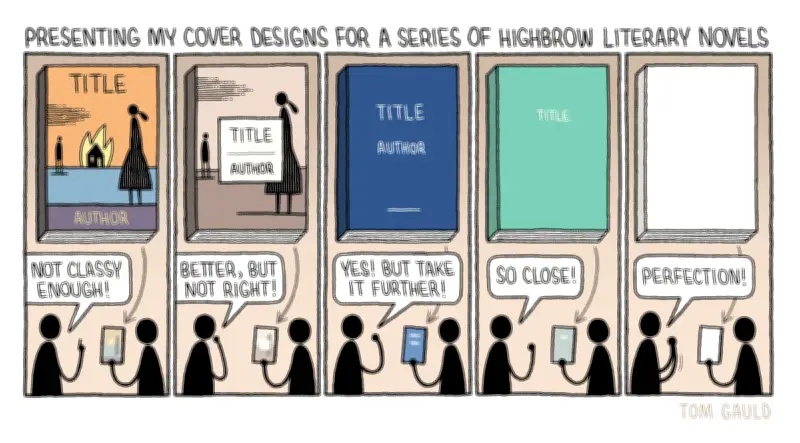
Cartoonist Tom Gauld has turned his satirical eye on the world of highbrow literary fiction, mocking the often-pretentious cover designs and blurbs that accompany such works. In his latest cartoon for the Guardian, Gauld presents a series of fictional book covers that exaggerate the minimalist and abstract trends seen in serious literary publishing.
The cartoon, published on June 28, 2026, features covers with titles like 'The Unbearable Lightness of Being Vague' and 'Austerity: A Novel of Quiet Desperation'. Each cover is accompanied by a blurb that parodies the opaque and overly serious language often used to describe literary fiction. For example, one blurb reads: 'A meditation on the spaces between things, and the things between spaces.' Another: 'For fans of quiet, slow-paced novels about nothing in particular.'
Satirical Elements Highlight Industry Tropes
Gauld's cartoon also pokes fun at the visual clichés of literary covers, such as sparse typography, muted colour palettes, and abstract imagery like a single bird, a geometric shape, or a blurred photograph. One cover in the cartoon shows a simple line drawing of a chair with the title 'The Chair: A Novel of Existential Seating'. The blurb underneath reads: 'A profound exploration of sitting, waiting, and the quiet dignity of furniture.'

The cartoon has resonated with readers and publishing professionals alike, who recognise the tropes Gauld is skewering. According to a spokesperson for the Guardian, the cartoon has been widely shared on social media, with many commenters noting the accuracy of the satire. 'It’s a perfect send-up of the kind of covers that make you think a book is important simply because it’s hard to understand,' one reader commented.
Context: Gauld's Ongoing Commentary on Publishing
Tom Gauld is known for his weekly cartoons in the Guardian, which often comment on literary culture, writing, and the publishing industry. His work frequently satirises the pretensions of the literary world, from author photos to book festival panels. In a previous cartoon, he mocked the trend of authors using overly complex metaphors to describe their own work.
This latest cartoon continues Gauld's exploration of the gap between the high-minded aspirations of literary fiction and the often-absurd reality of how it is marketed. By exaggerating the conventions of cover design, Gauld invites readers to question whether these designs genuinely reflect the content of the books or are merely a form of intellectual signalling.
Impact and Reception
The cartoon has sparked debate among publishers and designers about the role of cover art in conveying a book's tone and content. Some have defended minimalist covers as a way to let the writing speak for itself, while others have embraced Gauld's critique as a call for more creativity and honesty in cover design. The cartoon has also been praised for its humour, with many readers sharing their favourite fictional titles and blurbs from the piece.
As of publication, the Guardian has not released official statistics on the cartoon's reach, but social media analytics suggest it has been viewed tens of thousands of times within the first 24 hours. The cartoon is part of a long-running series that has cemented Gauld's reputation as one of the sharpest commentators on literary culture today.