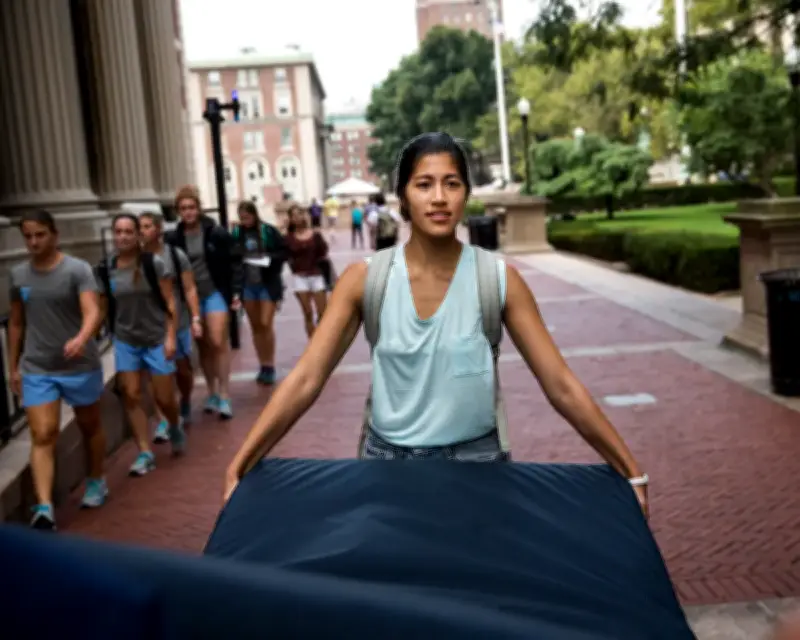
In September 2014, Emma Sulkowicz began carrying a 23kg blue mattress around her university campus. The mattress resembled those used in Columbia University dorm rooms, where Sulkowicz said she had been raped by a fellow student two years earlier. Her performance piece, which constituted her visual art senior thesis, drew attention to the lack of criminal charges against her alleged attacker and his continued presence at the university. As she hauled it across campus, others could choose to assist her with her burden, and many did. She recorded responses to the piece in a diary.
Viral Again in Response to Cornell Allegation
Footage of Mattress Performance (Carry That Weight) went viral in 2014, as momentum for #MeToo was building. Now the piece has gone viral again, in response to public fury at another allegation of campus rape. Jane Doe, a pseudonym used for anonymity, is suing Cornell University in New York and seven men, claiming they drugged and gang-raped her while she was studying there in 2024.
Sulkowicz's work joins a long line of women who have made art in response to rape, sexual assault and domestic violence. This radical, rarely explored canon encompasses a huge range of responses, from Paula Rego's 2008-9 altarpiece-like triptych Oratorio to Yoko Ono's 1964 Cut Piece, in which she invited an audience to remove her clothing with scissors as she knelt unmoving. Jenny Holzer used human bones in her 1994 installation Lustmord Table about rape as a weapon of war in the former Yugoslavia. Nan Goldin documented a violent relationship in The Ballad of Sexual Dependency, and Kara Walker made cut-paper silhouettes exploring the legacy of white male power in the American south.
A Canon Stretching Back Centuries
This canon stretches back at least as far as the 17th century, when Artemisia Gentileschi, whose rape and subsequent torture as part of her rapist's trial informed the rage in her Judith Slaying Holofernes (1612-13), painted Susanna and the Elders in 1610 at age 17, viscerally conveying intimate knowledge of vulnerability to sexual abuse.
That knowledge is something many carry, so it's no surprise that sexual and gender-based violence is a subject female artists return to. The current Tate Modern show on Frida Kahlo provides an apposite moment to reflect that Kahlo's most groundbreaking works will never make it onto coasters and tote bags. A Few Small Nips (1935) shows a woman's stabbed, naked body on a blood-smeared bed, inspired by a newspaper story in which a man who murdered his wife dismissed his actions with the words: "But I only gave her a few small nips."
Confronting Brutal Reality
No less bloody is Ana Mendieta's response to the rape and murder of Sarah Ann Ottens, a student at the University of Iowa. Rape Scene (1973) was a private performance staged in her apartment, where she posed semi-nude, bloodied and bent over a table for over an hour, forcing her audience to confront male violence. Her film Moffitt Building Piece, made that same year, films passersby unknowingly as they encounter a bloodstain left on the pavement, their responses serving as a metaphor for how violence against women is occluded by society.
This feels relevant in light of the gap at the heart of the Tate show: the violent manner of Mendieta's own death. Many believe her fall from a 34th-floor window was murder committed by her husband Carl Andre, who was tried and acquitted. The decision to sideline this element of her biography, perhaps in a well-meaning attempt to prevent a "victim" narrative, ended up muffling the pain and outrage that gives her works power.
That pain was manifest in Suzanne Lacy and Leslie Labowitz's In Mourning and In Rage (1977), staged while a serial killer dubbed "the hillside strangler" was murdering women in Los Angeles. The artists, with feminist activists and victims' family members, staged a funeral motorcade to city hall. Over 60 women followed a hearse from which 10 others emerged, 7ft tall in black mourning robes, delivering statements and a chorus of "In memory of our sisters, we fight back!" This followed Lacy's Three Weeks in May, which saw her daily updating a "rape map" of the city based on police statistics.
Still Painfully Relevant
Given that one in four women have been raped or sexually assaulted, according to Rape Crisis (England and Wales), such artworks will often feel emotionally heavy. Yet at a time when equality and justice can still feel far away, when so many women carry their own proverbial mattresses, it is crucial to continue giving voice to these experiences.
The author notes she was not alone in crying during A Second Life, Tracey Emin's retrospective at Tate Modern earlier this year. Watching Emin's 1995 short film Why I Never Became a Dancer, about teenage sexual exploitation and shaming during a dance competition, Emin says "Shane, Eddie, Tony, Doug, Richard … this one's for you," before breaking into a smiling dance to You Make Me Feel (Mighty Real). The work is defiance, strength and survival; what made the author cry was Emin's determination to be joyful despite abuse. What's a crying shame is that it still feels so painfully relevant.