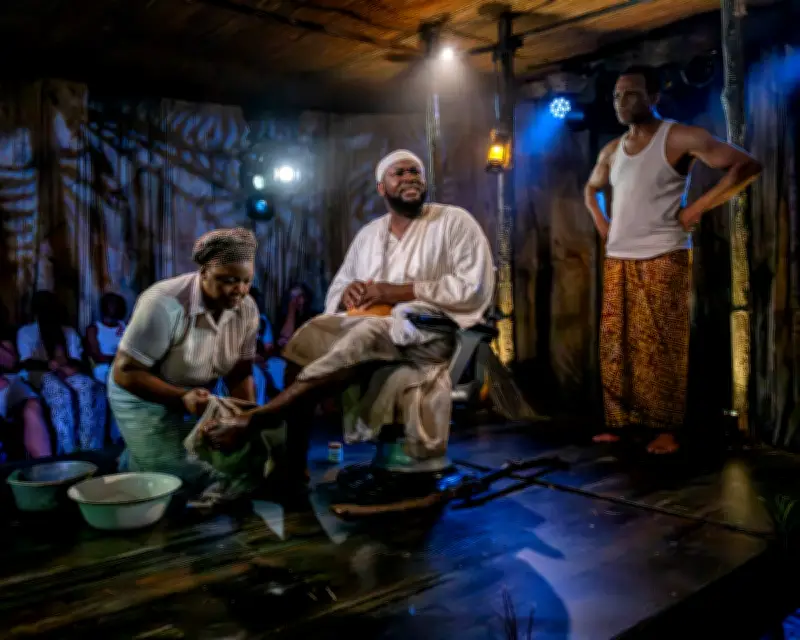
Utopia is the smallest of theatres, its 50-seat space made all the more intimate by the raffia ceiling and drape-lined walls. Yet this town-centre unit holds the biggest of characters on its stage, a wooden platform designed by Sarah Lewis-Cole that floats above the ground as if to evade the flood waters of the Niger Delta.
Archetypal Ferocity in a Single Act
They are big, in part, because of Wole Soyinka, whose 1958 play, unseen in this country for more than 50 years, has an archetypal ferocity. In a single act, he summons elemental forces: the twin brothers who have abandoned the family home for the big city; the blind stranger who arrives unannounced and is slow to declare his intent; the venal holy man, exploiting his status for personal gain.
It is both simple and strange, and set in a very 21st-century atmosphere of environmental doom. There is drought and infestation in the north, economic hardship in the dog-eat-dog city and ruination of crops here in the wetlands where the encroaching swamp is wiping out livelihoods. This is a land in transition, where the old bonds of spiritual belief and family ties are more of a curse than a help. The scale of change is beyond the human.

Bold Performances in an Intimate Space
Making these figures seem bigger still is director Mojisola Kareem whose excellent production makes no concessions to the tiny space. She draws out performances that are bold and sharply defined.
At its heart are the left-behind parents, Alu and Makuri. Expertly capturing a relationship that is equal parts irascible and loving, Urielle Klein-Mekongo worries about their absent son, while Jude Akuwudike barks back as the self-assured husband. Neither is as fragile or as confident as they would like to make out.
A Crucible for Grander Forces
Theirs is a domestic world, albeit one centred on the barber's chair by which Makuri plies his trade. But with the arrival of their unlikely procession of visitors – Obi Maduegbuna, otherworldly as the blind beggar; Theo Ogundipe, gaudy and domineering as the priest; and Joshua Roberts-Mensah, driven by a chillingly rational fury as the disillusioned son – their plain hut becomes a crucible for grander forces. It makes a play full of portent seem unsettling and intense.
At Utopia theatre, Sheffield, until 11 July.