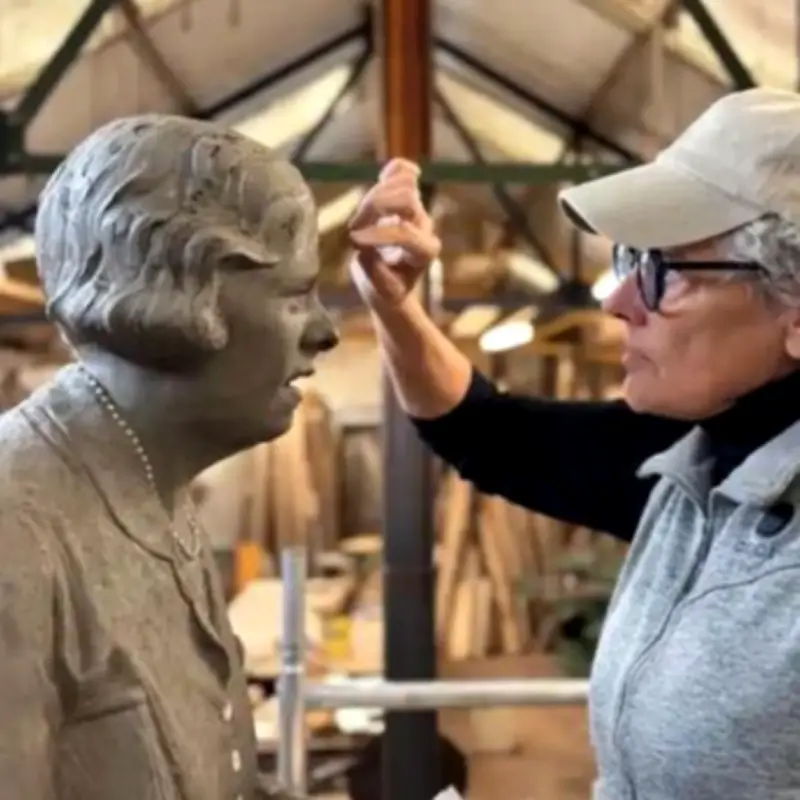
A statue honoring Elizabeth Andrews OBE JP, a tireless advocate for women's and children's rights, is set to be unveiled later this month at the Rhondda Heritage Park Museum in Trehafod.
The sculpture, created by artist Billie Bond, represents the fifth and final monument to a real named Welsh woman installed by the Monumental Welsh Women campaign. This nationwide initiative aims to recognize Wales' overlooked heroines and was featured by BBC Wales in 2019.
Elizabeth Andrews' statue joins four other women celebrated through the campaign: Betty Campbell, Wales' first black head teacher and champion of equality and diversity; Elaine Morgan, screenwriter and evolutionary theorist; Sarah Jane Rees, known as Cranogwen, a poet, mariner, preacher, and campaigner; and Lady Rhondda, suffragette, global businesswoman, and lifelong campaigner for equality.
Elizabeth Andrews is regarded as one of the most prominent Welsh female political activists of the early 20th century. Her statue will be unveiled at Rhondda Heritage Park Museum on Thursday, June 25, thanks to the efforts of the Monumental Welsh Women group.
Andrews was an internationalist, suffragist, and socialist who championed the needs of working-class families in the political sphere. She campaigned tirelessly for improved maternity and childcare provision and played a pivotal role in establishing one of Wales' earliest nursery schools.
Her successful campaign for the creation of pithead baths transformed the lives not only of miners but also of the women and children living within mining communities. She later became one of Britain's first female magistrates and was affectionately known as "Our Elizabeth" by the countless women she supported and inspired.
Born the seventh of 11 children into an impoverished mining family in Hirwaun, Cynon Valley, Elizabeth harbored ambitions of becoming a teacher but was forced to leave school at 13 to help her parents make ends meet. She worked as a dressmaker before moving to the Rhondda at age 26.
The move proved to be a catalyst for her political awakening as she witnessed the deep-rooted social problems afflicting her community. As the first Labour Party women's organiser for Wales—a position established after some women received the vote in 1918—she created women's sections, describing them as "working women's universities."
One of her first responsibilities involved translating pamphlets from English into Welsh to encourage women to exercise their newly acquired right to vote. In 1919, she provided testimony in the House of Lords to a Royal Commission examining the mining sector, delivering compelling accounts of how the mining industry affected family life.
She assumed a crucial role in coordinating community assistance during the 1926 miners' lockout following the general strike and the ensuing economic hardship of the depression throughout the 1930s.
Helen Molyneux, Chair of Monumental Welsh Women, said: "We are delighted to unveil our fifth and final statue of a real Welsh woman. Elizabeth Andrews' tireless work for her community—and for working families everywhere—continues to be seen in a tangible way today. We hope that highlighting her legacy, and the legacies of all five women honored by the Monumental Welsh Women campaign, will act as an inspiration to women and girls throughout Wales."
The 6.5-foot bronze sculpture of Elizabeth Andrews stands outside Rhondda Heritage Park Museum in Trehafod, Rhondda Cynon Taf, a museum dedicated to chronicling the heritage of mining communities across the south Wales valleys. The official unveiling will take place on Thursday, June 15, at 11 am.