Wilhelm Sasnal's Family/History Exhibition: A Disturbing Collision of Images
The ground floor of Sadie Coles HQ in London has been transformed by Polish artist Wilhelm Sasnal into a provocative visual landscape. His exhibition, titled Family/History, presents a jarring parade of broken images that challenge conventional narrative connections. From holiday snapshots to depictions of atrocities, and from Throbbing Gristle album covers to intimate family portraits, Sasnal reproduces the scattered attention and flattened perspective characteristic of our social media-dominated era.
Broken Connections and Unsettling Juxtapositions
Visitors encounter a disorienting array of paintings, most untitled, that resist easy interpretation. One moment you're facing a ghastly forest scene, the next you're confronted with a distorted image of a former US president surrounded by cronies, his face resembling a cigarette burn on a photograph. Nearby hangs a tender portrait of the artist's wife and daughter, creating an emotional dissonance that many find uncomfortable.
The largest painting in the exhibition reproduces at monumental scale the cover art of Throbbing Gristle's ironically titled album 20 Jazz Funk Greats. This choice is particularly loaded with meaning, as the band was once described by a Conservative MP as "wreckers of civilisation." The album cover shows the band posing in what appears to be a bucolic English landscape, but the backdrop is actually Beachy Head, Britain's most notorious suicide spot.

Cinematic Techniques and Historical Echoes
As both a painter and filmmaker, Sasnal employs montage techniques familiar from cinema, where disparate images are sequenced to imply new connections. This method relies on the viewer's willingness to bridge gaps between contrasting elements. The exhibition's title itself – family/history – suggests only the flimsiest of boundaries between personal life and historical forces, much like the stroke separating lines of poetry.
Those familiar with Sasnal's broader body of work will recognize connections between the grassy stripes in the Throbbing Gristle painting and his 2003 work Shoah (A Forest). This creates what some critics describe as an uncomfortable association between avant-garde art and historical genocide, forcing gallery visitors to confront difficult questions about art's relationship to trauma.
The Digital Age's Visual Crisis
Upstairs, the exhibition continues with more personal works, including a portrait of Sasnal's son Kacper. The painting shows the young man lying on a sofa with a book on his knees while reaching for his laptop, reminiscent of Michelangelo's depiction of God reaching toward Adam. This image captures the contemporary reality of scattered attention, where absorption in a single activity has been replaced by constant distraction across multiple media platforms.
"History is playing out on our screens, and we can't tear ourselves away from it," the exhibition seems to suggest. Nearby hang two small pastoral scenes showing men alone on riverbanks, one figure extracted from William Tylee Ranney's 1850 painting The Lazy Fisherman. These works gain additional resonance from the artist's personal history – his grandmother once told him that the river near his birthplace in Tarnów was thronged with bathers in the summer of 1939, just before war changed everything.
Diminishing Tension and Deliberate Incomprehensibility
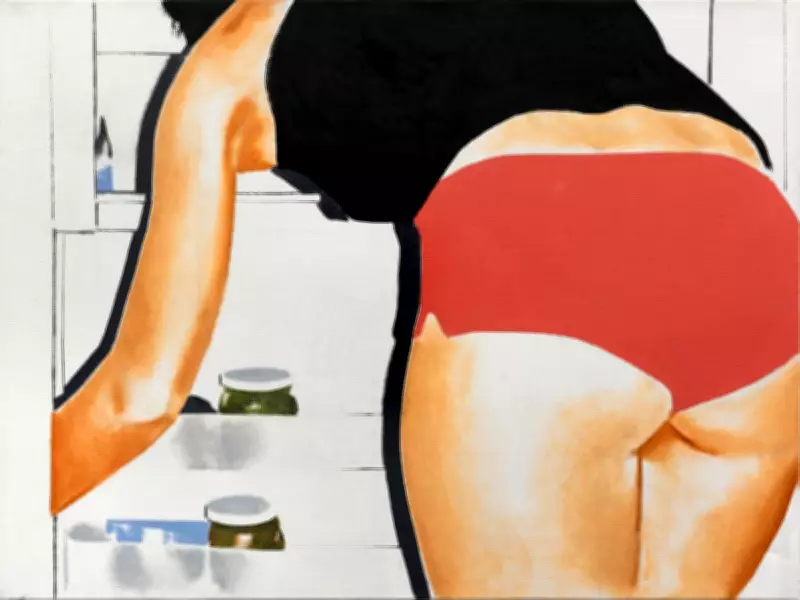
Some critics note that the exhibition's energy diminishes in the upstairs galleries, where family portraits and holiday scenes predominate without the dramatic collisions with history found downstairs. Paintings of a band on stage and two works depicting backsides in shorts have been described by some as descending into banality after the explosive start.

Yet this diminishing tension might be intentional. Unlike traditional montage that seeks to reveal higher truths through juxtaposition, Sasnal's works often produce only unease and confusion. The coexistence of good and evil, personal and historical, beautiful and horrific cannot be easily explained or reconciled. In one particularly poignant double portrait, the artist's wife and daughter face away from the viewer, looking out toward a calm sea as if to shield themselves from the horrors depicted on the surrounding walls.
The exhibition ultimately suggests that we cannot entirely protect those we love from history's reach, nor can we neatly explain away the uncomfortable coexistence of contrasting realities in our visual landscape. Family/History runs at Sadie Coles HQ in London until 23 May, presenting visitors with a challenging reflection on how we process images in an age of information overload.