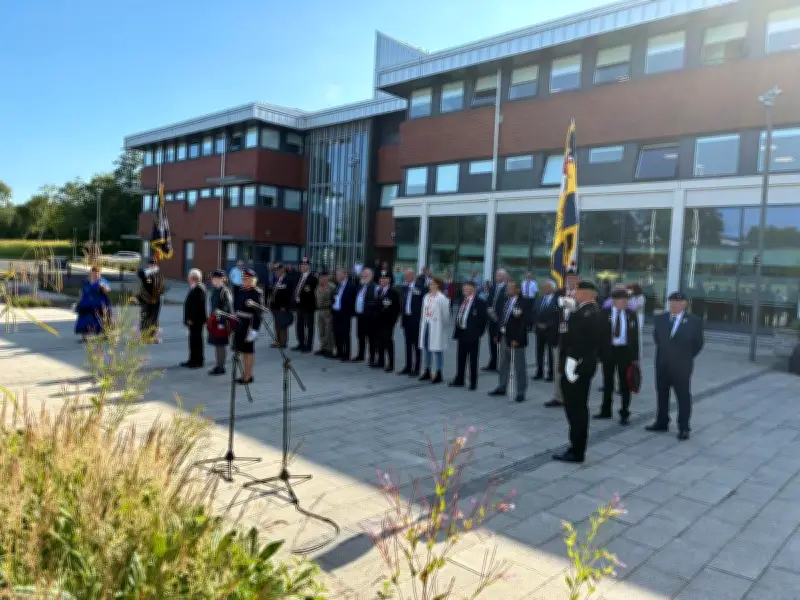
A special service was held at Northumberland County Hall on July 1, 2026, to mark the 110th anniversary of the Battle of the Somme, with particular focus on the Northumberland Fusiliers. The regiment suffered the highest number of casualties of any regiment on the opening day of the battle, which remains the single bloodiest day in British Army history.
Service of Remembrance
Current veterans attended alongside local dignitaries and officials at the council's headquarters in Morpeth. The council's civic head, Councillor John Beynon, said: "A generation of young men stepped out of the trenches. Many of our ancestors fought in the war and many sacrificed their lives."
Council leader Glen Sanderson, who has visited the battlefield, added: "It is incredible to go and consider what actually happened there 110 years ago. The Northumberland Fusiliers, for it is they that we particularly remember at the county council, were thinking about their homes in Northumberland - in Wooler, Cornhill, Morpeth, Alnwick and Berwick, and thinking about their family and friends. Then they went over the top. They were told to march towards the German Lines and were told to carry on whatever happened. As we know, the bombardment that was to have destroyed the trenches, the machine guns and the barbed wire had failed. These men walked to their death."
Casualties and Legacy
There were more than 57,000 British casualties on the first day of the battle, with 19,240 men killed in action or dying of wounds. Chester Potts, who served with the Royal Regiment of Fusiliers (the successor unit), described the conditions as the "biggest disaster in the history of the British Army." He stated: "The casualty rate was horrendous. Men were forced to march a mile in open ground, wave after wave was cut down. 150,000 men died. There were 400,000 casualties for the gain of just seven miles. In the German Spring Offensive in 1918, most of that land was lost. 72,000 men still lie out there. When you walk out there, you walk on their bodies. They left us a legacy of democracy and freedom. They should never be forgotten."
Ongoing Commemoration
The council is working with Northumberland Archives to highlight personal stories from the battle. A new display will run in County Hall, a special website is being created, and a touring library exhibition is planned over the coming months. Among the stories featured is that of Captain John Evelyn Carr, who fought in the Somme and was a Northumberland county councillor between 1913 and 1916. He kept a diary, writing on July 1, 1916: "A lovely summer day and one I shall never forget for many things. One principal thing was that my Battalion (as good as any in the British Army) was almost entirely demolished, only two officers that were with it got back unwounded. Captain Hudson and Lt Hayes, all the rest were either killed or wounded. The Colonel was badly hit in both lungs, the Adjutant was wounded and many of my dear pals were killed."