Audrey Niffenegger's long-awaited sequel to her bestselling debut, The Time Traveler's Wife, is finally here. Titled Life Out of Order, the novel took 14 years to write and marks a political turn for the author, who says the current US administration has radicalised her.
A Sequel Born from Dystopian Futures
Niffenegger began writing the sequel in 2012, just after Obama's re-election, describing that period as a “rosy” time in American politics, “as good as it gets over here”. The new novel required her to imagine the world in 20, 40, and 60 years' time, and as she explored various dystopian futures, American politics moved on, making her imaginings look worryingly realistic.
An early scene in the book features a group of neo-Nazis at a house party, written at a time when few believed the US would see a resurgence of neo-Nazism. Niffenegger says she is not “psychic or anything”, but the clues were there. “The first thing I remember reading in the news was Watergate, and so I’ve grown up with Reagan, and the Republicans coming on stronger and stronger, so that every Republican president we get is more of a disaster. And I thought the logical progression of that would be fascism,” she says.
The Story of Alba and a Darker Vision
The Time Traveler's Wife, published in 2003, tells the story of Clare, an artist who falls in love with Henry, a man with a rare genetic condition that causes him to lurch involuntarily through time. Henry is condemned to revisit painful chapters of his life and knows, but cannot change, future hardships. The sequel, Life Out of Order, follows their daughter, Alba, who has the same condition but more control over her time travel and a greater willingness to use her abilities for personal and political ends.
Niffenegger always saw The Time Traveler's Wife as a much “darker book” than many readers did. People would tell her the story was “so romantic” – “and I’m like yes, it’s so romantic. It’s also kind of heavy,” she says, because of the inevitability and the choice to be happy in the moment while knowing things will not work out well. With the new novel, the darkness is unmistakable.
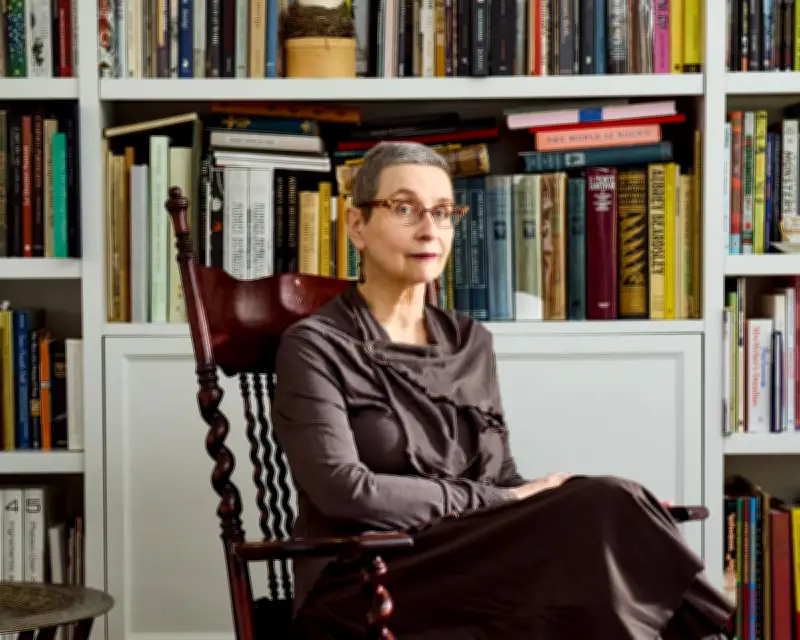
We meet in her book-filled Chicago home, shared with her husband, Scottish artist Eddie Campbell. The walls are hung with her bold, dreamlike paintings, and she has an impressive taxidermy collection, including a rhea in the front room, two doves in a bell jar, and a pangolin on the coffee table. She used to have more on display, but her three cats are “barbarians” who started “interacting with it in weird ways” as kittens.
From Obscurity to Global Fame
When Niffenegger started writing The Time Traveler's Wife, she was working as an artist and professor at Columbia College Chicago's Centre for Book and Paper Arts, making hand-bound, hand-printed books in editions of 10. The phrase “The Time Traveler's Wife” popped into her head while sketching one day. Published by small independent press MacAdam/Cage, she expected it to sell a few thousand copies; it sold more than 9 million globally.
She had a few lucky breaks, including a recommendation from novelist Scott Turow after his wife, artist Annette Turow, passed the book on to him. In the UK, it was picked for Richard and Judy's Book Club. She began receiving emails from people in long-distance relationships, and knows of a “surprising number” of children named Henry or Clare. The sudden success was “very odd”, and she struggled with “impostor syndrome”.
The novel's success brought attention to Chicago locations, including the Newberry Library, which had to print a Time Traveler's Wife FAQ sheet for the front desk. In 2009, the book was made into a Hollywood film starring Rachel McAdams, which was panned by critics; Niffenegger has never watched it. In 2022, HBO made it into a series.
Political Radicalisation and a Call to Action
Niffenegger received a $5m advance for her second book, Her Fearful Symmetry (2009), a ghost story set in London. She moved to the city for research and became a tour guide at Highgate Cemetery. She says she didn't expect people to know about the advance, adding, “It was like ‘That’s just my finances. Why would anybody care what’s going on with my bank account?’.”
Over the years, she has cut back on teaching to focus on writing and art, and runs a small nonprofit arts school, Artists Book House, founded in 2019. In the years since Her Fearful Symmetry, she says, “People just forgot I existed,” which seems to suit her fine.
Niffenegger has been thinking much more about politics while writing about the future. Both Alba and Henry find it easier to move backward than forward in time, because the future is harder to imagine, but the more they do so, the more concrete it becomes. She realised this is true more generally: we find it hard to respond to threats like the climate crisis because we struggle to visualise climate meltdown. In her book, she describes cities underwater, failing utilities, food shortages, and apocalyptic weather to make global warming feel less abstract.
“The current administration has radicalised her, she says. “Until the recent Trump debacle I was not a person who used to go to demonstrations. I was political in some ways, but I was not somebody who would drop everything and, you know, hit the street yelling. Now I am,” she says. She feels a sense of urgency: “I feel like whatever you can be doing, now’s the time. If what you can do is vote, vote. If that’s all you can do, cool. If you can give money to a cause, yay. If you can, go to a demonstration. Excellent. People should be paying attention and acting accordingly.”
One advantage of being a slow writer, she says, is being able to respond to current events. It would have been strange to publish the book without mentioning the pandemic and lockdowns. Part of the reason the writing took so long was that she was “waiting to find out the resolution to certain real world events”. While imagining civil unrest, she watched protests over the police killing of George Floyd and felt sure something would change, “But no, it just seems to have been like a rock falling into a pond,” she says.
Niffenegger will soon leave on a small book tour. She is thinking of expanding her graphic novel, The Night Bookmobile, into a series of interlinked short stories, but also about not doing too much. “After spending 14 years on one thing, I’m happy to have a little rest,” she says. Life Out of Order is published by Jonathan Cape (£22).