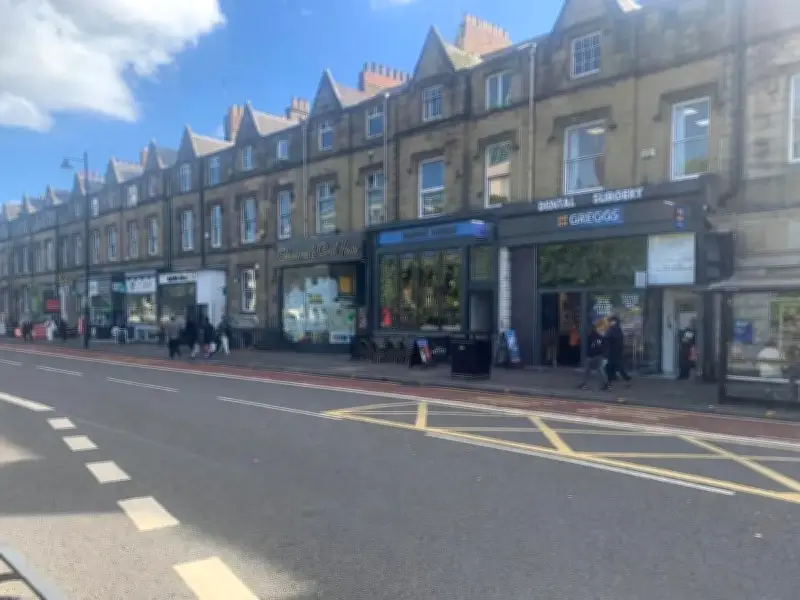
Archaeological work at 5 St Mary’s Place, Newcastle, has revealed the building’s origins as an elegant Georgian townhouse, long before it became a Wimpy bar in 1973 and later part of the Munchies chain. The findings, made by Newcastle-based AAG Archaeology, show traces of earlier rooms, ceilings, and fittings hidden behind modern cladding and a suspended ceiling.
From Georgian elegance to fast food
St Mary’s Place was built in 1829 as a single row of houses designed by architect John Dobson (1787-1865) to complement his St Thomas the Martyr’s Church, completed the following year. The street took its name from the medieval Hospital of St Mary Magdalene, a church and leper hospital thought to have been founded during the reign of Henry I and refounded in 1611 by James I. A 1997 excavation during road-widening found no trace of the medieval building.
The first known resident of number 5 was Robert Richardson Dees (1804-1908), a solicitor and President of the Newcastle Law Society, who later gifted land forming Richardson Dees Park. Another notable figure was Dr William Rea (1827-1903), a musician who became Newcastle’s Council Organist and founded the Promenade Concerts, living there from 1860.
A changing street
By the late 19th century, the building was subdivided and housed musicians and dressmakers, some of whom may have been euphemistically named. In the 1920s, engineering firms and a solicitor’s chambers occupied the address, while D Haswell Hairdressers ran the ground-floor shop from the 1930s to the 1960s.
When Wimpy arrived in Newcastle in 1973, the St Mary’s Place branch was among the first in the city. After competition from McDonald’s and Burger King, the Wimpy closed in 1994, followed by Breadcrumbs café, before Munchies took over around 1998. For the next quarter-century, Munchies served thousands of students and club-goers.
Hidden history revealed
AAG Archaeology notes that number 5 illustrates the decline from high-end townhouse to shopfront and fast-food outlet, with elements of each phase surviving. Further investigation promises to shed new light on the Haymarket area’s deeper past.