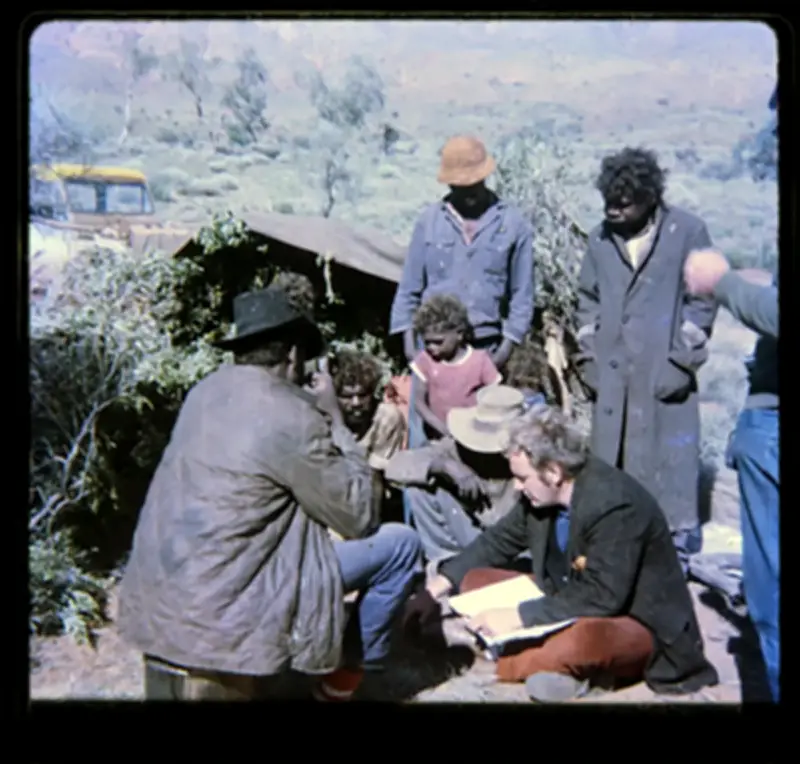
A new biography is challenging the long-held myth surrounding Geoffrey Bardon, the art teacher credited with sparking the Western Desert Aboriginal painting movement at Papunya in 1971. The book, Art Mania: Geoffrey Bardon and the Painting Men of Papunya by Kitty Hauser, examines Bardon's life, his relationship with the painters, and the forces that shaped his story.
For decades, the popular narrative has cast Bardon as a heroic and martyred figure who arrived at the remote settlement of Papunya, 250km west of Alice Springs, and convinced a group of Aboriginal men to paint their dreaming stories on hard surfaces. This led to the creation of the celebrated dot painting movement and a global art market.
A Complex Portrait Emerges
Hauser's biography, published by Giramondo, draws on the extensive private Bardon archive held by his widow, Dorn. The book presents Bardon not as a saint or sinner, but as a complex and pained individual. It also explores the role of his older brother, James Bardon, who used his younger brother's experiences as fodder for novels, documentaries, and articles.
Hauser concludes of the elder brother: “Jim got a fair bit of literary mileage out of the painting men, or his idea of them. There could hardly be a better example of appropriation, even if it has gone under the radar (including, perhaps, Geoff’s) because of the obscurity of Jim’s writing.”
A Story of Mental Health and Institutions
The book also focuses on Bardon's mental health. After leaving Papunya in 1972, he was admitted to Sydney's Chelmsford hospital under psychiatrist Harry Bailey, where he underwent deep sleep therapy, a treatment later exposed by a royal commission as responsible for 24 deaths.
Hauser draws a parallel between the settlement and the hospital, writing: “Didn’t both institutions seek to instigate (imperfectly) a deliberate forgetfulness, a whitewashing of minds, in one case, and of entire cultures in the next?”
Questioning the Hero Narrative
Indigenous art curator Margo Ngawa Neale says history tends to “inflate the influence of white fellas like Bardon over the existing painting practices in Black communities.” Neale, who is of Gumbaynggirr and Wiradjuri heritage, describes Bardon's involvement as “a short story with a long ending,” adding that he was “a damaged man but a talented one who gave the best of himself to the painting men of Papunya.”
Hauser's research, which credits the work of other scholars, establishes that painting was already happening when Bardon arrived and that he was not the first to take works out of the settlement. The book ultimately leaves the mystery of why Bardon left Papunya unresolved, suggesting “the limits of knowing.”