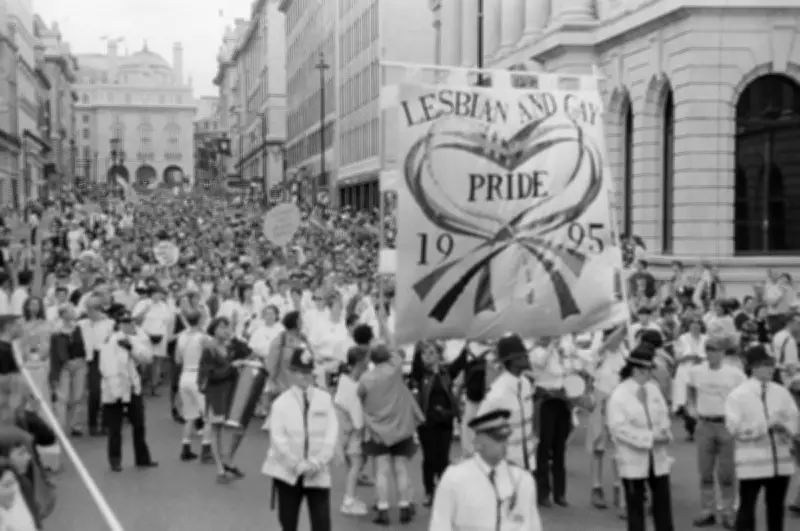
London's summer of 1995 looked like peak gay hedonism, with Pride that year finding its rave side as the familiar Trade nightclub logo hovered over a tent in Victoria Park. The political climate demanded it: if the LGBT+ community was not going to be recognised in statute, perhaps it could prompt a positive glance elsewhere.
Pride during the 1990s was the last blast of the annual gay march as protest, carrying the scent of the amateur. The decade began with 19,000 people coalescing on Victoria Embankment. By 1999, a year that galvanised queer politics due to the bombing of the Admiral Duncan pub, participation had topped one million, and corporations had started to notice and wanted in.
Obstacles in law and society
There was plenty to protest. In 1995, it was still illegal for lesbians and gays to serve in the armed forces or to adopt a child. The fight for legal equivalence had stuttered to a standstill when the age of consent inched down from 21 to 18, meaning gay people were still expected to wait two years longer to have sex than their straight counterparts. Further obstacles abounded, such as Section 28, which outlawed the “promotion of homosexuality” in schools.
The legalisation of gay marriage was a generation away, meaning betrothal was something gay people did only when in the closet. The gay happily-ever-after had only just been introduced to cinema by way of Jonathan Harvey's love story, Beautiful Thing, filmed on the banks of the Thames. The most propulsive TV character, Warren in This Life, was beaten up, arrested for cottaging and mostly filmed solo in therapy. HIV/Aids still had another year to go before losing its status as an assumed death sentence, with the advent of combination therapies. The grip of 1980s morality, a particularly brutal decade for queer people, was only just beginning to show signs of loosening.
A defiant party spirit
Despite the sociological temperature — almost certainly because of it — the community still knew how to throw a party like few others. Gay ownership of the night bristled with mischief, illegality and cut-throat glamour. British clubs of the 1990s were the envy of the planet, spanning the acid house hangovers at Heaven, the cosmic elegance of Queer Nation and the handsy free-for-all at The London Apprentice. Aware of this gloriously delinquent, defiant asset, Gay Pride upped its rave valve for summer 1995, ending with a pill-soaked party in Victoria Park. A tent housed some of this explosive energy, pairing the Ministry of Sound with Trade and DTPM, reverberating with floodlit house music, woozily disinhibiting stimulants and a surfeit of white denim.
Pride had stopped looking like something devised at a community meeting in a civic hall. It retained the heat of political tension, then defused it with hands-in-the-air defiance. The idea that banks and supermarkets might one day buy into this corporeal explosion of bodily resistance seemed simultaneously unthinkable yet somehow inevitable. The problem with inequality is that sooner or later it gets boring, costly and irrational for everybody. The bacchanalian excesses at Clerkenwell nightclub Trade, which opened at 3am on Sunday and partied hard into the afternoon, bequeathed a trashed Olympian flavour to the idea of the London gay nightclub during the decade.
Fightback through celebration
In one corner, christened Muscle Alley, men decked in no more than Calvin Kleins and a pair of sodden adidas Sambas lost their shit to a demented strain of sped-up northern European techno dubbed Nu-NRG. This excess briefly spilled over into Pride, reimagining Britishness as something uninhibited and free, shedding the skin of all that 1980s costume and repression. This was the countercultural and pop cultural fightback against inequality at its most extreme, disquieting and, yes, fun.
When recalling the gay 1990s and the idea of Pride itself, there is much to remember with dewy-eyed nostalgia, but also so much malevolence and personal antipathy that prompted these glorious explosions of DIY bonhomie. The gay experience, pre-internet, had centred on the night. Gayness wrapped itself up into wider questions of who you were, where you might go on holiday, which doctor you made an appointment with, what you did for a job, which landlord you might trust. Every rung on the ladder to rudimentary living was trip-wired with guesswork as to who and what found you acceptable. Just being was an act of political defiance.
That was what Pride meant back then: to explain to the world, while marching up prestigious London streets handed over for one day a year, that queer experiences were worth rethinking, laws were worth repealing and that the parties might just be the best. Life for queer people back then was doused in prejudice and tenacity, and responding to the bitterness with so much sweet remains to the community's eternal, prideful credit.