
Directed by Javier Calvo and Javier Ambrossi, or ‘Los Javis’ as they are affectionately known in their native Spain, La Bola Negra is a sprawling spectacle which weaves together the storylines of three interconnected gay men living in different periods of Spanish history.
Three Storylines Across Spanish History
The first is Carlos (Milo Quifes), a wealthy young man living in 1932 Granada, who is refused membership of an exclusive casino because of his rumoured homosexuality. He spends the rest of the film in a state of limbo, unsure of whether he should deny the rumours or accept that society will reject him because of his sexuality.
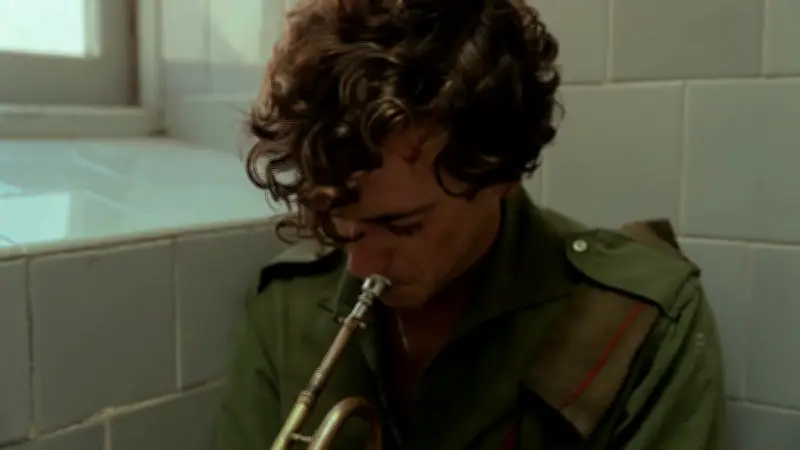
The second storyline is that of Sebastián (Guitarricadelafuente), a young musician who is forced to join Spain’s Nationalist faction in 1937, during the Spanish Civil War. It’s because of this, though, that Sebastián meets someone who will change the course of his life and whose acquaintance will reverberate through the years. An injured Republican soldier, Rafael Rodríguez Rapún (Miguel Bernardeau), who was an actor and played for Atlético Madrid before the war, is placed under his watch. Rapún is due to be executed and is only being kept alive for information, but that doesn’t stop the two secretly drawing close in the short time they have together.
A Modern-Day Connection
It’s slowly revealed that Rapún’s relationship with the real-life Spanish playwright Federico García Lorca, on whose unfinished queer play this film is partly based, is linked to the third storyline, which is set in 2017 and follows a postgrad history student called Alberto (Carlos González). As an out gay man living in Madrid with his boyfriend, Alberto is much freer to enjoy the life that Carlos and Sebastián could never have had. Against the wishes of his mother, Teresa (Lola Dueñas), with whom he is constantly arguing, Alberto journeys to Cantabria after finding out that his recently-deceased grandfather has left him something in his will.
We learn more about Carlos and Sebastián’s stories through Alberto, as the three plotlines gradually converge to form one grand, sweeping portrait of love which defies social and political oppression.
A Moving Spectacle
Over its two-and-a-half-hour runtime, La Bola Negra skillfully unearths the queer expression that’s been suppressed over the decades, whether that’s in a wartime setting, under the rule of fascism or amid conservative family conflict. It’s an achingly moving film, brought to life by a knockout ensemble cast (Penélope Cruz has a standout cameo) and delightfully rich cinematography and production design from Gris Jordana and Roger Bellés respectively.
While the transitions between the time periods could be a bit more seamless and the modern-day storyline feels noticeably less compelling than the other two, all things considered, La Bola Negra deserves all the praise (and possible Oscars) it will get and more.




