The Sedlec Ossuary, housed in the Church of All Saints and Ossuary in the Czech Republic, is decorated with the remains of an estimated 40,000 to 70,000 people. The chapel, located about an hour east of Prague, is one of the most visited monuments in the country and remains a functional Roman Catholic church where masses are celebrated.
Despite its understated medieval exterior, the underground chambers contain a remarkable sight: bones arranged into religious symbols, intricate craftsmanship and a sobering reminder of the region's past inhabitants.
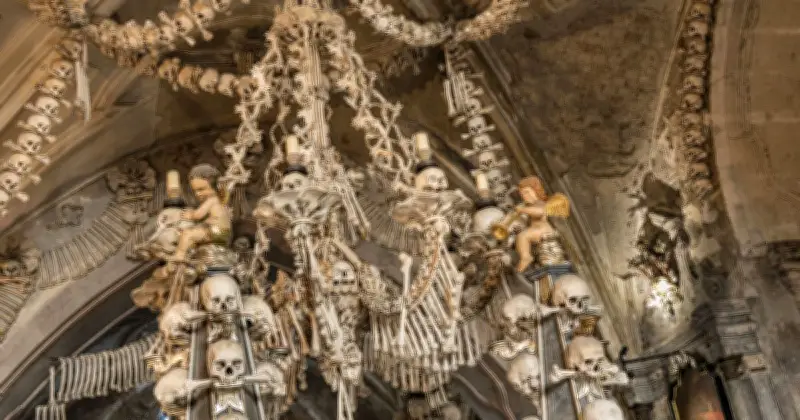
A Chandelier Made of Human Bones
The most striking feature of the ossuary is a massive chandelier suspended in the centre of the chapel. Constructed from human bones, the chandelier is said to incorporate at least one of every human bone. Elsewhere, skulls and bones are arranged into decorative garlands and other carefully composed displays, including a coat of arms associated with the Schwarzenberg family, a prominent Bohemian noble family that once held estates in the region.
These displays reflect centuries-old traditions of contemplating mortality, faith and the afterlife.
A History Stretching Back to 1278
Around 1400, a Gothic church was built in the centre of the existing cemetery, with a vaulted upper level and a lower chapel used as an ossuary for mass graves, making the site approximately 626 years old. The site's history, however, dates back to 1278, when the abbot of the Cistercian monastery at Sedlec travelled to Jerusalem on the orders of the King of Bohemia. According to local tradition, the abbot returned with soil from Golgotha, the site associated with the crucifixion of Jesus Christ, which was scattered across the monastery cemetery, giving the burial ground special religious significance.
Word of the sacred earth spread, and people from across the region sought to be buried there, making the cemetery a highly desirable resting place. The number of burials increased, influenced by outbreaks of plague and conflicts that affected Bohemia in the following centuries. As the burial ground filled, space became increasingly limited.
The 1870 Transformation
During the 15th century, a Gothic church was constructed on the site, with an underground chamber used to store human remains removed from the cemetery to make room for additional graves. The bones remained there for centuries before the chapel acquired its distinctive appearance.
The transformation came in 1870, when woodcarver František Rint was commissioned by the Schwarzenberg family to organise the accumulated remains. Rather than simply storing the bones, Rint arranged them into carefully designed decorative structures, turning the underground chamber into a massive display of bone art. The chandelier, ornamental chains and family coat of arms have become among its most recognisable features.