The Magic Circle is marking the centenary of Harry Houdini's death with two special events that restage the 'Daily Mirror Handcuff Challenge,' the stunt that brought the American escape artist his first front-page national newspaper headlines and international fame.
Houdini, dubbed 'King of Handcuffs' and famed as the world's greatest illusionist, died on October 31 1926, aged 52, from diffuse peritonitis - severe inflammation caused by a ruptured appendix. Documentary series and radio shows will be broadcast to mark the anniversary.
The 1904 challenge that made Houdini a star
'We challenge the handcuff king,' screamed the headline on March 14 1904, daring Houdini to escape from a pair of custom-made solid steel cuffs commissioned by the Mirror. The article continued: "Mr Houdini admitted he was afraid. Has Houdini met his Waterloo?"
In March 1904, after effortlessly escaping every restraint thrown at him by audience members at London's Hippodrome Theatre, Houdini was surprised by Mirror reporter Frank Parker, carrying the cuffs. Forged by a Birmingham blacksmith over five years, the lock was considered unpickable by Britain's top locksmiths, and Parker challenged Houdini to escape them.
Paul Zenon to recreate the escape
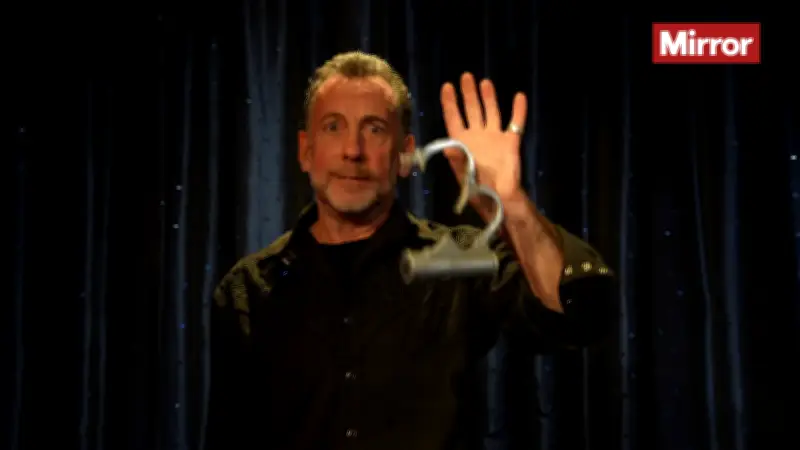
The Mirror was invited to the Magic Circle's secretive London HQ for an exclusive preview, in which Yorkshire-born magician Paul Zenon, 62, promises to escape from handcuffs modelled on those presented to Houdini. Paul, who has Gold Star membership of the Inner Magic Circle, says: "It was the original publicity stunt. Houdini was apparently friends with the press baron Alfred Harmsworth (who later became Viscount Northcliffe), who had launched the Mirror a few months before, and changed it to the Daily Illustrated Mirror, as it wasn't initially successful. So, it's likely that it was a mutually beneficial publicity stunt, set up in advance."
Paul, author of three magic books and a regular on TV's Countdown, has written and stars in the Halloween shows, which feature other signature Houdini effects and stunts alongside a reenactment of the Mirror Handcuff Challenge. He says: "It was what's known as a Bramah lock. It uses a cylindrical key with slotted depths that depress a circle of sliding wafers or sliders against spring tension, instead of traditional levers or pins. It's basically a lock within a lock, which makes it extremely difficult to pick."
The historic escape and its aftermath
Legend has it, Houdini refused the challenge three times - finally accepting and returning to the Hippodrome five days later, on March 17, for a special matinee show. Paul says: "By taking up the challenge, Houdini got national coverage - and the Mirror got more readers. It was one of the first successful large-scale publicity stunts. And the Mirror challenge captured people's imagination. When it came to the actual day, there were 4,000 people in the Hippodrome - it was absolutely jammed."
Houdini stood before the spectators and confessed: "I do not know whether I am going to get out or not." An orchestra played as Houdini disappeared into his stage cabinet. After 20 minutes he emerged, drenched in sweat, and asked if the cuffs could be removed for a break, but the Mirror reporter refused. Paul says: "Bess, Houdini's wife and assistant, left the theatre because she was so stressed. After 55 minutes, he appeared again, and asked if the cuffs could be removed in order for him to take off his heavy coat. Again the Mirror reporter said no, so Houdini pulled a penknife from his pocket and cut the jacket to ribbons on stage, turning his frustration into brilliant showmanship."
After a total of 70 minutes, Houdini finally emerged holding the open shackles high. The audience went wild, carrying the weeping, exhausted star around the arena on their shoulders. The Mirror commemorated the historic showdown by gifting Houdini a solid silver replica of the legendary cuffs. The illusionist called the escape "one of the hardest but fairest tests" of his life.
Paul's own escape attempt
Paul says: "It was the stunt which turned Houdini into a household name. He got national press coverage for that whole week and then for months afterwards. Houdini was only about 5ft 2in, despite claiming to be 5ft 7in. He was quite a small man. In 1904, Houdini also knew the locksmith who made the cuffs and had been in Birmingham not long before - which might explain why the cuffs were such a good fit!"
Ahead of the Houdini Halloween 100 shows - one on Monday October 26 at the Hippodrome Casino, London and one on Thursday October 29 at Madam Lola's Cabaret and Vaudeville, Brighton - Paul gave The Mirror a 'private viewing.' Standing inside the Magic Circle HQ, behind an unmarked blue door on London's Euston Road, he was locked into replica cuffs with six half turns of their ornate silver key, with a black silk bag placed over his hands. The lock was released at nine minutes and 24 seconds.
After Houdini completed his Mirror Handcuffs stunt, he issued his own challenge. The magician, whose death was not directly caused by the punch but by an acute appendicitis, challenged sceptics in a letter published in the Mirror on March 21 1904, headlined 'Houdini's Hurt.' Referring to 'unjust remarks' regarding his authenticity, he wrote: "I hereby challenge any mortal being to open the Mirror Handcuff in the same space of time that I did" - offering them 100 guineas. A few people threw their hats in the ring, but nobody succeeded in opening the Mirror handcuffs until now. For more information, go to themagiccircle.co.uk/shows/houdini-halloween-100 and madamlolas.com.