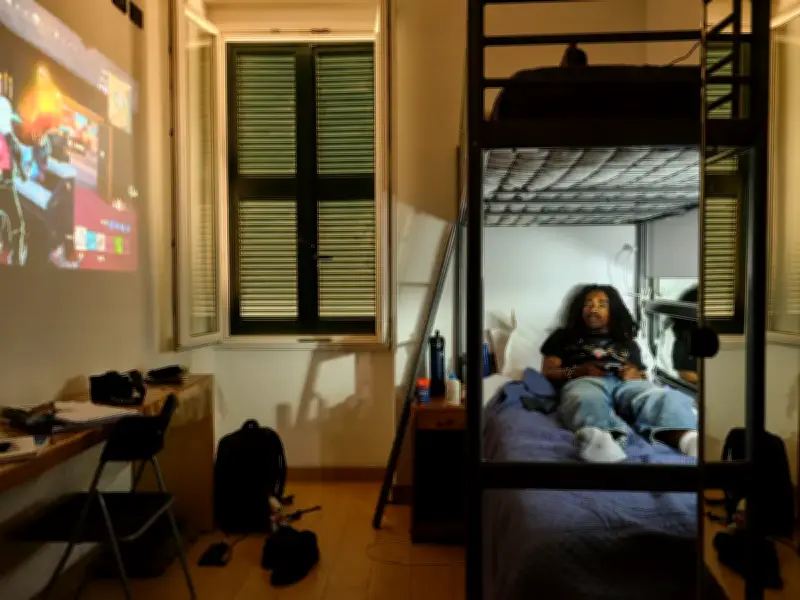
Photographer Niccolò Rastrelli has launched a project titled IRL, exploring how Gen Z, the first generation of digital natives, express themselves both in their bedrooms and online. The project pairs posed portraits of subjects in their personal spaces with curated snapshots of their phone screens, revealing the contrasts and connections between their private and public identities.
Portraying Gen Z Diversity
Rastrelli, born in 1977 and a member of generation X, recruited subjects across the full span of Gen Z, from 14-year-olds to adults in their late 20s. Most were in Italy, but he also visited the UK, Morocco, and France. Each portrait has two paired components: on one side, the subject is photographed in their bedroom, whether in their family home, a flatshare, or university halls. They are intentionally posed, nearly always making eye contact with the camera, often clutching phones or sitting by a computer, with familiar sights like tangled cords and extension cables by the bed.
“I decided to shoot in the bedroom because when you’re young it’s such an important place. It’s really your first solo home,” Rastrelli explains. “Before social media, it was also the main place where you could build your identity.” The room and its contents—posters, paintings, books, an electric guitar, a barbell, a massive stuffed unicorn—tell a story about the person.

Co-Curated Social Media Selections
Alongside the portraits, Rastrelli asked each subject to pick snapshots of their phone screens representing their usual activity. Nearly everything is from Instagram, one of Gen Z’s main apps, with many images from temporary “stories” rather than feed posts. There are selfies with silly filters, casual snaps of friends and food, and black-and-white portraits from film cameras. It was important to Rastrelli that the youngsters “co-curated” the selection, just as they arranged and posed in their bedrooms.
Rastrelli also gave subjects a questionnaire about their social media relationship. Many responses surprised him—for example, that they often maintain more than one account on a single platform. Lana, 16, has multiple Instagram profiles with varying privacy levels. “Only on my most private account do I feel free to really be myself,” she told him. He was struck by how many see social media less as personal expression than as a work tool. The clearest example was 23-year-old web developer and social media manager Francesco, who doesn’t post on his own account. As Rastrelli observes, “It’s like when you meet chefs. They all say they don’t cook at home because they’re cooking all day in the restaurant.”
Generational Differences and Future Plans
Recent years have seen growing debate about social media’s potential dangers for young people. In the UK, a ban for under-16s is set to be enforced from next spring, though Italy has no such plans. From his conversations, Rastrelli doesn’t think Gen Z seems any more affected than elders: “Many of them use social media less than people from my generation.” The primary difference is the platforms they use—Facebook, now associated with boomers, barely came up. This has made Rastrelli consider repeating the project focusing on the older generation: “We are all involved with social media.”
The project includes portraits of individuals like Stevie, 20, a student from Pennsylvania studying in Rome, who maintains a public and private Instagram account; Sofia, 14, whose parents have blocked Instagram and TikTok; and Ali, 28, in Rabat, who works in social media marketing and sees his bedroom as a place to rest while online is where he expresses his personality. Silvia, 23, in Rome, says she feels like herself both offline and online in different ways, being quieter at home and more extrovert on social media. To see more images from Niccolò Rastrelli’s project, go to instituteartist.com.