With just 36 of Frida Kahlo's paintings on show at Tate Modern, visitors might feel short-changed by what ends up feeling more tribute than deep dive, writes Anny Shaw.
An Iconic Figure, but Where Is the Art?
“Iconic”, I have been told by countless editors, is a word that should never be used to describe an artist, but Frida Kahlo is a rightly venerated exception to that rule. This is a woman who, out of a challenging life story, constructed an eccentric persona and unmistakable look, eliciting a devoted response from generations of followers who have made thousands of images in her likeness.
Yet it is Kahlo the person we are greeted with on entering this exhibition, which opens today having already pre-sold more tickets than any other show in the museum’s history. There are intimate and rarely seen works: family photographs and a small retablo of Kahlo and the muralist Diego Rivera, with whom she had two tempestuous marriages, painted in 1944 to mark their wedding anniversary. Their faces are spliced together, joined by intertwining roots, surrounded by a frame Kahlo painstakingly made from pearlescent clam shells.

Among the exhibition’s quiet revelations is a luminous self-portrait from 1926, painted a year after the bus accident that left her with life-changing injuries. Dressed in a loose bathrobe, Kahlo appears composed, almost ethereal. Elsewhere, she confronts the trauma more directly. The references to childhood and an end of innocence are deeply unsettling.
From Obscurity to Cult Hero
In the next gallery, we are shown the tools of Kahlo’s transformation from relatively unknown local painter to cult phenomenon: the traditional south Mexican dress she adopted in around 1934, the gold and turquoise jewellery, the hair arrangements and staged photoshoots that show her going from camera shy to master of the gaze in a few short years. If Surrealism attempted to Europeanise Kahlo, here we are emphatically reminded of how she came to align her identity with her mother’s mestiza heritage, rather than her father’s European-German origins.
Though she rejected the Surrealist label, this period bore some of Kahlo’s most thought-provoking and imaginative works, but key masterpieces are missing (perhaps a sign of the costs and complications of borrowing blue-chip works now in private hands). Instead, the Tate has sourced a handful of unusual pieces — part paintings, part objets trouvés — that were shown in Paris in 1939 by the Surrealist founder André Breton. In one self-portrait dedicated to fellow artist Jacqueline Lamba, Kahlo depicts herself within the thorax of a metal butterfly; in another Kahlo painted her image onto a sheet of aluminium framed in glass, which the artist was drawn to for its existing bird and flower motifs. Like objects, identity can also be found and repurposed, Kahlo reminds us.
A Shift Away from Kahlo
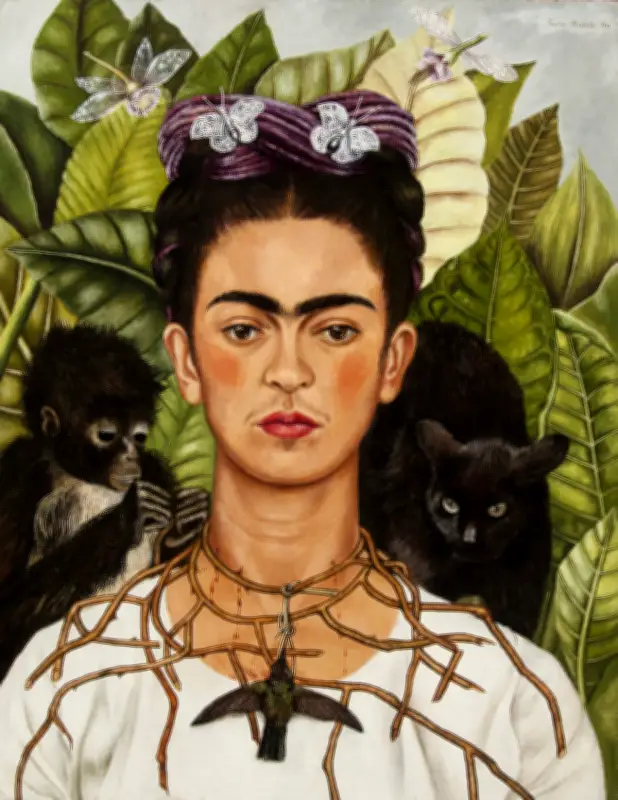
Sadly, it is here, about halfway through and all too soon, that the show begins to depart from Kahlo’s work, pivoting to lesser-known female artists working in a Surrealist vein. There are still some gems: Kahlo’s painting of the suicide of actress Dorothy Hale, Girl with Death Mask and the infinitely recognisable self-portrait of Kahlo with a hummingbird. Beyond that, the exhibition descends into tribute act. There are cartoon homages, Day of the Dead shrines and droves of self-portraits of other artists as Kahlo. Some are successful, others less so.
The Art of Merchandising
Kahlo’s contribution to queer and disability activism should not be underestimated, and the Tate’s inclusion of some of the rigid orthopaedic corsets and built-up boots she turned into bold fashion statements offer a far more vivid sense of her spirit than many of the works in the second half of the show. We are mercifully, if only briefly, returned to Kahlo via one of her final self-portraits, which shows her in a wheelchair looking fixedly out at the viewer. Next to her is an easel with a painting depicting Dr Farill, a surgeon Kahlo credited with saving her life.

The phenomenon known as “Fridamania” reaches fever pitch in the final gallery, which is filled with merchandise ceaselessly bearing Kahlo’s image — Converse trainers, tote bags, hairbrushes and bottles of tequila. During her lifetime, Kahlo wittingly sold her own image — a move that has been interpreted as feminist. “I will never accept money from any man till I die,” she is quoted as saying in the exhibition catalogue. But this just feels gimmicky.
Kahlo only made around 200 paintings in her lifetime; but with a slender 36 on show at Tate Modern, visitors might feel short-changed by what ends up feeling more tribute than deep dive. If “Fridamania” eclipsed the artist in our collective unconscious, she is also at risk of being eclipsed in this exhibition. And that is hardly fitting of an icon. Until January 3, 2027; tate.org.uk