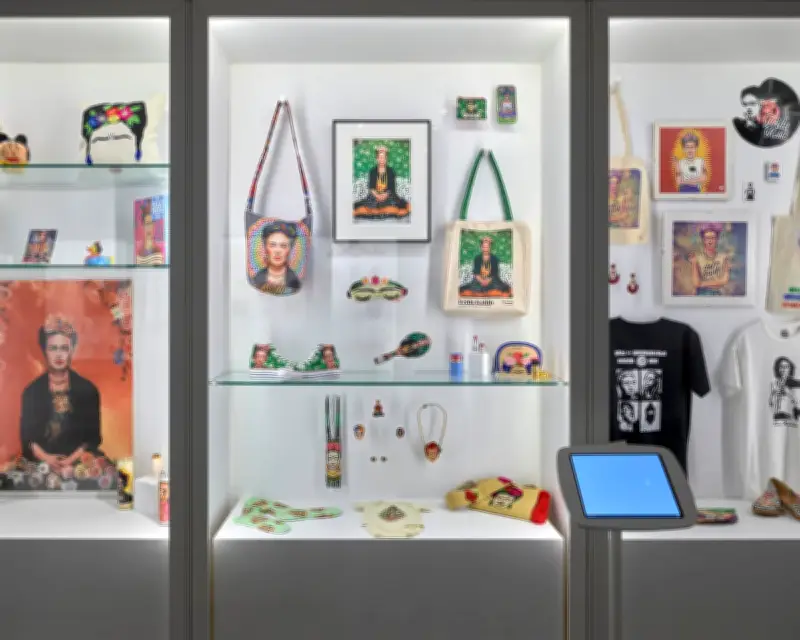
Tate Modern's new exhibition, 'Frida: The Making of an Icon', confronts the tension between the sanitized, mass-market image of Frida Kahlo and the complex reality of the artist herself. The show, which opened earlier this month, explores how Kahlo's face has become ubiquitous on consumer goods—from socks and dolls to phone cases and keychains—often reduced to a shorthand of monobrow, lipstick, and floral headdress.
Kahlo's Commercialization and Democratic Ownership
Beatriz García-Velasco, co-curator of the exhibition, defends the phenomenon, stating: 'The idea of Frida being universally accessible and inspiring is not something to be apologetic for. It speaks to the extraordinary range of artists and communities she has inspired: Chicana/o art, feminist movements, disability arts, queer culture, and constituencies all over the world who have claimed her as their own.' However, the exhibition also critiques this commodification through works like Rio Yañez's 'Ghetto Frida', which satirizes the commercialization of Kahlo's image.
García-Velasco acknowledges contradictions, citing the 2018 Frida Barbie that depicted Kahlo as a pale-skinned, non-disabled woman with plucked brows, despite her mixed Indigenous heritage and use of a wheelchair. She notes a 'productive tension' between such products and handmade devotional objects like nichos and ex-votos that honor Kahlo as 'Santa Frida'.

The Real Kahlo: Pain, Politics, and Personal Struggles
Critics argue that the real Kahlo—sharp-tongued, scandalously rude, a prodigious drug user, heavy drinker, and committed communist—has been erased. Hettie Judah, author of 'Lives of the Artists: Frida Kahlo', emphasizes that Kahlo's art often dealt with pain, heartbreak, and identity, as seen in works like 'Henry Ford Hospital' (1932), which depicts her bleeding after a miscarriage, and 'A Few Small Nips' (1935), a violent portrayal of domestic abuse.
Kahlo's relationship with the camera was pivotal. Her father, Guillermo Kahlo, was a photographer, and she learned to pose early. Color photographs by her lover Nickolas Muray have shaped her popular iconography more than her self-portraits, which are often more complex and painful.
From Feminist Icon to Global Phenomenon
Kahlo's posthumous fame began in the 1970s with a silkscreen print by Rupert García, which became a totem for Chicano communities. By the 1980s, the feminist movement embraced her, and a 1982 exhibition at London's Whitechapel Gallery introduced her work to a global audience. The 1983 publication of Hayden Herrera's bestselling biography and Madonna's public fandom cemented 'Fridamania'.
Despite her secular canonization, Kahlo was no saint. She was filled with self-doubt and capable of treating loved ones poorly. As Judah writes, 'If we expect figures we admire to be pure and flawless, we set ourselves up to fail.' The exhibition runs at Tate Modern until 3 January.