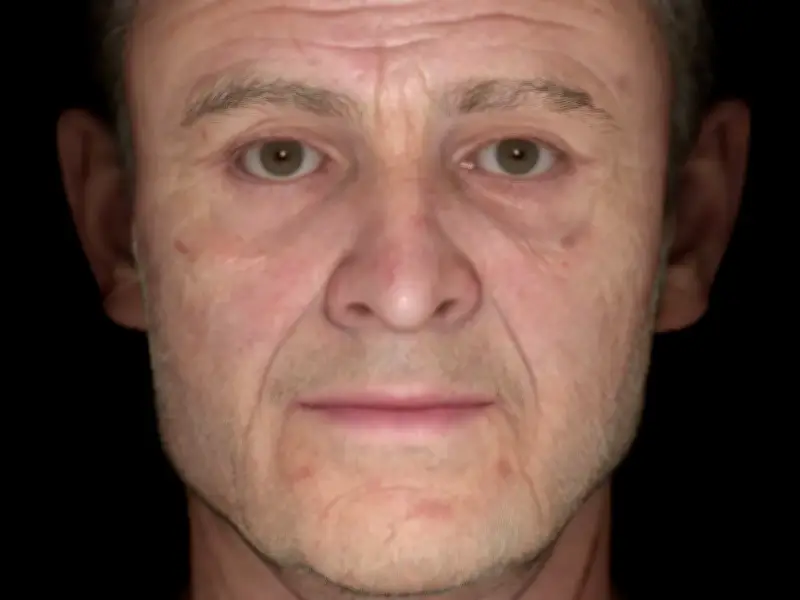
Scientists have unveiled a facial reconstruction of a man who lived through the Norman Conquest, following research on his 1,000-year-old skeleton. The remains of "Conquest Man" were discovered about 50 years ago at St Peter's Church in Barton-upon-Humber, Lincolnshire.
A 50-Year Investigation
English Heritage and Historic England spent half a century working to understand the unknown man's background, including DNA analysis. They said the results shed new light on experts' understanding of a period that changed the course of English history. The reconstruction brings us face-to-face with an everyday person who survived the Norman Conquest for the first time.
The man was of mixed heritage, just over five feet tall, stocky, muscular, aged between 50-60, and had several healed fractures. He was given a privileged burial, steeped in Scandinavian ritual, in the Norman-owned church of one of William the Conqueror's knights.

Burial Details and Significance
He was laid to rest in a coffin made from an oak tree felled around 1079, with his arms folded, head supported on a grass pillow, and kept from falling sideways by two lumps of local chalk. Three apple wood staffs, known as grave goods in the Scandinavian tradition, were found by his side.
Kevin Booth, English Heritage's head curator of collections, who coordinated the study, said: "I've been fascinated by this individual - this man of the Conquest - for 20 years. Who was he, what did he experience, could he have been at the Battle of Hastings, what sort of person might he have been?"
"With this new analysis, it feels like we can really get close to him. To be able to now look at his face is to feel we can almost speak to him. More than that, it makes us think of his role at the time of the Conquest - his loyalties and anxieties."
Scientific Analysis and Heritage
English Heritage worked with researchers from Historic England, the Crick Institute, the British Geological Survey, University of Southampton, muVIS, and FaceLab. The research involved osteological analysis, ancient DNA, isotope analysis, and digital facial reconstruction.
The DNA results suggest substantial ancestry from continental Europe, while his burial included objects and practices associated with Scandinavian traditions. Oxygen levels in one of his teeth are consistent with time spent in a cold climate as an adolescent, while strontium levels are more compatible with the area closer to Barton upon Humber.
Dr. Sarah Stark, human skeletal biologist at Historic England, said: "The science does not point to one simple homeland for this individual. Instead, his skeleton, burial, ancient DNA and isotope results suggest a man connected to the wider continental world."
Members of the public will be able to see the remains of Conquest Man at St Peter's Church on September 20.