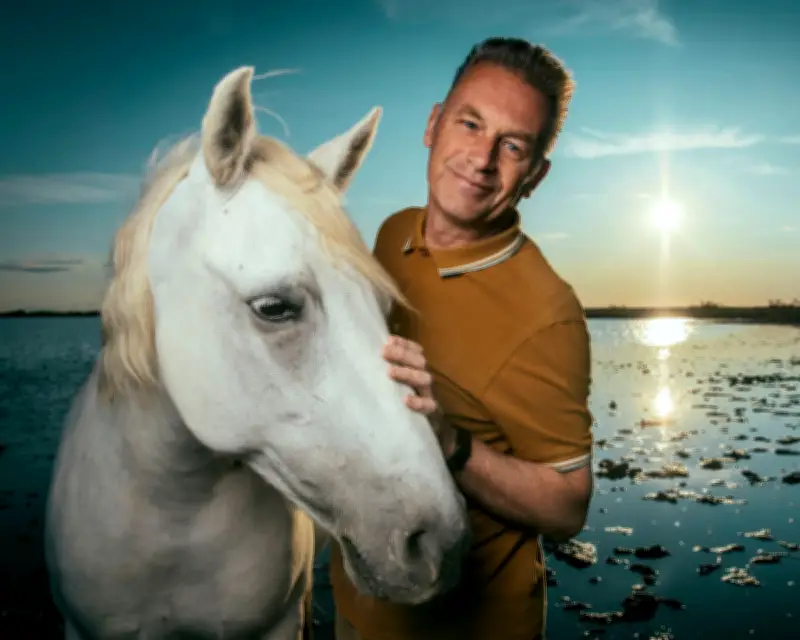
Chris Packham's new five-part BBC series, Evolution, is an epic ode to the story of life on Earth, beginning with Luca—the Last Universal Common Ancestor, a single-celled organism from 4.2 billion years ago. Packham explains, 'There is still a physical connection between me and you, and a cell that existed billions of years ago. I find that absolutely brilliant.' The show aims to shake up preconceptions, challenging the idea that evolution is slow, over, or that humans are its pinnacle.
Redefining Evolution's Narrative
Packham acknowledges that for billions of years, life was simple cells floating in a broth. But Evolution focuses on turning points—periods of rapid change. The series uses specific animals to explain key processes: breathing through the elephant, reproducing through the ostrich, eating through the bat, thinking through the dolphin, and running through the horse. In the opener, Packham marvels at a tree hyrax, an improbably close genetic relative of the elephant, calling it 'incredibly cute.'
Packham's storytelling often chooses the slimy over the cute. 'I'm not averse to cute,' he says, 'but I prefer dogs to puppies.' He adds, 'I don't dislike puppies! I just don't get the big eye, big ear thing. For me, that's a developmental stage, leading to where it's meant to get.'

Technology and Evolution
Packham uses CGI to depict extinct species like the palaeomastodon, a tiny, pocket-sized hippo-like creature. He admits, 'I can get very romantically excited about a fossil, but for the audience, there's a limit to how many times I can hold up a piece of rock and say "truly remarkable."' He is not a Luddite, noting that human evolution includes cultural evolution—from the combustion engine to AI—which will profoundly affect our species.
Feeding and the Bat
The story of sustenance focuses on the bat, the hungriest animal weight-for-weight, consuming its body weight in insects daily. Packham traces feeding back to the earliest mode: a single chamber where food entered and waste exited through the same hole. 'As soon as you've got a mouth and an anus, you want your sensory organs near your mouth, and the brain close to those. We didn't evolve heads until we'd evolved an arse. I quite like that.'
Packham's Evolution as a Broadcaster
Packham's broadcasting style has evolved, blending Attenborough-like wonder with increasingly radical honesty on climate and wildlife issues. He highlights the intelligence of creatures: 'Swallows choose white feathers for nests because bacteria break them down, producing a substance that impacts microbes, leading to higher hatching rates. It's astonishing.'
The series challenges human exceptionalism. Packham points out that some reef fish have theory of mind, and spiders can dream. 'Obviously they have a subconscious, and they're activating that subconscious based upon the input of their conscious mind.'
Mass Extermination, Not Extinction
Packham distinguishes between mass extinction and mass extermination: 'We are consciously aware that we are destroying life. Given our creativity, imagination, and intelligence, do we want that extermination on our conscience? I don't think we do.' He rejects the idea of humans as a scourge, saying, 'We are a remarkable organism. We've invented damaging things, but that's part of the evolutionary process.'
The series ends with a soliloquy calling for 'an evolution of human hope'—a way of thinking to live harmoniously on the planet. Packham finds personal solace in a 2,000-year-old yew tree near his house: 'I go and sit under it and, within minutes, I feel totally inconsequential. Chris Packham is not an important organism.'
Evolution begins on 13 July at 9pm on BBC Two.