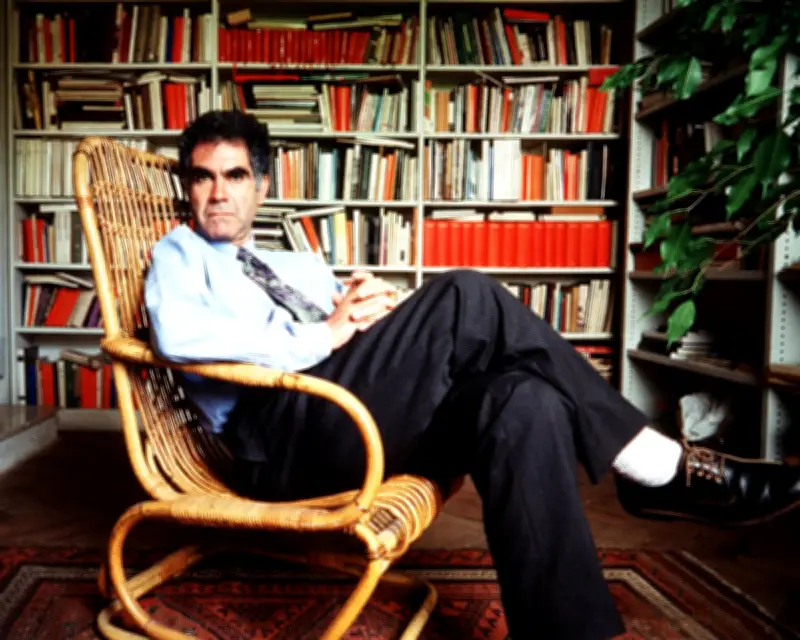
Italian historian Carlo Ginzburg, who revolutionized the study of history by pioneering microhistory, has died at the age of 87. His groundbreaking 1976 book, The Cheese and the Worms: The Cosmos of a Sixteenth-Century Miller, became an international bestseller and a manifesto for a new way of understanding the past.
Microhistory and the Marginalized
Ginzburg's work challenged overarching theoretical frameworks like Marxism and liberalism, instead emphasizing the edges of society, the marginalized, and the telling detail over the grand narrative. His chance discovery of Inquisition trial documents in Udine allowed him to explore an entire society and culture through the life of one previously ignored individual: Domenico Scandella, known as Menocchio, a miller from Friuli.
Menocchio was accused of heresy by the Catholic Inquisition for his unorthodox religious views. Despite being from the rural classes, he possessed an unusual level of literacy. His worldview, which showed surprising tolerance for other beliefs, was shaped by the books he read. Ginzburg linked Menocchio's ideas to his reading, showing how the miller developed a unique cosmology: 'all was chaos... earth, air, water, and fire were mixed together; and out of that bulk a mass formed – just as cheese is made out of milk – and worms appeared in it, and these were the angels.'

Resistance and Execution
Menocchio stubbornly clung to his beliefs despite torture and repeated trials, making him a symbol of resistance to power. He was eventually burned at the stake in 1599. Ginzburg's book, structured like a film under the influence of cinematic techniques from Eisenstein, featured fast edits, vignettes, and reflections on method across 62 short sections. Translated into 25 languages, the English version appeared in 1980.
Academic Career and Influences
Born in Turin just before World War II, Ginzburg spent much of his early life in hiding due to his father Leone's Jewish roots and anti-fascist stance. Leone, a co-founder of the publishing house Einaudi, was captured and tortured to death by the Gestapo in 1944. Ginzburg's mother, Natalia, became a leading postwar writer and intellectual.
After school in Turin, Ginzburg attended the Scuola Normale Superiore in Pisa in the late 1950s, part of a 'golden' generation of scholars. He also studied at the Warburg Institute in London and was influenced by historian Arnaldo Momigliano. In 1966, he published his first book, The Night Battles: Witchcraft and Agrarian Cults in the Sixteenth and Seventeenth Centuries, also based on Inquisition trial records.
International Recognition and Later Work
In 1988, Ginzburg joined the University of California, Los Angeles (UCLA), where he taught for 18 years while holding visiting lectureships worldwide. He returned to Italy in 2006 to the Scuola Normale, retiring from teaching in 2010. His work extended beyond history into art history, with writings on Piero della Francesca, and philosophy, accompanied by influential reflections on historical method, evidence, and the importance of clues and signs.
Ginzburg occasionally intervened in Italian political life. He campaigned for his friend Adriano Sofri, a far-left leader accused of ordering a 1972 murder. In his 1991 book, The Judge and the Historian, Ginzburg compared Sofri's treatment to witch trials and reflected on the roles of historian and judge.
Personal Life and Legacy
In later life, Ginzburg saw parallels between his father's persecution and Menocchio's fate. As Anthony Pagden noted, Ginzburg was 'a highly sensitive and imaginative historian whose prose style reproduces much of his mother Natalia’s clarity and precision.' He was first married to historian Anna Rossi-Doria, with whom he had two daughters, Lisa and Silvia. The marriage ended in divorce. He is survived by his second wife, Luisa Ciammitti, and his children. Ginzburg was born on 15 April 1939 and died on 17 June 2026.