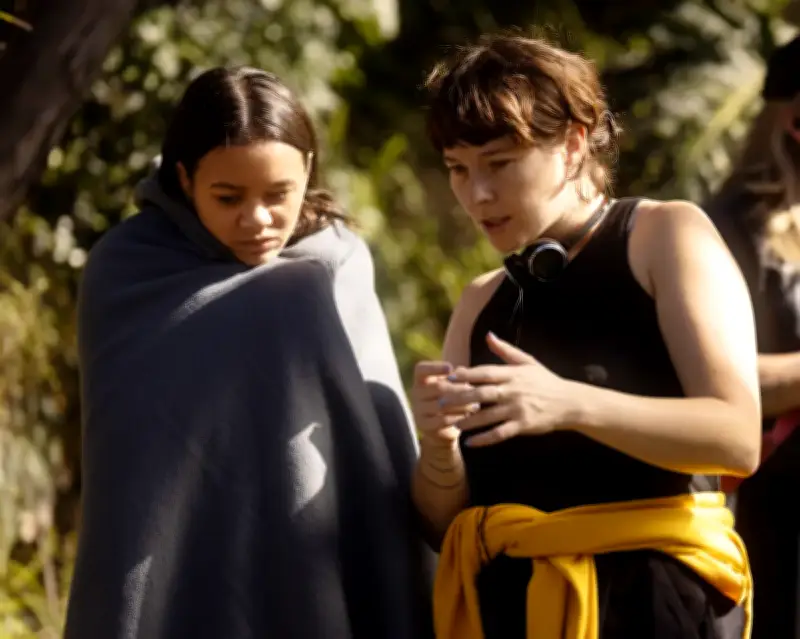
Paloma Schneideman's debut feature Big Girls Don't Cry has become a festival hit, exploring the uncomfortable space between consent and non-consent in a coming-of-age story set in early-2000s New Zealand. The film, which premiered at Sundance in February, has won the Grand Prix at the Nouvelle Vagues film festival and screened at South by Southwest and London's BFI Flare.
The story follows 14-year-old Sid, played by Ani Palmer, as she navigates adolescence in the small, golden-sand town of Ōmaha. A scene on a moonlit beach, where Sid encounters one of the cool older city boys visiting for the summer, captures the unsettling reality of teenage negotiation of consent.
A story about the 'tricky space' of consent
Schneideman, 34, said she wanted to tell a story about the place “between consent and non-consent, where it was just something we felt we had to do”. She noted the response from audiences, including an 18-year-old at a screening who said, “I feel so seen and exposed.”
“It’s such a tricky space, and I don’t think we see it a lot. How do we make amends with the scars of that time?” she said. The film also explores desire, queerness, and finding your way through small-town New Zealand in the early millennium.
Festival acclaim and critical response
Since its Sundance debut, the film has drawn praise from critics. Variety called it a “gentle, rigorous, queer coming of age story”, while the Hollywood Reporter said it “pulses with a powerful sense of place and terrifically charged scenes of chaotic intimacy”. Actor Kristen Stewart, who presented the Nouvelle Vagues Grand Prix, said it “unpacks the early 2000s, and subliminal trespass, and pain and strength … with such an astounding touch”.
The film is set for general release in New Zealand and the US on 8 and 9 October. Schneideman expressed gratitude for how audiences have connected with it: “The most amazing part is seeing how many people take such ownership over the film, they think it’s for them. And it is.”
Development and influences
Schneideman developed Big Girls Don’t Cry while at Wave in the Ocean, the film school set up by Oscar-winning director Jane Campion, as part of its first 10-person intake in 2022. It is the first feature film released by a graduate and is supported by the New Zealand Film Commission.
The script, which Schneideman began writing in 2019, evolved during the 25-day shoot between Ōmaha and Auckland early last year, with actors Palmer, Australian Noah Taylor, and American Rain Spencer contributing their own lines. “They’re all master improvisers, they meet me in this middle space between the script and the screen. Some of their best lines were theirs,” she said.
Campion, an executive producer on the film, encouraged creativity, including a daily movement practice, and listening to intuition. Schneideman developed what she calls a “body gauge” to help her discern if a shot, performance, or cut wasn’t right. “When the work’s not there, when the performance is not there, it actually just makes me feel quite sick. I can’t tell you how many sleepless nights I had, staring up at the wall being like – how do we blow that up and start it again and fix it?” she said.
Looking ahead, Schneideman is already planning her next film, which she describes as an “anti romance” exploring the wounds of lost love. Asked if this will be a hallmark of her career, she said: “Yeah. Rip it open. Then when I finally feel healed, just rip it open again. We don’t want a film that’s just happy, and everything goes right. I think that would be deeply dissatisfying.”