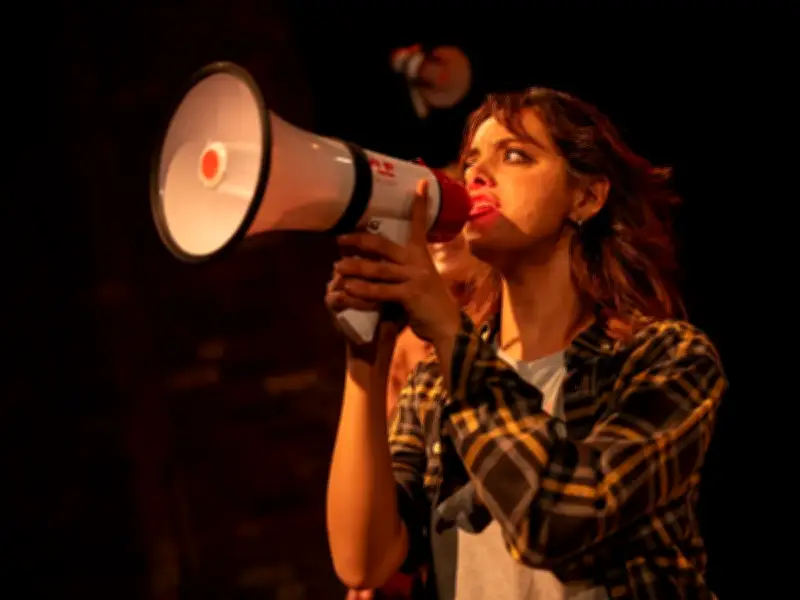
Floodlights switch on with a loud mechanical snap. They illuminate a circle of sand and a lone woman. Radios crackle as barely-seen officials bark questions at her.
This is an interrogation. The woman is the vice president (Nadia Dawber) of an imagined Republic of Gaza. And the interrogators? Members of the International Olympic Committee (IOC), who are investigating what went wrong ahead of the 39th Olympic Games in the year 2048.
A curious premise
This is the premise of Application 39, the show at Aviva Studios. It imagines 'a Gaza risen from ruin, unexpectedly awarded the right to host the 2048 Olympic Games, exactly 100 years after the Nakba'. The application, made by two mischievous IT workers Rayyan and Selma, spirals the Republic into serious political consequences after pushing against the boundaries of a punitively harsh and fragile long-term ceasefire deal with Israel that is in its 14th year.
Lamma, the deputy prime minister, is thrown into political machinations beyond her control. It's a black comedy. With jabs at the UK, US, as well as Israel and the IOC, there are no holds barred, and audience members sometimes let out shocked groans alongside laughter as jokes cut dangerously close to the bone.
Playfulness amid serious themes
Despite dealing with serious themes of war, occupation, loss, and incarceration, there's a remarkable amount of playfulness conveyed by the Palestinian cast. Writer Ahmed Masoud doesn't shy away from comic absurdities - from the flamboyant, yoga-loving President of Gaza (Ghantus Wael) trying to keep his meditative cool while discussing freedom and oppression, to the main characters performing a Dabkeh folk dance with a malfunctioning Israeli guard-drone.
For Masoud, the play is ultimately about togetherness and hope - the main reason he decided to centre the play around sport.
“Whenever I told people that I was writing a play about Gaza City hosting the Olympics, they laughed,” Masoud told the audience in a pre-show Q&A. “I did too because this is the whole point of the play, to challenge people's perspectives on what my home could offer.
“Sport is big in Palestine. Parkour, surfing, football. You have a lot of dead time under occupation, waiting at checkpoints, so it's a really important way to spend time.
“It also really brings people together. As much as there's a lot of corporatism and politics in these big competitions like the Olympics or the World Cup, it's a shared international language. I think bringing Gaza into it creates a really interesting dialogue.”
Flashbacks to war
The story follows Selma (Sama Rantisi) and Rayyan (James El-Sharawy), neighbours who've been friends with each other since they were - literally - thrown together during a bombing in their childhood.
Much of the play takes place in a future where Palestinian cities have been split into separately-governed states strictly controlled by IDF drones and robots. But flashbacks take us back to a war and genocide that took place 14 years earlier - one that, when the story was first written in 2018, was entirely fictional.
These are some of the most powerful parts of the play and are largely based on testimonies from Masoud's family and friends, transcribed almost verbatim from voice notes sent to the playwright from the Jabalia refugee camp.
At one point, the stage goes completely dark and we hear the terrified struggle of the two nine-year-old main characters trapped under bombed-out rubble. It takes them days to make it to the surface, and several more days to make it to a hospital just half-a-mile away, which is surrounded by tanks.
Despite the raw and harrowing nature of the memories, the focus isn't on the tragedy, but the ingenuity and determination of the characters in these moments.
“I'm an artist, but I'm an activist too,” Masoud explained of the play. “I want to tell my people's story. It's for you to see people in Gaza as people, as humans, because we've been dehumanised so much. We've been called human animals. We've been reduced to numbers on the screen. When you come to see a play like this written by any Palestinian writer, it's to think of the people, think how they wake up, think how they laugh, think how they cry, think of them as they are.”
The show is sometimes funny, often bizarre, always dark, but the human stories certainly shine through.