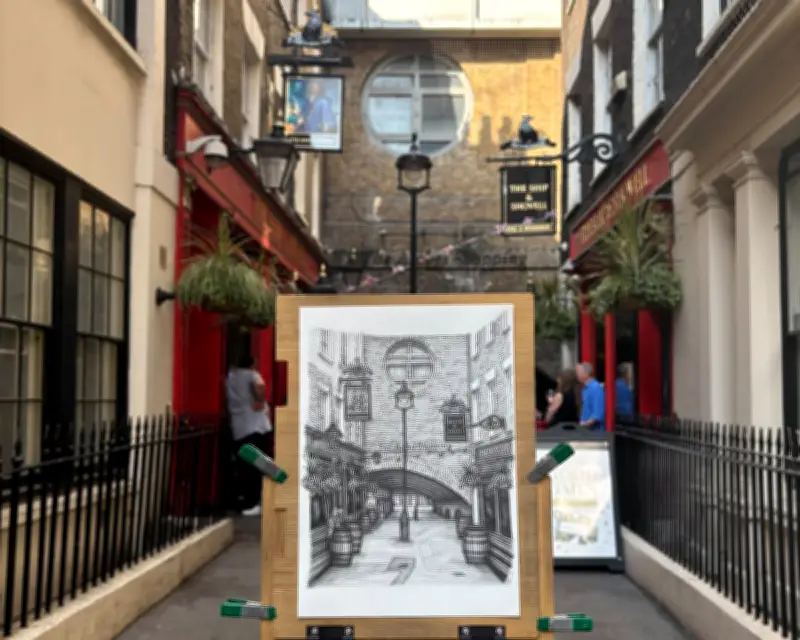
On the pavement outside a London pub, 32-year-old Lydia Wood is sitting in the sunshine at her easel, peering up at the building and sketching with a pencil. Passersby pause to catch glimpses of her work, but what they might not know is that for the artist, this isn't just a nice day out, but part of a years-long project with no apparent end in sight.
The Pub Project: A Decade-Long Endeavor
Wood began what she calls “the pub project” in 2021. Since then, she has drawn intricately detailed sketches of more than 350 pubs: her goal is to draw all 3,500-or-so of London’s beloved watering holes – a quest that could take her at least 10 years.
After losing her teaching job during Covid, Wood started sharing her art online, and asked her social media followers if they wanted her to draw their favourite pubs. “I didn’t anticipate the response,” Wood says. “People genuinely missed the ritual of going to the pub with their friends, and they were worried about the pubs that were struggling.”

From Viral Sensation to Published Book
Wood’s pub drawings subsequently went viral and have now been collected in a book, Locals, which contains a selection of 60 intricate pencil drawings of boozers across London. There are riverside pubs, pubs in alleyways, pubs with cats, and even a whole chapter on pubs called The Coach and Horses. “I wanted the book to feel like you are suddenly pulled to one end of the city, and then to the other,” Wood says.
For the artist, the work isn’t just about documenting the architecture of these buildings, but celebrating the communities within them. Pubs are under threat across Britain – in the capital, around 1,000 pubs have closed in the last 20 years. Yet people still need them.
Pubs at Risk and Community Campaigns
There are pubs trying to attract younger generations with drag shows, book clubs and quiz nights,” Wood explains. “And I think that will be rewarded in the long term,” Wood says.
“I get messages all the time saying: ‘Come and draw my pub, or please, can you draw this pub before it gets demolished next year?’” Wood says. “Pubs serve a huge purpose, especially for those communities growing up around them.”
She recently travelled to south Wimbledon to draw the 150-year-old Trafalgar pub after she learned that developers wanted to demolish it to make way for flats. “Some of my Instagram friends, who also make pub content, were making a video documentary about this pub at risk,” Wood says. “It’s more than 100 years old and a beautiful building.” Locals are campaigning to bring The Trafalgar under community ownership.
The Artistic Process and Community Engagement
The drawings take anywhere from six hours to multiple days to complete. “I could have picked an easier medium to work with to make the process quicker, but I think the pencil is often underestimated as a tool,” she says. “It’s used for the sketch stage, or the beginning or idea. But to use it to make the piece as a whole is an interesting process.”
There’s another upside to her method: spending long periods of time outside pubs means she gets to meet lots of new people. She often receives free pints from landlords and ends up chatting with curious locals. Her art then becomes, she says, a vehicle to talk about pubs in crisis but also the history of London and these buildings’ place in it.
Indeed, sketching these historic establishments has led Wood to discover whole new worlds. “It opened my eyes to the city,” she says. “From a quiet countryside lane in Richmond to a bustling road in Limehouse, it’s really fun to experience the whole spectrum of locations.”
Five of London's Notable Boozers
Ship & Shovell, Charing Cross This pub consists of two buildings: The Ship on one side, and The Shovell on the other. Originally two terrace houses, the pubs are connected via an underground passage. “This drawing is about 90% alleyway and only 10% pub,” Wood says.

The Faltering Fullback, Finsbury Park On the intersection of two streets, north London’s The Faltering Fullback proudly sits adorned in greenery. The beer garden feels like a treehouse, with seating on multiple levels. “When I was sketching outside, a group of schoolchildren and their teacher came to watch me draw the pub,” Wood says. “What I love about this project is the people I get to meet.”
Blythe Hill Tavern, Catford Lydia Wood’s drawing project began close to home. “This is my favourite pub because it is my local, and I have so many memories here,” she says. “It’s the first pub that I drew.”
The Blackfriar, Blackfriars Built on the site of a medieval Dominican friary, the exterior of the Blackfriar pub is depicted here on a canvas of 42 by 52.9cm – the largest drawing Wood has completed. “My drawings usually take five or six hours to complete. This one took me five days.”
The Cockpit, Blackfriars The pub used to be a literal cock-fighting pit in the 19th century, while William Shakespeare is said to have bought a house near the site in the 1600s. “Each little layer of the pub is different. Its mosaics, etched glass, brickwork and gargoyles make it really unique.”
The Rifleman, Twickenham This backstreet pub is named after the first world war rifleman – and local – Frank Edwards, also known as the Footballer of Loos. The pub is now under threat of closure and locals are fighting to keep it going. “I was caught in the rain and had the pleasure of finishing the drawing inside by the open fire with a pint. Loyal locals also kept buying me drinks as I worked,” Wood says.
Locals: An Illustrated Ode to London’s Pubs by Lydia Wood is published by Hodder and Stoughton.