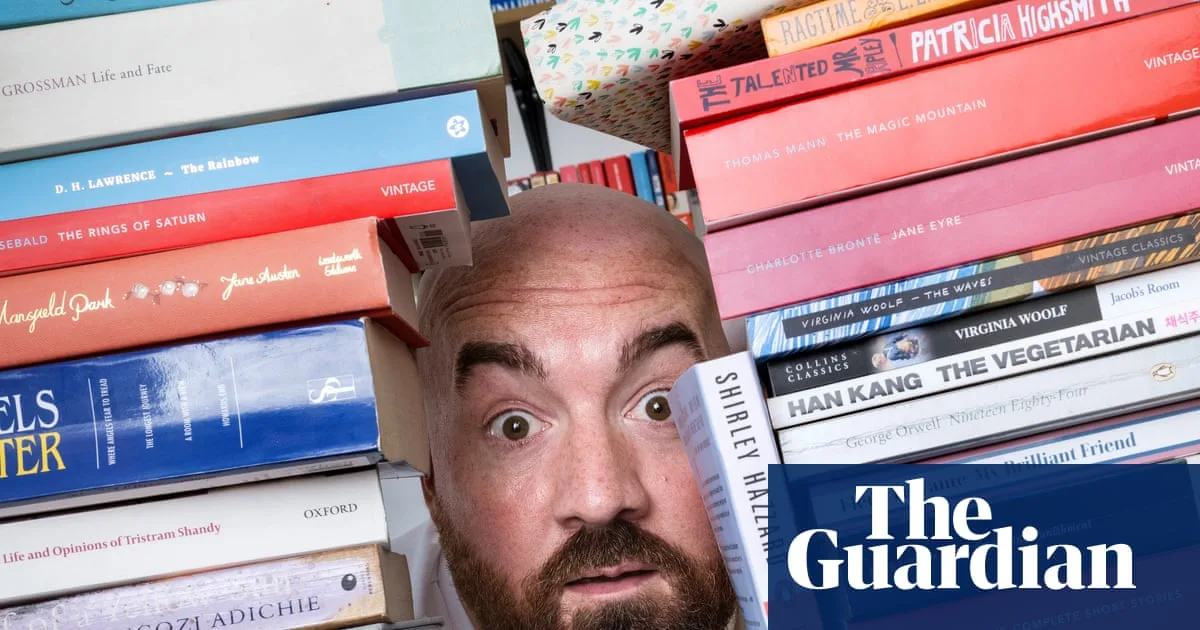
In less than a decade, surrounded by screens, I lost my ability to read some of the best books ever written. But, inspired by the Guardian’s 100 best novels list, I was determined to get it back.
It is a privilege to be surrounded by books. My parents hail from the literary working class, a subsection of society that believes great works lead to a richer life. Reading for them was an inverted form of class snobbery. My dad could read as well as anyone. He’d prove it on package holidays, sitting on the balcony the entire time, head bowed, cigarette in hand, flicking through the pages of Jane Austen or Herman Melville.
As for my own reading life, my mum wore me down, shouting “Read a book!” any time I dared say I was bored. I soon capitulated. I was nudged towards the classics, defined by Italo Calvino as books people say they should “reread” because they’ve either read them or do not want to admit they have not. In my late teens and 20s, I worked my way through the greats. I fell in love with a woman called George and thought Middlemarch was magic.
My appetite for classics receded along with my hairline. My early 30s gave way to the contemporary, to favourites such as Zadie Smith, Sally Rooney, Elena Ferrante, Roddy Doyle and Chimamanda Ngozi Adichie. Then, a few weeks ago, I stumbled upon the Guardian’s new list of the 100 best novels. I nearly collapsed with smugness. I’d read 68 of the books and decided on the spot to read the remaining 32.
But then I opened the first book. The Life and Opinions of Tristram Shandy, Gentleman is not about life, nor is it about Tristram Shandy. The novel deals largely in opinion. Laurence Sterne threatens the reader in the opening pages, suggesting a few possible digressions, and spends the rest of the novel making good on that threat. I found Tristram Shandy inexcusable. The language was verbose, the plot indecipherable, the detours infuriating.
I turned to something more contemporary. Dracula felt fun for the first 150 pages and I appreciated the vampire’s general campness. But I struggled with the glaring absurdity of the epistolary format. Every journal entry was written in the exact style of a rambling Victorian novel. And Van Helsing did my head in, with all that moralising, all that dithering.
In my 20s, I used to take Charles Dickens on holiday. I read David Copperfield by the pool. I had a hard time with Hard Times, but Great Expectations lived up to the hype. So now I turned to Our Mutual Friend. But again, reading Our Mutual Friend, I found my concentration lagging. I kept checking the football scores and I don’t really care about football. Even with Dickens, a writer I once loved, I found the narrative complicated, the prose as heavy as the 900-page book. I put the novel down after 60-odd pages.
Despise one classic and you can blame the book. Despise three on the trot and the problem seems larger. So what had changed? Have we all changed? Or was it just me? The page makes few demands. It is linear and monologic, allowing us to focus on a single task. The page has no pop-ups, no calls to action, no ads clamouring for attention. But screens, according to research by psychologist Gloria Mark, compel us to switch attention, push us towards new shiny things. We focus on interfaces, ads, dialogic elements, rather than the content. Online, according to research by Chartbeat, one in three readers spend less than 15 seconds on a page.