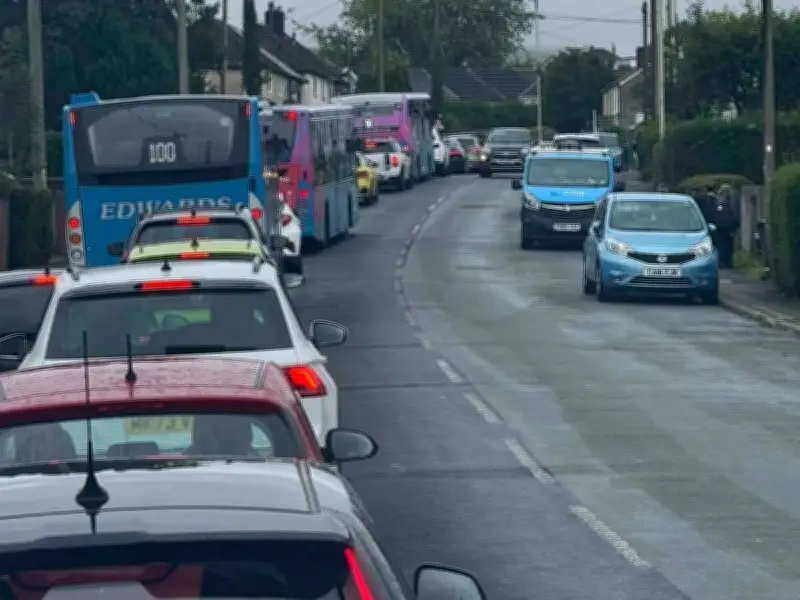
Concerns remain about the effects that changes to school transport in Rhondda Cynon Taf (RCT) are having after a year of being in place, but the council says that the data does not show adverse impacts.
In March 2024, cabinet approved changes to the home to school transport policy in RCT to revert to the Welsh Government statutory walking distance to secondary schools and colleges of three miles from September 2025.
After walking route assessments were done, transport eligibility from September 2025 was decided with around 2,300 pupils told in April 2025 that they would no longer be eligible for school transport from the start of the next school academic year.
Policy aligns with statutory requirements
An overview and scrutiny committee report for Monday, October 5, says the change to the policy aligns transport provision more closely with Welsh Government statutory transport requirements and helps the council to maintain affordability within future financial constraints, continue to be able to meet its statutory requirements and maintain discretionary transport for its most vulnerable users.
It said the council continues to provide discretionary transport provision in excess of the minimum Welsh Government statutory requirements, including provision for primary age pupils, Welsh language and faith schools, learners aged under five and post-16 learners.
The council’s spend on home to school transport is forecast to be £17.6m for the 2026-27 financial year, compared to £10.5m back in 2021-22.
But the Save the School Transport Campaign RCT/Wales has found several concerns still remain over the impact on transport, attendance, punctuality and the wellbeing of those pupils affected.
Campaign group’s findings
The Save the School Transport Campaign RCT/Wales has carried out analysis based on 176 survey responses.
On transport they found that private car travel is the most common mode suggesting a strong reliance on household vehicles for journeys to education, public buses and dedicated school transport remain important showing that numerous learners continue to depend on organised or shared transport options and that active travel is used by a smaller proportion of learners which may reflect barriers relating to distance, safety, route quality, or confidence.
On attendance, a substantial number of learners reported that attendance had been affected, with 72 respondents finding an impact.
The group’s analysis says that transport barriers may contribute to both absence and lateness particularly where learners rely on cars, experience traffic delays, or face limited public transport availability.
It says that improving the reliability, affordability, and accessibility of transport may support stronger attendance and reduce disruption to learning.
On punctuality, the key findings are that late marks are a clear punctuality concern with 83 respondents reporting that they or their child had been affected.
The analysis finds that most late marks fall within the one to 10 range but a smaller group reported repeated and more frequent lateness.
It also says that transport-related delays may reduce learning time, disrupt the start of the school day and affect learner engagement.
When it comes to the last six months, the analysis says that increased traffic is the most significant reported change with people saying that routes to education are becoming busier and less predictable.
The analysis finds that crowded buses are also a major concern suggesting that public transport capacity may be under pressure at peak times.
And it says that reported improvements in bus services are comparatively limited with fewer respondents finding increased provision than those reporting crowding or congestion.
When it comes to route changes, the key findings are that increased school-time traffic is the main route issue showing congestion around education routes.
Another finding is that reduced public bus availability is also a significant concern suggesting that learners may be struggling to access reliable transport.
It also finds that positive infrastructure changes were reported less often including improvements to bus shelters, crossings, dropped kerbs and route maintenance.
And it says that the overall impact may include longer journeys, increased lateness, and reduced punctuality particularly where learners rely on public transport or travel during peak time.
On learner feeling and wellbeing, the analysis finds that negative emotional responses were the most common with 125 respondents reporting feelings such as anxiety, stress, tiredness, distraction or fear.
It finds that only some learners reported positive feelings with 15 respondents indicating that they felt happy, comfortable or confident.
The analysis says that transport difficulties may therefore affect learner wellbeing, particularly where journeys are stressful, uncertain, or unreliable.
Council data on attendance and lateness
The report says the overall attendance levels of pupils who don’t receive school transport increased by 2.29% between 2024-25 and 2025-26.
For the same periods, the overall attendance levels of pupils who do receive school transport decreased by 1.65%.
The report says: “The updated data therefore does not identify an adverse impact on attendance amongst pupils not in receipt of school transport following the implementation of the revised policy.”
This data is measured to the end of the first summer half-term across both 2024-25 and 2025-26. This is because Year 11 pupils are not expected to attend beyond their examination period, which would otherwise skew attendance figures.
Updated data is now available to compare late marks across the 2024/25 and 2025/26 academic years for pupils in year seven to 13, the report said.
Overall, the number of late marks decreased for both student categories. There was a 0.71% reduction among pupils not receiving transport and a 0.84% reduction among pupils who are receiving school transport.
The report said: “The updated data therefore does not identify an adverse impact on lateness amongst pupils not in receipt of school transport following the implementation of the revised policy.”
Household costs and Welsh-medium education
On September 14, 2026, it was confirmed to secondary schools that the previously-agreed hardship fund would continue for 2026-27, with a further £100,000 available and it is in the process of being allocated to schools.
In response to the feedback from scrutiny, clearer guidance has been provided for schools for 2026-27 in respect of the criteria and use of the fund.
The funding must be used to cover costs such as educational resources, short-term barriers to attendance, school lunches, family engagement support, extracurricular activities, and other essential needs to support a pupil’s wellbeing.
A monitoring form has been shared for schools to return before the end of the academic year to explain their use of the fund.
The funding has a suggested maximum of £100 per pupil, with each school allocated a total of £5,882.35.
In terms of wider household costs associated with public transport, the report mentions the Welsh Government £1 bus fare scheme which provides reduced fares for children and young people (five-to-21-year-olds) and has been extended until March 2027.
The report says that updated transition data demonstrates the implementation of the revised transport policy has not had an adverse impact on the number of pupils transitioning and remaining in Welsh-medium education.
It says: “Whilst acknowledging there are some schools in RCT with a higher proportion of pupils transitioning into English-medium secondary education, it should be noted that this has been a trend for a number of years prior to the transport changes coming into effect.
“It is also important to note that school admissions do not gather reasons from parents/carers in relation to their destination choices made.”
It says the transition data for the last three years show a year-on-year increase in the numbers attending Welsh medium education for each category, as well as those choosing to transition and remain in Welsh-medium secondary education.
The figures for nursery show 21.64% of children transitioning into Welsh medium in 2023-24, 24.07% in 2024-25, and 24.54% in 2025-26.
The figures for reception show 20.35% transitioning in 2023-24, 21.72% in 2024-25, and 23.96% in 2025-26.
For year one the figure in 2023-24 is 19.61%, for 2024-25 it is 20.21%, and for 2025-26 it is 21.56%.
From year six to year seven in 2023-24 the figure is 92.85%, in 2024-25 it is 94.48% and in 2025-26 it is 95.07%.
For sixth forms in 2023-24 the figure is 37.6%, in 2024-25 it is 40.81%, and in 2025-26 it is 50.6%.