New Footage Reveals Over 100 Shafts at Giza, Fueling Second Sphinx Debate
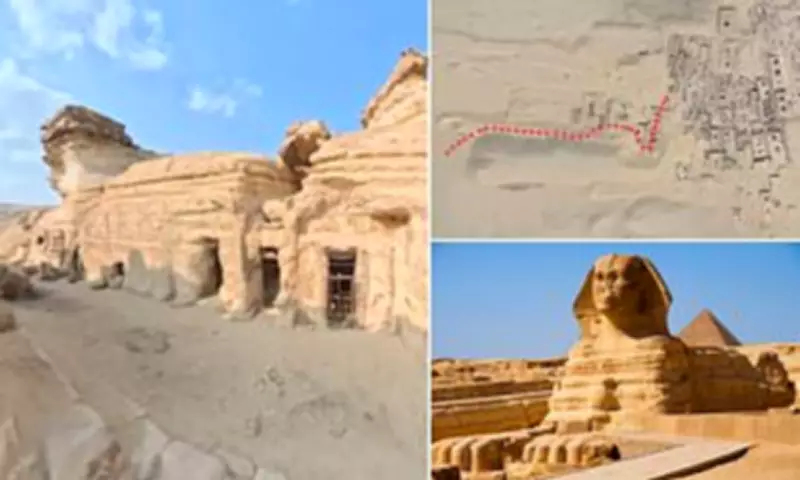
The possibility of a second Sphinx in Egypt has ignited renewed archaeological debate after newly released footage documented dozens of deep shafts surrounding a mysterious mound at the Giza plateau. The video, capturing more than 100 shafts clustered in the northwest corner near the western cemetery, has provided fresh context for claims of a hidden monument.
Detailed Documentation of the Site
Independent researcher Trevor Grassi of the Archaeological Rescue Foundation released the footage, which shows him walking along the perimeter of the mound. He passes numerous square shafts carved directly into the limestone bedrock, with some measuring only about three feet across and others roughly eight feet wide. Grassi, who has nearly two decades of experience researching Giza, described seeing 'endless shafts all over the place going straight down, all blocked with sand.'
He emphasized that many shafts appear to extend more than 100 feet underground, based on equipment he lowered into several openings. The unusually dense concentration—reportedly over 100 shafts within 100 meters—raises significant questions about their purpose, with Grassi suggesting they could be ventilation or access points for a larger underground network rather than isolated burial chambers.

Claims of a Subsurface Anomaly
The renewed interest follows claims by researcher Filippo Biondi, who last week announced on the Matt Beall Limitless podcast that scans detected a large anomaly deep beneath the mound. Using satellite radar technology to detect ground vibrations, Biondi reported data pointing to a massive structure concealed under a 180-foot-high mound of hardened sand. He stated with about 80 percent confidence that the anomaly resembles vertical shafts and passageways similar to those beneath the original Sphinx.
Biondi cited the Dream Stele, an ancient text positioned between the paws of the Great Sphinx that appears to depict two sphinx figures, as part of his evidence. This aligns with a theory first proposed by Egyptologist Bassam El Shammaa in 2007, based on ancient pyramid texts suggesting a mirrored balance in Egyptian architecture.
Historical Context and Skepticism
Grassi spent 12 years studying under independent researcher John Anthony West, known for promoting the controversial theory that erosion patterns on the Great Sphinx indicate it is thousands of years older than traditionally believed. Grassi first traveled to Egypt in 2018, joining geologist Robert Schoch, and is now investigating Biondi's claims.
However, Zahi Hawass, Egypt’s former minister of antiquities, has dismissed similar claims, arguing that the areas around the pyramids and Sphinx have been extensively studied and excavated over decades without uncovering evidence of a second monument. Hawass maintains that no definitive proof has been found.
Analysis of the Mound and Shafts
The mound itself is positioned along what researchers describe as a mirrored alignment across the plateau, extending from the known Sphinx through a central axis between the two largest pyramids. Archival photographs from the 1900s suggest the mound may not have existed before the early 20th century, possibly forming as a spoil heap from nearby excavations.
Grassi argued that this detail strengthens the possibility of buried features, as spoil piles sometimes accumulate above previously excavated areas. He noted that clearing sand from existing shafts would be a non-invasive method to investigate further, stating, 'All we have to do is pull some sand out of there, and we'll know if they connect straight into this.'
Ongoing Debate and Future Investigation
While no definitive proof of a second Sphinx has been discovered, researchers say the location warrants further investigation due to the number of openings and the underground anomaly. The footage offers critical context for the debate, documenting the full perimeter of the site for the first time and highlighting the dense shaft concentration.

Supporters believe the shafts could conceal underground structures, but skeptics like Hawass urge caution, emphasizing the need for rigorous archaeological validation. The debate continues as researchers call for more studies to explore what may lie beneath the sands of Giza.