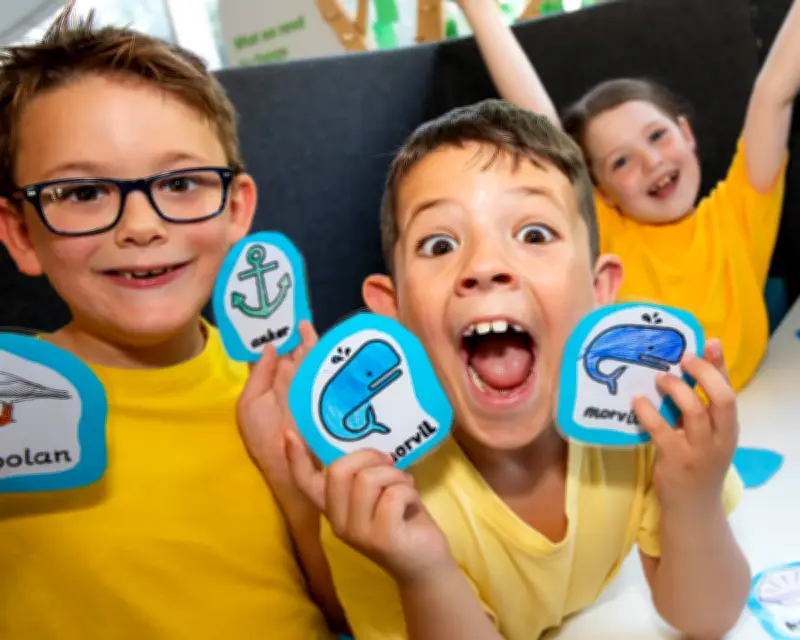
Nearly 200 children from across Cornwall gathered at Lys Kernow (County Hall) in Truro for the Go Cornish Celebration, a vibrant event showcasing their enthusiasm for the Celtic language Kernewek. The event comes as Cornwall council finalizes a bold 10-year strategy to revive the language, aiming to make it a "thriving, forever language – widely spoken, seen and heard in everyday life in Cornwall."
Children Embrace Kernewek with Joy
Seven-year-old Albie, a pupil at Trewirgie Infants’ School in Redruth, expressed his love for learning the language: "We used to talk this way in the old days. And I like speaking now. I enjoy the songs we sing, the Cornish books we read, all the words. It’s fun." His teacher, Kirsten Maun, who leads the Cornish programme at the school, noted that children relish learning Kernewek. "Our school had already embraced our Cornish history," she said. "For example, our classes are named after local tin mines, but I think learning the language helps the children understand their identity more deeply. They know they’re Cornish and they think that’s a special thing to them. Plus, they just like learning different words." She added that the word for butterfly – tykki duw – was particularly popular.
Ambitious 10-Year Strategy for the Language
Cornwall council’s strategy includes ensuring every child leaves primary school with a basic understanding of Cornish, establishing the first bilingual school, and making Cornish routinely seen and heard in civic spaces. Goals also include registering marriages and births in Cornish, introducing bilingual road signs, and developing public service media in the language. Council leader Leigh Frost, watching children share songs and stories in Kernewek, said: "You’ve got to have a bit of ambition, haven’t you? We’re looking at what Wales has achieved in the last few decades. The Cornish language deserves that same opportunity." In January, Kernewek was officially recognised under part three of the European Charter for Regional or Minority Languages, giving it greater protection and status. However, the strategy is funded on a shoestring budget of £170,000 a year.
Resurgence Amid Challenges
According to legend, Kernewek vanished as a living language in the late 18th century with the death of fish seller Dolly Pentreath in Mousehole. However, a revival driven by passionate volunteers has brought it back. The council estimates there are 500 advanced speakers and 2,000 with basic knowledge. Frost linked the promotion of Kernewek to the campaign for Cornwall to be recognised as the fifth nation of the UK, which could unlock more funding. "Make us a devolved nation of the United Kingdom, give us funding that is worked out in the same way as the other nations and we’ll crack on," he said.
Cultural Milestones and Community Support
Kernewek is enjoying a cultural moment. A podcast called Learn Cornish, Dyski Kernewek, hosted by Radio 1 DJ Danni Diston, recently launched on the BBC. Cornish filmmaker Mark Jenkin, who uses Kernewek in his movies, is gaining international acclaim. Earlier this month, a mass written in Kernewek premiered at Truro Cathedral, described as a "significant moment" for the language. Loveday Jenkin, a member of Mebyon Kernow, attended the mass and noted: "I see a lot of Cornish speaking in the community, which I didn’t see 50 years ago." However, there are sceptics. Reform UK councillor Sean Smith questioned whether public demand justified investment given pressures in housing, adult social care, and economic inequality.
Sense of Identity and Forward-Looking Vision
Jenefer Lowe, the grand bard of Cornwall, emphasised the language's importance: "It’s about a sense of place and identity. It connects you to the place you live in. The language underpins everything." She noted that 15 years ago she knew almost every Cornish speaker, but now she doesn’t – "and that is a good sign." Will Coleman, of Golden Tree, which leads the Go Cornish learning programme, beamed as children studied each other’s artwork inspired by the language. "I knew that if we could get a gang together they would all bounce off each other and inspire each other," he said. "I go to these schools and they just cannot get enough of it. They realise there’s this treasure chest being opened up and they’re being invited to rummage around in it and play with a bunch of stuff. This kind of event demonstrates clearly that language enriches lives. It brings people together, it’s inclusive, it’s celebratory, it’s forward-looking. What’s not to love?"