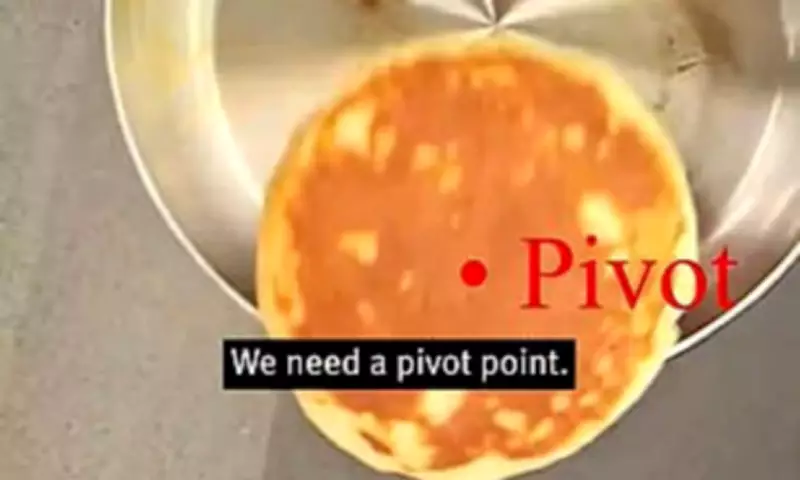
Physicists have unveiled the scientific secrets to executing a flawless pancake flip just in time for Shrove Tuesday celebrations. Their research promises to transform chaotic kitchen mishaps into picture-perfect culinary creations that land perfectly every time.
The Common Pancake Flipping Problem
While many home cooks can easily prepare pancake batter, the critical tossing motion frequently results in disaster. Numerous enthusiasts end up with crumpled, uneven pancakes in their pans or, worse still, find their breakfast scattered across the kitchen floor. This frustrating experience has now been addressed through rigorous scientific analysis.
Royal Institution's Breakthrough Discovery
Researchers from the prestigious Royal Institution of Great Britain have developed a precise formula to consistently "stick the landing" during pancake flips. Their findings center around identifying each pancake's unique "pivot point" - the crucial axis around which successful rotation occurs.

In an educational video released online, the scientists demonstrate how Newton's fundamental laws of motion govern pancake behavior during flipping maneuvers. "To achieve proper flipping, linear force alone proves insufficient," explained one researcher. "We must establish an effective pivot point to generate the necessary rotational movement."
The Physics Behind Perfect Flips
For successful pancake rotation, physicists emphasize the importance of torque generation. This occurs when the pan applies force slightly offset from the pancake's center of mass, creating angular acceleration that initiates controlled spinning.
"The secret to flawless pancake flipping lies entirely in physics," stated the Royal Institution researcher. "At rest, only two forces act upon the pancake: gravity downward and the equal normal force upward from the pan surface."
Newton's Laws in Pancake Action
The scientist elaborated that changing the pancake's motion requires applying a net force, illustrating Newton's first law of motion. This principle states that objects at rest remain stationary, while moving objects continue moving unless acted upon by external forces.
"When we flick the pan upward, we exert an upward net force that accelerates the pancake," she continued. "This demonstrates Newton's second law directly - the upward net force produces corresponding upward acceleration."
Once airborne, the pancake transforms into a projectile influenced solely by gravity. The researcher noted that flipping technique significantly affects trajectory: "Depending on execution, the pancake will move differently through the air. A simple linear force along a straight path cannot produce proper rotation."
Mastering the Pivot Point Technique
The crucial technique involves using the pan to push slightly off-center from the pancake's mass center, generating essential "angular acceleration" for controlled flipping. "The spinning motion remains nearly constant once the pancake leaves the pan," the scientist added. "Aerial timing must allow for either half or full rotation to ensure flat landing."
While the demonstration utilized a thicker American-style pancake, researchers confirmed identical physics principles apply to thinner crepes. They noted that using larger pans with deeper sides might facilitate better flipping results, though practical application sometimes proves challenging.
From Theory to Practice
Commenting on their demonstration video, observers noted the pancake appeared flipped "too far," landing on its original side. The Royal Institution humorously acknowledged: "This represents one of those situations where theory scores 10/10 but practical execution... perhaps 5/10. At minimum, we avoided floor pancakes."
The Science of Perfect Pancake Preparation
Beyond flipping mechanics, previous scientific research has identified optimal batter formulas. For traditional UK-style thin pancakes, experts recommend combining 200ml milk, 100g flour, one or two eggs, and a pinch of salt.

Professor Ian Eames, a fluid mechanics specialist from University College London, suggests different proportions for American-style pancakes: 200ml milk, 200g flour, and two eggs. He advises whisking batter with a fork, allowing 10-15 minutes resting time, and substituting vegetable oil for butter to achieve perfectly thin, crisp results.
Pancake Topping Psychology
According to YouGov polling data, UK adults prefer lemon juice with sugar (69%), followed by syrup or honey (45%), chocolate spread (34%), and fresh fruit (33%). Executive chef George Dyer from Ski Vertigo analyzes what these choices reveal about personality traits.
Traditionalists: Lemon and sugar enthusiasts appreciate simplicity and tradition, preferring basics executed well.
Health-Conscious: Fresh fruit selectors often prioritize fitness and nutritional value, even on indulgent occasions.
Naturalists: Honey choosers typically avoid processed sugars, seeking cleaner, more natural sweetness alternatives.
Comfort Seekers: Chocolate spread lovers embrace pure indulgence without pretense, recapturing childhood enjoyment.
Connoisseurs: Maple syrup fans appreciate quality and luxury, preferring refined sweetness over granular textures.
Nostalgics: Jam or compote selectors often seek cozy, sentimental experiences reminiscent of family kitchens.
Celebrators: Whipped cream or ice cream enthusiasts embrace full celebration without moderation.
Goal-Oriented: Protein topping consumers (nut butters, Greek yogurt, eggs) typically maintain fitness regimens while participating in culinary traditions.
This comprehensive scientific approach to pancake preparation, flipping, and consumption demonstrates how physics and psychology combine to enhance Shrove Tuesday experiences across British households.