Police have imposed an overnight curfew in parts of Paris after France experienced its worst rioting in years, with thousands of businesses damaged or looted and at least 2,400 people arrested. The restrictions were announced on Monday to prevent further violence following a weekend of unrest that saw demonstrators target city halls, public buildings and businesses across the country.
Paris police said the curfew was intended to protect “people and property from the violence and looting.” It bans people from entering or remaining in Place de la République, where rioting broke out on Saturday, and the shopping district of Les Halles, which has been targeted by looters. The restrictions will remain in place from 11pm on Monday until 6am on Tuesday, while gatherings and demonstrations have been prohibited from 8pm.
Curfews extended beyond Paris
Prime Minister Sébastien Lecornu had earlier called for “very limited” and “localised” curfews as authorities attempted to prevent further disorder. Other areas have also introduced restrictions. In northern France, curfews for children and teenagers under the age of 18 have been imposed in several cities, including Lille, from 8pm until 6am for the next two days. Nice, on the French Riviera, has also introduced an overnight curfew for under-18s from 9pm.
Mr Lecornu defended the police response to the unrest, saying that no one had been killed despite scenes of severe violence and widespread property damage. He said: “Despite scenes of severe violence and extensive property damage, no-one was killed, and that is a miracle.”
Comparison with past unrest
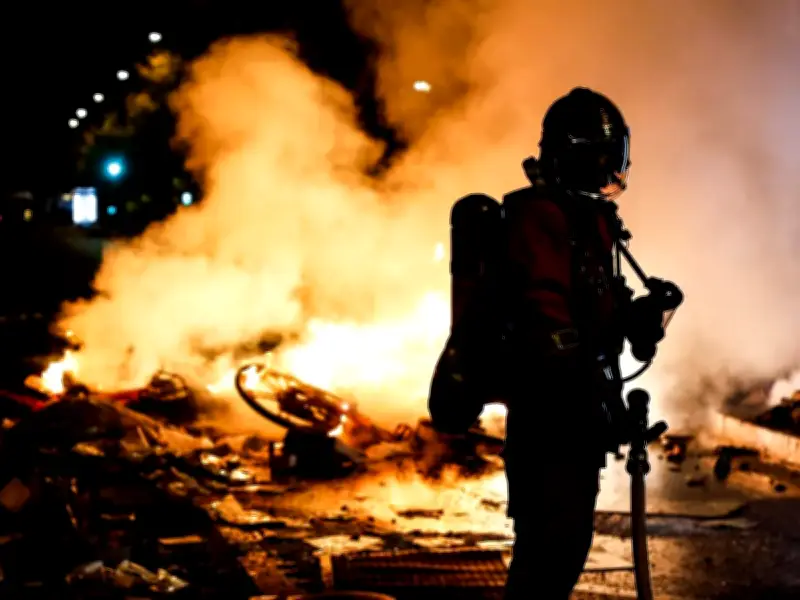
The unrest has drawn comparisons with previous waves of violence in France, including the riots that followed the fatal police shooting of a teenager in 2023 and the Yellow Vest protests that began in 2018 over fuel prices and wider economic grievances. The latest disorder erupted during nationwide protests against rising living costs and poor conditions in schools. On Sunday evening, groups set fire to bins, bicycles and other objects while businesses were looted in Paris, Lyon, Marseille and other cities.
Authorities estimated on Monday that at least 3,000 businesses had been damaged or looted during the weekend's violence. In one of the most dramatic incidents, flames engulfed the 19th-century city hall in Limoges, central France, on Saturday. The fire caused the roof to collapse and came close to destroying the building. In Marseille, the local prefect banned protests and other gatherings from noon until 8pm on Monday.
Political fallout and resignations
The scale of the unrest has also prompted a political crisis, with Interior Minister Laurent Nuñez offering his resignation on Sunday. President Emmanuel Macron refused to accept it, saying continued leadership of law enforcement was needed during the emergency. Mr Macron has instructed the minister to take steps to ensure transparency over alleged failures in planning and intelligence gathering that preceded the violence. The president also called for new policing tactics to be introduced as quickly as possible to bring the unrest to an end.
Mr Nuñez said he had offered to resign because he felt responsible for what had happened. “I submitted my resignation because I am responsible for everything that is happening,” he told France Inter radio. “Now, the real issue is ensuring that this doesn’t happen again. We obviously need to be better at anticipating the kind of mobilisation that is unfolding.”
The interior minister blamed the violence on “hordes of troublemakers and looters” and “far-left activists,” while acknowledging that police tactics needed to adapt to groups moving rapidly between locations. He also admitted that authorities had lost control in some major cities during Saturday's unrest, when hundreds of businesses were looted. “You can’t look shopkeepers in the eye when hundreds of businesses have been looted and say: ‘We haven’t lost control in some of these major cities.’ Obviously,” he said.
In Paris, clean-up crews and firefighters were clearing shattered glass and debris from the streets on Monday. Ouri Zagoury, who owns a video game shop near Place de la République, said he had closed his store on Saturday afternoon before watching looters force their way inside on surveillance cameras. “There were so many people coming in and out. And even though I called the police, they said not to intervene, that they would come, but they never did, which is another problem,” he said.
Jordan Bardella, president of the far-right National Rally party, criticised the government's handling of the crisis. “The government has failed, the head of state has failed in his essential duty of protecting the French people,” he told reporters. Mr Bardella called on the public to use their votes to respond to the unrest, as he campaigns alongside Marine Le Pen ahead of next spring's presidential election.