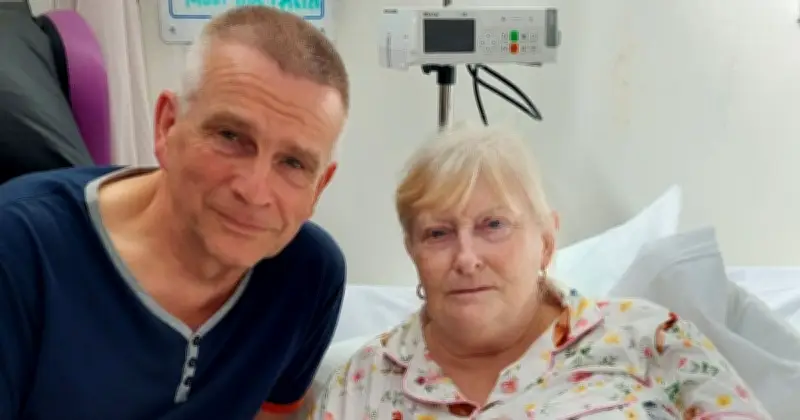
A former police officer injured in the line of duty has been left paralysed after surgery, spending a 'nightmare' nearly 22 weeks in hospital. Sue Mitchell, 64, served with Essex Police before suffering horrific spinal injuries as a 22-year-old PC when teenage burglars rammed the police car she was travelling in after just days in the job in November 1984. Despite her injuries, she chased and arrested one of the suspects. Later, Mrs Mitchell returned to work, having regular injections to counter pain before having her first of multiple surgeries and medically retiring aged just 26.
Morphine Pump Implant and Replacement Surgery
A morphine pump manufactured by American company Medtronic was implanted in 1998. It was due for replacement, with the battery scheduled to expire in October 2025. But since surgery to replace it, carried out at John Radcliffe Hospital in Oxford in August 2025, the former copper has 'seen a steady increase in her pain and a decline in her mobility and general health'.
Mrs Mitchell, who has had stints at John Radcliffe Hospital and James Paget University Hospital in Norfolk, said: 'Forty two years on from my injury on duty and still suffering the consequences.' She added: 'John Radcliffe Hospital after making their error last August were reluctant to become involved in investigating the cause of my problems. They only agreed to admit me at their hospital after I asked my MP to intervene. Now approaching 22 weeks in hospital this seems like a never-ending nightmare.'
Complications and Catheter Concerns
The decline in Mrs Mitchell's health prompted the couple to obtain a private CT scan to understand what was happening. While the pump was replaced, the catheter which carries the morphine from the pump into the spine was not, so Mr and Mrs Mitchell were concerned that this might be defective or had moved from where it should be, it being 10 years old at the time. The morphine pump has an internal battery which lasts up to seven years and delivers the painkiller directly to the spine via a catheter connected to it by tubing. The tip of the catheter is implanted directly into the spine so that the drug is pumped directly into the spinal fluid.
Mr Mitchell said the couple's concerns grew because the catheter was not replaced at the same time as the pump. The surgery was 'completed with the original catheter being connected to the new pump and its integrity being confirmed only by close visual inspection', he added. 'Key to all of our concerns about the catheter is that the tip which is visible on the scans is sitting in the spinal fluid very close to the spinal cord at Sue's T12 vertebrae level, which is the level below which her loss of feeling starts.'
Confirmation of Broken Catheter
Medics later admitted that the catheter had migrated. In a complaint, Mr Mitchell wrote that John Radcliffe was 'ignoring the seriousness and urgency' of his wife's condition. 'Sue has already lost use of her right leg, bowel and bladder and there is a risk of losing use of her left leg,' he added. It was finally agreed that Mrs Mitchell would be transferred to Oxford for further investigation, which happened on April 5. A dye test confirmed that the catheter was broken, and doctors confirmed their opinion that the catheter visible on the scans was a broken off piece, within the spinal fluid adjacent to the spinal cord.
Mr Mitchell said: 'They advised they did not believe this broken piece to be part of the most recent catheter, but is in their opinion part of an old redundant catheter… Our opinion remains, contrary to what Oxford have said, that the section of broken off catheter visible with its tip at the T12 vertebral level is the end of what was the most recent catheter.' He added: 'It is just too much to believe that the catheter which was definitely live and in that position in 2023 has disappeared completely from Sue's spine in a couple of years and been replaced by another redundant one in more or less the same position.'
Ongoing Pain and Rehabilitation Challenges
The couple were told that none of the tests undertaken showed the cause of Sue's current paralysis, with Oxford experts stating that there did not seem to be evidence of damage to the spinal cord arising from the catheter tip or otherwise. Mr Mitchell said: 'They cannot however offer any alternative reason for Sue's symptoms and insist that removal of the broken piece of catheter from within Sue's spine is too risky.'
Mr Mitchell said: 'Sue has continued to suffer horrendous pain meaning she has had to take strong painkillers, which have caused many unpleasant side effects and in particular nausea and vomiting, requiring continuing use of anti-sickness drugs, with their own side effects. In fact the difficulty in controlling the vomiting has prevented attempts to try to rehabilitate Sue as much as is possible so she may at least get home in the meantime. These weeks of being trapped in hospital in pain and being sick ultimately forced Sue to decide that reconnection of the pump is the only practical option to give her a chance to live with a reasonable quality of life. Limited by disability, yes, but able to live her life with reduced pain after adapting as much as possible.'
Mrs Mitchell had surgery to implant a new catheter for her pump on Tuesday, June 30.
Hospital Response
Professor Andrew Brent, Chief Medical Officer at Oxford University Hospitals NHS Foundation Trust, said: 'I am very sorry to hear about Mrs Mitchell's experience of care at OUH and understand how distressing this has been for her and her family. I am grateful to them for raising their concerns. While we are unable to comment on individual cases, this is a complex situation and we are in contact with the family to discuss the medical plan and next steps, including further treatment aimed at resolving her symptoms. Providing safe, timely, and high-quality care is our top priority. We take all feedback and concerns extremely seriously and are committed to listening to patients, learning from their experiences, and continually improving our services.'
The Express contacted James Paget University Hospital and Medtronic for comment. Sue Mitchell is a supporter of The Express' crusade to award a medal to police officers who were retired after suffering an injury in the line of duty.