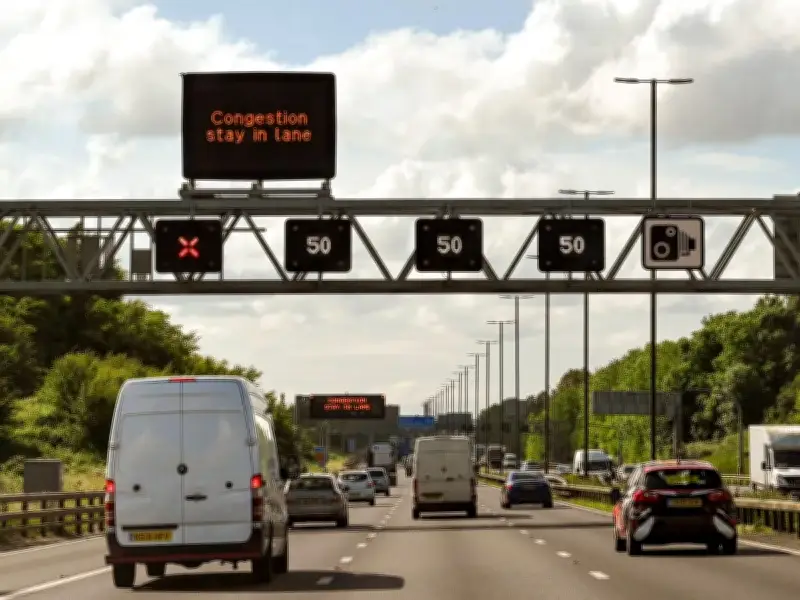
Temporary motorway speed limits displayed on overhead gantries are legally enforceable when shown within a solid red circle, according to police and National Highways. The clarification comes as millions of drivers use smart motorway networks and navigate major roadworks daily, with many questioning whether reduced speeds must be obeyed when no dangers or workers are visible.
Social media discussions and motoring forums have featured contradictory assertions, prompting traffic officers to clarify the statutory road traffic requirements.
Highway Code and legal basis
Rule 261 of the Highway Code states that any speed restriction displayed within a solid red circle is legally binding and enforceable under the Road Traffic Regulation Act 1984. These compulsory limits remain in force continuously, irrespective of traffic volumes or the lack of visible construction teams.
National Highways explicitly confirms that speed restrictions shown within a red circle "will always be enforceable", whatever the justification for implementing them. The National Police Chiefs' Council (NPCC) also states: "Temporary speed limits, often seen at roadworks or during other events, are legally enforceable by police."
Advisory limits distinction
Disregarding specific overhead signals constitutes a strict-liability offence that activates automated enforcement cameras, resulting in immediate fines and penalty endorsements. However, regarding variable speed restrictions, there is a significant technical distinction.
Driving tuition provider PassMeFast explains that advisory speed limits, typically displayed on motorway gantries with flashing amber lights and without a red circle, carry no legal force. These are designed to assist motorists during adverse weather or traffic situations.
Enforcement and penalties
While numerous police forces adhere to NPCC guidelines that establish a discretionary threshold (for instance, 10% plus two miles per hour), officers retain the legal authority to prosecute drivers for exceeding a limit by as little as one mile per hour. Authorities may deem disregarding amber speed limits as careless driving if it contributes to a collision.
Temporary speed restrictions are monitored by speed cameras, particularly on smart motorways and within roadwork areas. Should you be caught exceeding the limit, you could receive a Fixed Penalty Notice (FPN), potentially resulting in a £100 fine and three penalty points on your licence. The sanction may prove more serious depending on your speed.