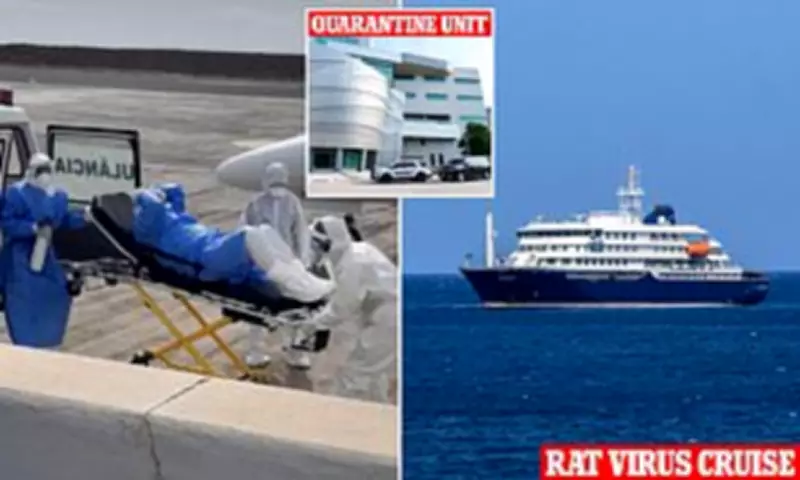
Americans who were aboard the cruise ship where a hantavirus outbreak killed three people will finally be permitted to leave quarantine on Monday. However, the next few weeks will present another grueling challenge.
Details of the Quarantine and Monitoring
It remains unclear how many of the 18 passengers currently being monitored at the National Quarantine Unit in Omaha, Nebraska, will be allowed to depart. Those who do leave will be subjected to an additional three weeks of isolation in their homes, accompanied by round-the-clock monitoring. Federal officials have stated that healthcare workers or law enforcement agents will constantly surveil the passengers to ensure they do not leave their residences, a measure that is unusually stringent compared to previous efforts to contain the same virus.
Attorney Steven Hyman, who represents two of the passengers from New York, told the New York Times that his clients were directly informed of the strict protocol. He elaborated to the Daily Mail: 'The major stress for them was just to go home. If the requirement is that they have to isolate themselves, they are willing to do so.' He added that 'They were beginning to fray, because it’s not the most comfortable in terms of being totally isolated in one room. They wanted to get home, and they were making that clear.'

Uncertainty and Divergent Protocols
It was unclear whether Hyman's clients would be allowed to leave the Nebraska quarantine unit. However, New York Health Commissioner James McDonald stated late on Friday that they could return home on noncommercial flights and self-isolate until June 22. The health commissioner did not address whether the passengers would be constantly monitored.
Hyman told the Daily Mail that his clients expect to return home on Monday and will abide by any Centers for Disease Control and Prevention guidelines, though he added: 'I haven't seen any formal order about that. It’s certainly unnecessary.'
Despite some of the 18 passengers being allowed to leave quarantine, others have expressed a desire to remain in the unit for the virus's full 42-day incubation period in case they develop symptoms. The passengers have already spent nearly three weeks in isolation. They were brought back to the US from the Canary Islands on May 11 and have been monitored at the only federally funded quarantine unit in the country since then. None of the passengers have developed symptoms or appear to have the disease.
At least two passengers were ordered to remain in the Nebraska quarantine unit until at least Sunday, which marked the end of the 21-day period when symptoms are most likely to emerge. The orders came from Interim CDC Director Jay Bhattacharya after the passengers made plans to return home and self-isolate, which they were initially told they would be allowed to do after testing negative for the disease.
Comparison to Previous Outbreaks
During a similar outbreak of the same hantavirus strain in 2012, patients were allowed to self-isolate at home for 42 days and monitor themselves with regular check-ins from healthcare workers. None got sick. Caitlin Rivers, an epidemiologist and professor at the Johns Hopkins Bloomberg School of Public Health, told the New York Times that 24/7 monitoring is unusual and overkill. 'I’ve never heard of that, and I don’t think it’s needful,' she said.
It also appears that at least seven Americans who were onboard the cruise ship but left early are being subjected to different, less strict rules. Those individuals took commercial flights back to the US and have been self-isolating at home with daily check-ins from healthcare workers in person or through video calls. It is unclear why the protocols for the two groups are different.
Background of the Outbreak
The cruise ship where the virus broke out, a Dutch liner called the MV Hondius, began its trip to Argentina in early April. Two passengers died from the Andes strain of the hantavirus that month, and a third died in early May. Hantavirus is rare and carried by rodents. It usually does not transfer between humans, but the Andes strain in particular can be transmitted between people who had close contact. The CDC has said that there have been no confirmed cases of the virus in the US connected to the cruise ship outbreak.

Speaking about his clients, Hyman told the Daily Mail: 'This has been a long ordeal for them. All they did was go on a cruise, and they end up on front-page news and at risk of their life. This needs to come to, hopefully, a happy end. The next best thing is for them to get home where they will be comfortable.'
The Daily Mail has reached out to Hyman and the CDC for comment.