Holidaymakers faced mid-air chaos this week after a series of bomb threats and hoaxes triggered emergency diversions across Europe. The disruption began on Tuesday when seven flights departing the UK and other countries were grounded or rerouted amid sudden security alerts. By Thursday morning, the situation escalated sharply as 12 passenger airliners were targeted at 30,000 feet.
Fighter Jet Interception and Emergency Landings
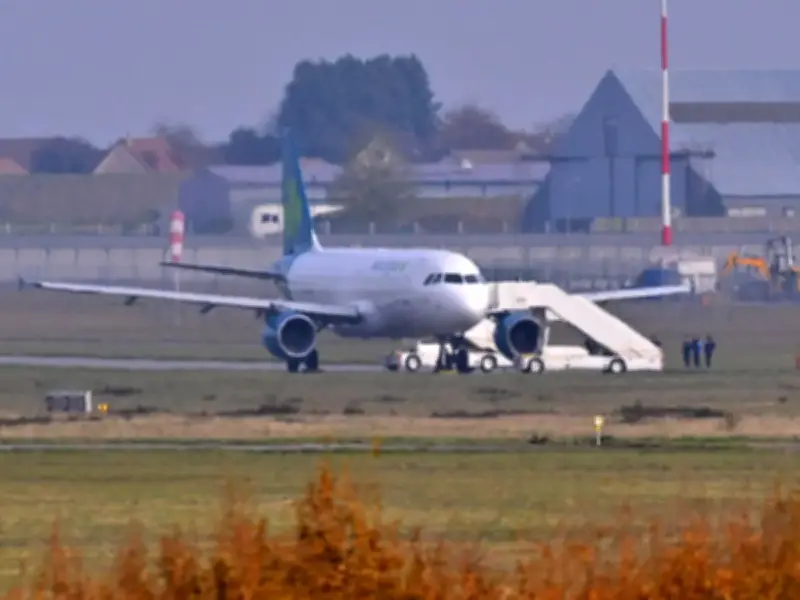
In the most dramatic incident, an Aer Lingus flight from Dublin to Rome was intercepted mid-air by a French fighter jet and forced to land at a military airbase. The aircraft was rerouted to Evreux-Fauville Air Base after a bomb threat. Meanwhile, three Ryanair services and several other flights heading into Prague, Rome, Vienna and Brussels were all hit with emergency alerts.
With thousands of passengers caught up in the disruption, travellers demanded answers about why the threats keep happening and whether Russian President Vladimir Putin could be behind them.
Aviation Protocols and Expert Analysis
Phoney alerts plague the aviation industry constantly, but the scale of this week's chaos is rare. Carriers follow rigid protocols whenever a warning arrives. In Britain, flights must submit a mandatory occurrence report directly to the Civil Aviation Authority (CAA). Most threats turn out to be pranks, but air-traffic crews cannot afford to gamble with passenger lives.
Philip Baum, visiting professor of aviation security at Coventry University, told The Guardian: "Most are from individuals who think it is funny or want to delay a flight for some reason. If the industry was to respond to every unsubstantiated threat, flights would grind to a halt." He added: "The reality is that terrorist organisations who might like to smuggle a bomb on to a flight don't tell people, they claim responsibility after the attacks."
However, Baum noted that when planes are forced to make sudden emergency landings, it would "imply that the threats are credible and specific in nature, and therefore one has to respond accordingly."
Government Response and Suspicions of Russian Involvement
A UK Government spokesperson said on Tuesday: "The UK has one of the most robust aviation security systems in the world, with well-tested processes for dealing with any potential threats, as well as malicious hoax threats, like those we've seen today." The spokesperson added: "Our world-leading police and intelligence agencies work closely every day to keep us safe, using the tools they have to assess and respond to potential threats."
While Moscow has denied any dirty tricks, security experts suspect the Kremlin is waging a "hybrid warfare" campaign to sow panic across Western transport hubs. They believe hostile foreign powers are increasingly turning to online-hired stooges to spark disruption.
Eric Schouten, an aviation security expert from Dyami and former Dutch intelligence liaison officer, told The i Paper that the wave of warnings matches Russian destabilisation tactics. He said: "If you look at the modus operandi and disruption, this does fit in with how state actors like Russia work at the moment." He added: "Calling up the disposable agents basically and saying, hey, let's disrupt aviation and can you make fake calls. You get 50 euros or 100 euros, and they don't even know that they're doing it for Russia."
Schouten also warned that it is only "a matter of when" civilians are killed, saying: "If you start sabotaging railway systems, airport systems, food systems, medical systems, people will die." Professor Anthony Glees, a security expert at Buckingham University, also pointed the finger directly at Moscow, suggesting Putin's military intelligence service, the GRU, uses hired hands "whose existence the Russians can claim they have no knowledge."