New Evidence Emerges in 1947 Murder of Las Vegas Casino Mogul Bugsy Siegel
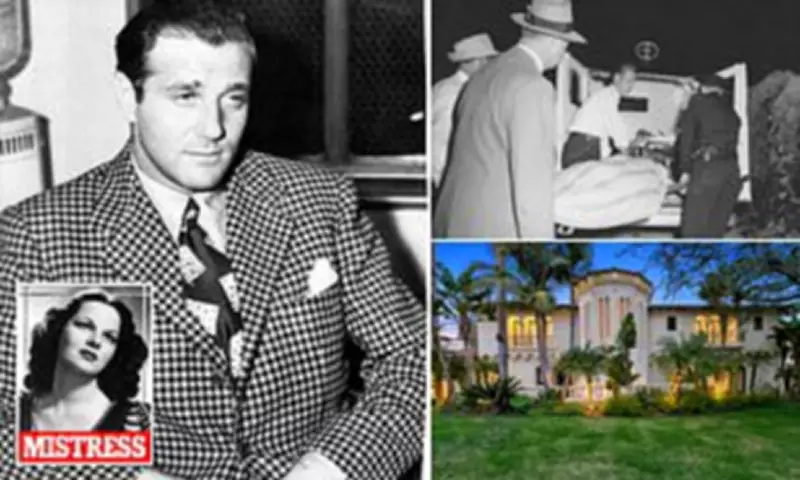
As he relaxed at his mistress' $17 million Beverly Hills mansion, the infamous mobster who built the Las Vegas Strip's first luxury casino was killed in cold blood by two gunshots to the head. For decades, mystery has surrounded who pulled the trigger that killed Benjamin 'Bugsy' Siegel, but experts have now offered new insight into what happened on the fateful night of June 20, 1947.
A Detailed Timeline of the Fateful Night
Larry Gragg, a historian and author of two books about Bugsy, provided the Daily Mail with a detailed timeline of the night the gangster was murdered, which he reconstructed through FBI files, the memoir of an FBI agent, and other sources. On the night of his murder, Bugsy, who had moved in the highest circles befriending movie stars including Clark Gable and Cary Grant, was entertaining at the luxurious Los Angeles pad after going to dinner with friends.
But 280 miles away at his beloved casino, The Flamingo, a table of revelers aroused suspicion as they stood out like a sore thumb. It was 8.30pm, and a Las Vegas resident and his friend had visited the Flamingo for a night out, Gragg told the Daily Mail. They recounted everyone having a good time at a dinner show, except for one table of eight men who had not been clapping or laughing.

During the show, another individual whispered something into each of the unamused men's ears. They soon slowly got up and began to spread around key points in the Flamingo. Two went to the front door, two went to the registration desk of the hotel, two went to the security desk, and two went to the cashier's cage.
The Murder and Immediate Aftermath
As this was occurring, Bugsy was having dinner in Beverly Hills with his friend Allen Smiley, his longtime mistress Virginia Hill's brother, Chick, and Chick's girlfriend, Jerry Mason. The group returned to Virginia Hill's mansion around 10.30pm. Shortly before 11pm, as Bugsy was reading the Los Angeles Times next to Smiley on the living room couch, he was shot dead through the window.
The assailant, who was concealed by shrubbery, fired a total of nine rounds with an M1 carbine from 14 feet away. Four of those bullets hit their mark. One struck Bugsy on the bridge of the nose, knocking out his left eye. A second hit him in the cheek and exited through the back of his neck. The other two shots tore through his chest. The rest of the bullets destroyed a white marble statue of Bacchus, the Roman god of revelry, which stood on a grand piano. One of them put a hole in Smiley's jacket, but he was unharmed, as he had immediately dove to the floor.
Just minutes after the hit, an FBI agent Curtis Lynum received a call 'from his most important confidential informant in Las Vegas,' Gragg told the Daily Mail. The informant was calling from a payphone outside the Flamingo, and he told Lynum, 'Ben Siegel has been shot and killed in Beverly Hills.' Immediately after the call, gangsters Moe Sedway, Gus Greenbaum, and Morris Rosen walked into the Flamingo and proclaimed that it was now under their control. The eight men who had spread about the casino were there to enforce its takeover.
Expert Analysis and Theories
Gragg told the Daily Mail he is 'certain' that Sedway was the confidential informant who called the FBI, because in Lynum's autobiography, his description of the informant perfectly matches Sedway. The fact that the call was placed so soon after the shooting, and the immediate, well-planned takeover of the casino, made Gragg 'absolutely convinced that Moe Sedway knew what was going to happen,' he said. '[Sedway] and Greenbaum and Rosen were ready to walk in as soon as they got word that Siegel had been shot,' the historian added. 'That's as close as I can get to a definitive answer.'

Although the timeline of events does not identify who the shooter was, the other historians interviewed by the Daily Mail agreed that it indicated the mob knew Bugsy would be killed that night. Claire White, the senior director of education at the Las Vegas Mob Museum, said: 'The fact that someone is murdered in LA and that in Las Vegas, 300 miles away, two men immediately know what happens next - that's planned. And it's something that is not only planned, but it's something that Greenbaum and Sedway, I think we can reasonably assume, were at least aware of and prepared for.'
The experts the Mail spoke with laid out three main theories as to the motive of Bugsy's murder, which White said, 'break down one of two ways. Either that it is a mob hit, or that it is not a mob hit - that it is in some way personal or unrelated to his criminal activity.' Two of the theories attribute Bugsy's assassination to the mob for different reasons, and the third suggests he was murdered because of a vendetta held by Virginia Hill's brothers.
The Mob Rift Theory
Born in New York, Bugsy was an extremely successful criminal who was influential with the National Crime Syndicate, a collaborative alliance between the Italian and Jewish mobs in the Big Apple. He led Murder Inc, the enforcement arm of the syndicate, and in the mid-1940s, he moved from New York to California and began securing gambling interests in Las Vegas for the mob. In 1946, Bugsy began working with William Wilkerson, founder of the Hollywood Reporter, to construct Vegas' first luxury casino, the Flamingo.
In May of that year, the gangster took over control of the project and secured funding from the mob for its construction. It was a dangerous strategy made all the more risky by Bugsy's overspending. The Flamingo was meant to cost $1.2 million to build, but he ended up going dramatically over budget and spent at least $7 million. High-ranking gangsters who loaned Bugsy money for construction of the Flamingo were getting impatient because they were not getting their investments back, let alone any profit. They also suspected that he was skimming money.
The Flamingo first opened in December 1946, when it was still unfinished, and its tables were $275,000 in the red during the first two weeks. The casino briefly shut down before reopening on March 1, 1947, and it soon began turning a profit. By that point, however, many believe the mob's patience had run its course. Bugsy was assassinated less than three months after the reopening. 'The primary prevailing theories are that Siegel was killed because of souring relationships within his own organized crime associates,' White told the Daily Mail. 'That was at least in part motivated by his mismanagement of the Flamingo Construction project... as well as the belief, either real or otherwise, that he was skimming off the top of the Flamingo construction project.'
The Personal Grudge Theory
Gragg told the Daily Mail that Sedway and Bugsy had a falling out in late 1946 or early 1947 and that a Las Vegas policeman was convinced that Sedway engineered the killing of Bugsy. The conflict between Bugsy and Sedway could have been a result of a few issues, including management of the race wire, an illegal bookie network that made it possible to place off-track bets on horse races from anywhere in the US. White explained that some members of the mob believed Bugsy was 'skimming money from the race wire in LA without having explicit permission to take that personal cut.'
But the most compelling reason for the falling out is that Meyer Lansky, one of the leaders of the National Crime Syndicate, had assigned Sedway to oversee Bugsy's expenses and suspected skimming. When Bugsy found out about this, he held a meeting with Flamingo officials and told them he was going to take out Sedway. When Sedway learned of Bugsy's plan, he held a meeting of his own with the same officials, as well as Lansky. It is theorized that Sedway's plan was essentially to kill Bugsy before Bugsy killed him, which Lansky authorized.
That theory came from the prospectus for an autobiography written by Sedway's wife, Bee. She contended that Lansky had greenlit the hit on Bugsy, with the only caveat being that the shooter must be someone outside 'the family.' Bee claimed that a man named Matthew Pandza, with whom she was having an affair, agreed to carry out the hit. Bee is the only source of this theory, so it is impossible to substantiate. Whatever the reason was for souring relationships between Bugsy and the rest of the mob, all of the historians the Daily Mail spoke with agreed that Lansky would have had to authorize Sedway's assassination.
The Love Angle Theory
A highly dramatic but less accepted theory is that the brothers of Bugsy's mistress, Virginia Hill, conspired to kill him because they found out that the gangster would physically assault her. A skilled gambler named Bernie Sindler, who had been hired to make sure the Flamingo's dealers weren't cheating, wrote an autobiography in which he recounted a conversation with Chick Hill, one of Virginia Hill's brothers. Chick had learned that Bugsy was physically abusive, and Sindler remembered him saying: 'I ought to kill the son of a b****.'
In his autobiography, Sindler wrote that Chick was in the mansion on the night of the shooting to make sure the curtains were open so the shooter, who was one of Virginia's other brothers, would be able to see Bugsy through the window. Sindler argued that his theory was supported by the fact that Bugsy was not killed in a typical mob hit, which was characterized by a point-blank shot from a pistol to the head, rather than a long-distance barrage of shots from a rifle. Some people also point to the fact that Virginia had flown to Paris just a few weeks before Bugsy was killed, indicating that she knew what was about to happen.
But Lissa Rodgers, a historian who wrote a book about Virginia Hill, told the Daily Mail: 'I don't really subscribe to the idea that her brother, who was also actually friends with Bugsy, went and got somebody to rub him out for mistreating Virginia.' 'Bugsy and Virginia's relationship was over a decade long... But they had gone back and forth and they were kind of getting to the end. The strain of the Flamingo and other things sort of dissolved [their relationship].' Rodgers said. 'It was an abusive relationship, but I just don't think her brother did it,' she added.
An 80-Year Legacy
After nearly a century, Bugsy's unsolved murder continues to capture the public's curiosity, and the celebrity gangster's legacy still ripples through Las Vegas' history and image. For all his flaws, Bugsy's vision for Sin City's first luxury casino, 'really did help Las Vegas turn the corner,' White told the Daily Mail. 'The opulence of the Flamingo set the stage for a huge Las Vegas boom in the late 1940s and 1950s.' And Bugsy's grisly murder, which Las Vegas once worked hard to distance itself from, has become cemented in the city's lore.
His name is plastered throughout bars and restaurants in the Flamingo, which will celebrate its 80th anniversary this year. The Beverly Hills Police Department still lists Bugsy's murder case as open, and its files are sealed to the public. The Daily Mail reached out to the department to ask if it is still actively investigating the murder, but did not receive a response. Although historians have inched closer to the truth of who ordered Bugsy's death and who pulled the trigger, certainty remains elusive. Without access to the sealed files, Gragg said, 'it might be a case that's never solved.'