Middle East Engulfed in Conflict as Iran Retaliates Against US-Israel Strikes
The Middle East has been plunged into a severe and escalating military conflict following a wide-scale attack by the United States and Israel on Iran. In a dramatic retaliation, Tehran has launched strikes across the region, targeting multiple nations and prompting the closure of critical airspaces.
Widespread Strikes and Explosions Reported
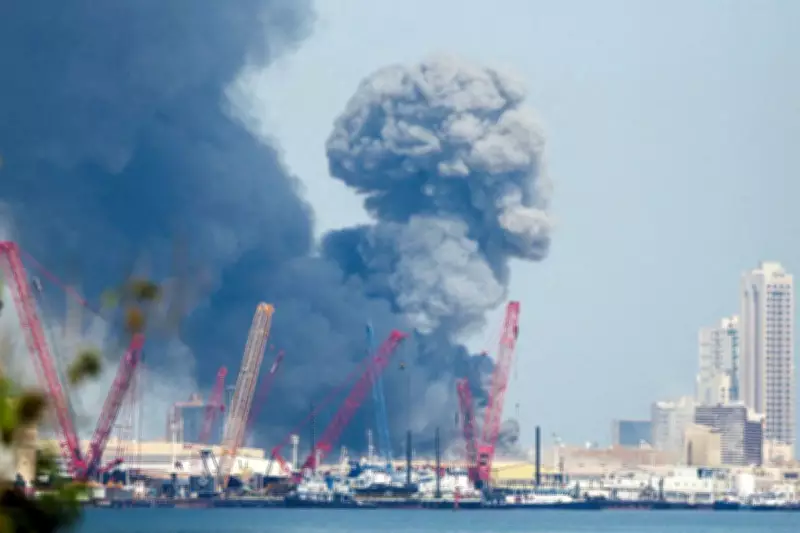
Explosions and missile attacks have been reported in numerous locations throughout the Middle East as Iran's Islamic Revolutionary Guard Corps (IRGC) executes its retaliatory operation. The nations of Bahrain, Qatar, the United Arab Emirates, Kuwait, and Jordan have all been subjected to attacks following the initial US-Israel assault ordered on Saturday morning.
According to detailed reports, military sites within Iran itself, including in Kermanshah, Qum, Isfahan, Tabriz, and Kara, have been targeted. The IRGC has declared it is directing powerful missile blows against all Israeli and US military bases in the region, vowing that this operation will continue relentlessly until the enemy is decisively defeated.

Key Targets and Regional Fallout
The conflict has seen significant attacks on strategic locations. Israel witnessed explosions in Tel Aviv shortly after the initial strikes, with its Defence Force mobilising to intercept threats. In Qatar, multiple waves of blasts were heard in the capital, Doha, prompting its foreign ministry to reserve the right to respond.
The US Navy's 5th Fleet service centre in Bahrain has been hit by a missile attack, as confirmed by state media. The United Arab Emirates, which hosts several US military bases, reported several strikes, resulting in at least one fatality in Abu Dhabi after its military intercepted incoming Iranian missiles. Additional reports of attacks have emerged from Jordan, Iraq, and Saudi Arabia, illustrating the broad geographic scope of the retaliation.
Aviation Chaos and International Reactions
The military escalation has triggered immediate and severe disruption to global aviation. Airspaces over Iran, Iraq, Kuwait, the United Arab Emirates, Lebanon, Bahrain, and Jordan were effectively emptied as flights were urgently diverted. Dubai International Airport, the world's largest global aviation hub, suspended all travel operations.
Global airlines have cancelled flights across the Middle East, and the European Union's aviation regulator has formally recommended that all its airlines avoid the airspace affected by the ongoing military intervention. This has created a significant ripple effect for international travel and logistics.
Political Statements and Escalating Rhetoric
Confirming the initial attack, former US President Donald Trump stated that the US had launched "major combat operations" aimed at eliminating imminent threats from the Iranian regime, specifically to prevent Iran from developing nuclear weapons. He labelled the regime "a vicious group of very hard, terrible people" and reiterated that it could never be allowed to possess a nuclear weapon.
In response, Ebrahim Azizi, head of the national security commission of the Iranian parliament, issued a stark warning, stating, "Now you have started down a path which end is no longer in your control." This underscores the grave potential for further escalation as retaliatory strikes continue across the region, marking one of the most severe military confrontations in recent Middle Eastern history.