
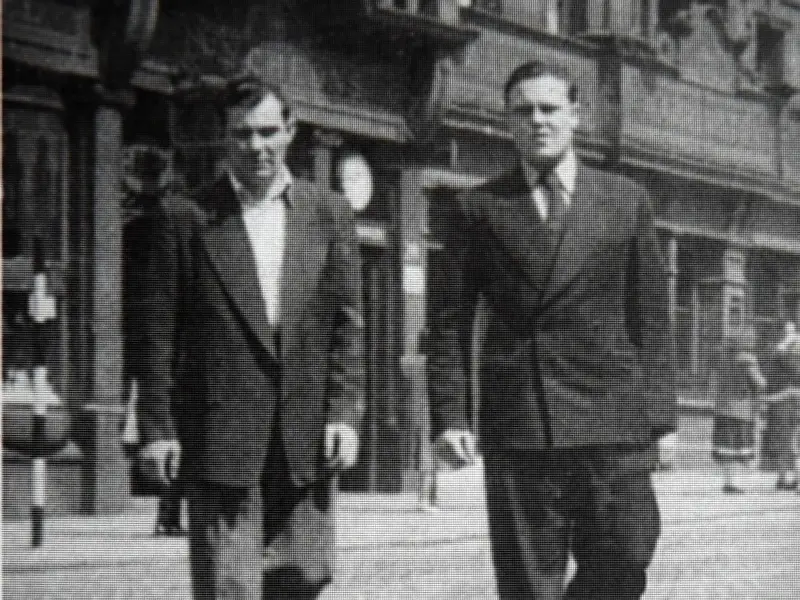
George Kelly was hanged at Walton Prison on March 28, 1950, for the murder of Cameo Cinema manager Leonard Thomas, despite maintaining his innocence and a lack of solid evidence. The case, which also involved his friend Charles Connolly, was marred by an anonymous letter, a dodgy witness, and the suspect dealings of an unscrupulous detective.
The Double Murder at the Cameo Cinema
On March 19, 1949, while audiences watched a thriller, a man in a brown coat, trilby hat, and mask burst into the manager's office of the Cameo Cinema in Wavertree, Liverpool. He shot Leonard Thomas, 44, in the chest. Assistant John Catterall, 30, arrived moments later and was also shot dead. The bungled burglary left two men dead and detectives under immense pressure. Around 65,000 people were questioned without success.
Anonymous Letter and Unreliable Witnesses
An anonymous letter pointed to Kelly and Connolly as the perpetrators—Kelly as the shooter, Connolly as the lookout. The letter was traced to Jacqueline Dickson and James Northam, two convicted criminals who later gave evidence for the prosecution in exchange for immunity. Northam, a notorious criminal with a long prison record, claimed Kelly confessed to the shooting. Dickson, a sex worker under Northam's control, supported his account.
Arrest and Protestations of Innocence
Connolly was arrested at 2.30am on September 30, 1949, and said: 'I have never been in the Cameo Cinema in my life. I don't know the place.' Kelly was arrested later that day at 10.45am. He told police: 'I never had a gun in my life. I do not know how to fire one. I have never handled one.' He added: 'I do not know Charles Connolly. I do not know him. I have never seen him in my life.'
First Trial and Retrial
At the first trial, which lasted 13 days, the jury failed to reach a verdict. A retrial was ordered, with both men to stand separately. Kelly's second trial took place at Liverpool Assizes in St George's Hall in January 1950. Rose Heilbron, defending, argued that the only evidence linking Kelly to the murders was the testimonies of Northam and Dickson. She said: 'Innocent men have been charged before and I dare say they will be charged again, but while there is a jury system in this country they will not be convicted.'
Conviction and Execution
On February 8, 1950, after deliberating for just 55 minutes, the jury returned a guilty verdict. Judge Mr Justice Cassells sentenced Kelly to death, saying: 'On that night of March 19 you committed a cruel and brutal murder for which the jury have rightly found you guilty. A man who uses a gun to assist him in robbery can expect no mercy.' Kelly was hanged on March 28, 1950, at the age of 27. Connolly, who pleaded guilty to robbery, was jailed for 10 years and died in 1997 at 73, always maintaining his innocence.
Unscrupulous Detective and Miscarriage of Justice
The case sparked controversy in legal circles, with many agreeing the evidence was weak. In 1998, Liverpool solicitor Rex Makin submitted a dossier to the legal commission investigating miscarriages of justice, claiming lead investigator Chief Inspector Bert Balmer was responsible. Makin told the ECHO: 'In my view, Balmer was the daddy of the verbals. I saw him at work over a period of time and he was an unscrupulous detective. I loathed the man. I think he was responsible for a lot of unsatisfactory trials in Liverpool. The Cameo case against Kelly and Connolly was based on verbals and would be thrown out of court today.'
Overturned Verdicts in 2003
In October 2003, the Court of Appeal heard that another criminal, Donald Johnson, had allegedly confessed to the murders while in prison, but this information was not disclosed at the original trial. The court ruled the original verdicts 'unsafe' and overturned them both. Kelly and Connolly were officially innocent, though neither lived to see their names cleared. Robin Makin, Rex Makin's son, who represented Kelly's family, said: 'George Kelly's brothers made efforts on his behalf from the time of the conviction in 1950 and there was nothing that could be done. There is tremendous concern about the way in which matters were handled at that time.'




