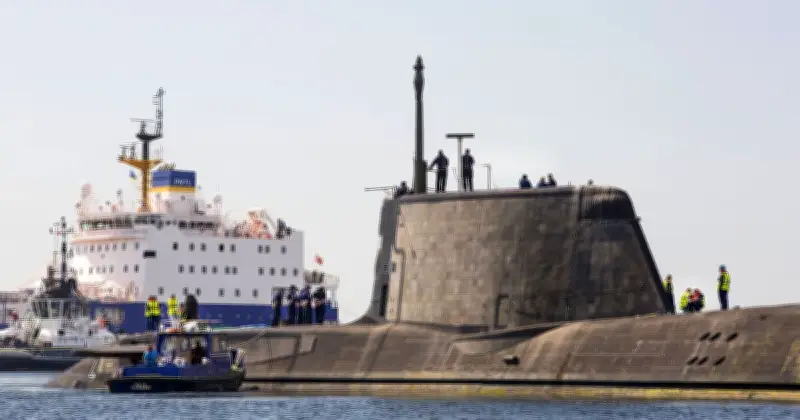
Sailors are being trained to use high-pressure fire hoses as a last line of defence against drones targeting Britain's nuclear-armed submarines while they are in port. The extraordinary measure could see personnel attempting to blast an incoming drone out of the sky if it manages to evade other defences surrounding the vessels.
Fire hoses as final defence
The hoses, known as centre-fed reels, can be positioned on the decks of Vanguard-class submarines while they are alongside at HMNB Clyde in Faslane, Scotland. They are fitted with pistol-grip nozzles, allowing sailors to aim powerful jets of water at an approaching drone in an attempt to knock it off course or bring it down.
The prospect of relying on fire hoses as a final layer of protection is particularly striking given that Britain's Vanguard submarines carry the UK's Trident nuclear deterrent and are considered most at risk from such attacks while on the surface or alongside in port.
Royal Navy's multi-layered security
The Royal Navy insists Faslane is protected by several layers of security and that sailors with hoses are not the base's only defence against drones. But a Navy source told The Sun that personnel had to make use of the equipment available.
The source said: "You have to use what you've got. We always thought this would be for small spy drones or civilian dicking around, but the threats moved on a lot." The source said the measure could become a last line of defence if other systems failed to stop an approaching drone.
They added: "In a worst case scenario, the plan is to grab the centre fed hose reel and use it to knock a drone off course or even knock it down."
Rising drone activity near military bases
The location of Britain's nuclear submarine base could also present another challenge if drones were launched from nearby. The Navy source said: "There are lots of public roads, people can roam on the hills. If several drones were launched nearby there is less time to react."
The concerns come as reported drone activity around military facilities has increased sharply. Reported drone flights near military bases have risen from just nine in 2019 to 340 over the past 12 months.
The threat is not limited to Britain. Charlie Williams, the author of a report by the International Institute for Strategic Studies concerning Russian drone activity around nuclear sites across Europe, said: "Faslane is very clearly of interest to hostile states. We know it has been targeted before and it would not be surprising if it was targeted again. It is very surprising they are relying on fire hoses to defend the submarines. We have to hope the MoD is investing in the right kind of capability to defend it."
The threat posed by drones has become increasingly clear during the war in Ukraine, where unmanned systems have been used to attack military targets far behind front lines. However, the Ministry of Defence stressed that Britain's military bases are protected through a wider, multi-layered security system.
The MoD said: "The first duty of Government is national security, and we take the security of our people, sites and local communities extremely seriously, in particular those housing nuclear capabilities. The protection of our bases is kept under constant review, with a multi-layered approach that includes physical barriers, patrols, surveillance, monitoring, and counter-drone capabilities. Through the Defence Investment Plan, we are investing an additional £470million over the next four years to strengthen the protection of UK military sites."