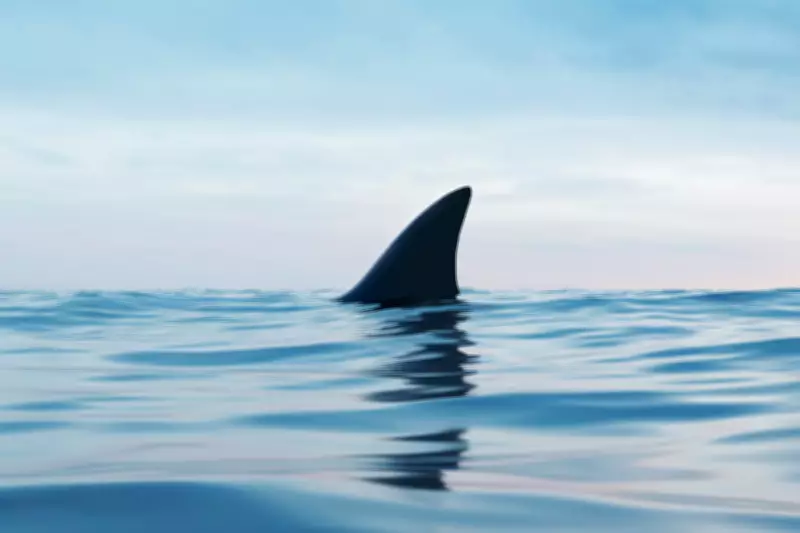
Terrifying footage has emerged showing a large shark stalking hydrofoilers off the coast of Santa Barbara, California. The encounter took place when two friends, Ron Takeda and Tavis Boise, were hydrofoiling—riding surfboards equipped with underwater wings that lift them above the surface.
The shark followed Takeda for at least five minutes, a duration that he described as unusually long. “I wanted it to be a dolphin,” Takeda told KTLA. “I honestly didn’t think it was a dolphin, but I wanted it to be one. I yelled, ‘Tavis, is this a dolphin?’”
Takeda stated that there was no time to feel fear during the incident, even as the shark appeared relentlessly interested in him. “Lots of people see the shark, but that’s it and then it’s over,” he said. “This one was relentlessly chasing, and that’s really what’s so unique about this encounter.”

The video captures the moment Boise notices a shark fin breaking the surface just feet behind Takeda. Almost simultaneously, Takeda spots the predator and yells, “Is that a shark?” Boise shouts back, “Yeah. Don’t fall!” He then calls out, “Oh my God, it’s coming for you. What the f***. Ron! Ron! Go! Go!”
Takeda zigzags across the waves in an attempt to evade the shark. The animal eventually lost interest, allowing both men to safely return to shore. “I had a little bit more of an emotional reaction watching it (the footage) because it’s definitely not a dolphin and you’re watching it chase your friend, and it’s very clearly interested in him,” Boise said.
The incident comes amid a series of recent shark sightings along the California coast. In Huntington Beach, lifeguards spotted an estimated 10-foot great white shark feeding on a sea lion carcass near Sunset Beach, prompting a 48-hour closure. That same weekend, another great white sighting near the Huntington Beach Pier forced the suspension of a major professional surfing competition.
Despite the increase in sightings, experts note that shark bites in Southern California remain rare, with only a few dozen confirmed cases recorded over the past several decades, according to data from the California Department of Fish and Wildlife. “We can encounter them all we want, but really it’s their ocean and we’re just small primates,” Boise told KTLA.