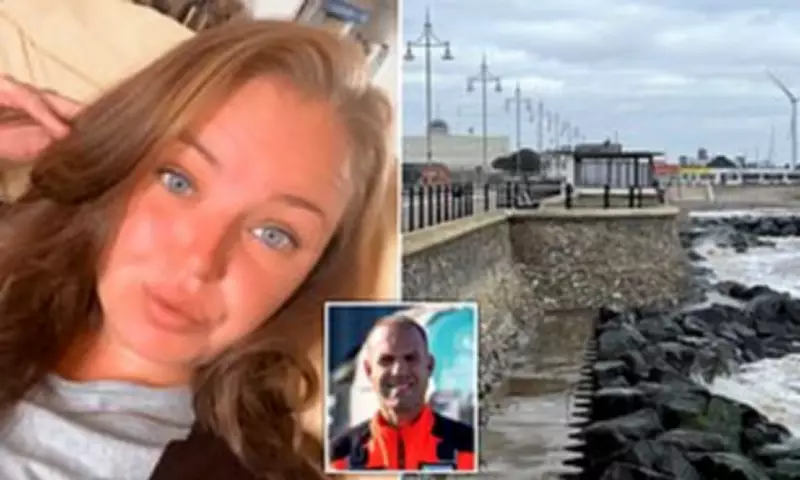
Paramedics and police who responded to a mother trapped headfirst under water should not have assumed she was dead upon arrival, an expert testified at an inquest. Emergency services were dispatched to the seafront in Lowestoft, Suffolk, after reports that Saffron Cole-Nottage, 32, had fallen and become wedged between sea defense rocks as the tide rose.
Expert Testimony on Rescue Guidelines
Pre-hospital emergency care specialist Professor Richard Lyons told the hearing in Ipswich that none of the responders followed guidelines requiring 30 minutes of rescue efforts starting from the first responder's arrival, regardless of when submersion occurred. 'I would expect an ambulance crew to have that 30-minute initial rescue time in their mind,' he said. 'Knowing that the clock starts when they arrive and that 30-minute revival period would be the minimum – I would expect the ambulance crews to be aware.'
Professor Lyons emphasized that the guidance is clear: the clock starts when the first responder arrives. 'The only purpose of the guidance is to maximise the chance of a successful rescue attempt. We accept that the time is likely to be after the submersion time but the point is it’s a confirmed time that will not be ambiguous and is free of the error of bystander reporting.'

Details of the Incident
The inquest heard that Ms Cole-Nottage became stuck between rocks on the evening of February 2 last year while walking a dog with her daughter. A teenage girl called 999 at 7:52 pm, but it took seven minutes for the call handler to realize the tide was rising fast after being told Ms Cole-Nottage's head was going under water. Paramedic Colleen Gibson arrived at 8:10 pm and, after looking over the railings, went down to the rocks with police who arrived at 8:13 pm. She declared Ms Cole-Nottage dead. Firefighters who arrived shortly after were unaware of this declaration and pulled her out within a minute.
Survival Probability and Alcohol Factors
Professor Lyons stated that survival is 'probable' if a submerged person is removed and given CPR within five minutes. After ten minutes, 'the brain is invariably affected,' and 'beyond 25 minutes, survival would not have been possible.' He noted that Ms Cole-Nottage's head might have been in an air pocket, which could have extended survival time. The inquest also heard that Ms Cole-Nottage had been drinking and was approximately three times the drink-drive limit. Professor Lyons suggested this may have made her 'more likely to stumble' and impaired her ability to push herself out. However, Saba Naqshbandi KC, representing the family, argued that the rocks were smooth and offered no means of escape. Professor Lyons conceded that if she was physically trapped, alcohol levels would be irrelevant due to the geography.
Failures in Communication and Coordination
Professor Lyons concluded that police and other responders need better awareness that rescue should be attempted in similar situations. 'There was a wrong decision [on this occasion] and this was carried through the train. Any responder can arrive on the scene and they should go in with the mindset of “Start the clock for the rescue.”' During questioning, paramedic Gibson was asked why she did not inform other responders of the potential to save Ms Cole-Nottage. She replied, 'I don’t know.' Barrister Bridget Dolan KC suggested that police would have attempted rescue had they known, but Gibson said, 'I don't believe that to be safe. I wouldn't be able to reach down into the rocks head-first with the water.'
The inquest continues, with further evidence expected on the coordination failures and the 999 call handling algorithm.