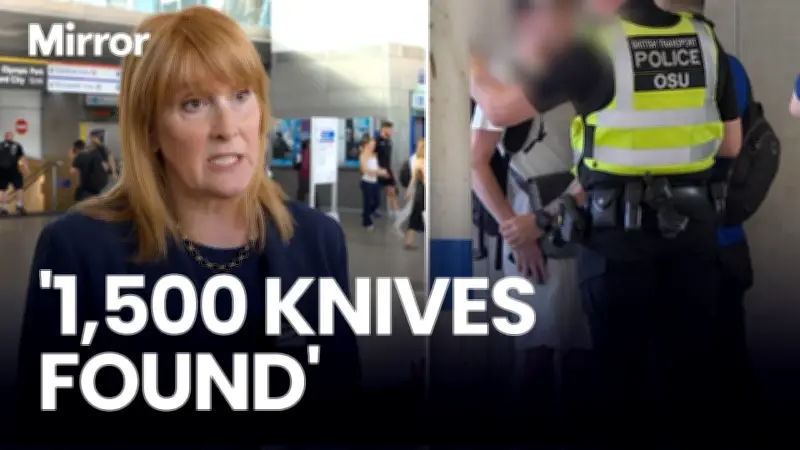
Almost 3,000 drug-dealing lines have been shut down and nearly 1,500 knives seized in the past year as part of a record police crackdown on county lines gangs that exploit vulnerable children to traffic drugs and carry weapons. The operation, led by British Transport Police (BTP) and supported by the Home Office, targets the criminal networks that use children as 'foot soldiers' to transport illegal substances across the country.
Major Operation at Stratford Station
The Mirror joined BTP officers on a major operation at Stratford railway station in east London, where more than 40 uniformed and undercover police officers, drug dogs, and safeguarding experts converged. The operation led to the interception of one vulnerable child involved in county lines who had been missing, and the child was immediately given support. Charities and council social services representatives were present to ensure swift action without bureaucratic delays. On that single day, six people were arrested, including one for possession with intent to supply class A drugs.
Government and Police Response
Policing Minister Sarah Jones, who observed the operation, told The Mirror: 'County lines is a really horrific crime, which is a violent one, which is about basically the journey that drugs take across the country to get to people who want to buy their drugs for their weekend drug taking or for their drug use. And what often happens is you have big criminal gangs that are exploiting kids to get on the trains, get on the bus, to get on the coach, and take the drugs where they need to go. It's a horrible, nasty, violent business. A lot of people get stabbed.' She added that the government funds a major programme targeting the 'real power behind the county lines network.'

Detective Superintendent David Udomhiaye of BTP said uniformed and plain-clothes officers are on the railways '24/7' to tackle the gangs. 'It's a massive problem because they're exploiting vulnerable people, as well as young children, and getting them to do the dirty work, if you like, for them. The railway is crucial to the county lines operating model because it allows these criminal gangs to send vulnerable people across the country to vast areas carrying drugs, weapons, money. That's why we do these operations. Today, you might see us in uniform, but we do these kinds of operations every single day, not just at Stratford. So even though you can't see us, just know that we are always out 24/7.'
Safeguarding and Charity Support
BTP's approach prioritises safeguarding, with support from charity workers such as those from Catch22 on the frontline. Johnny Bolderson, a senior service manager at Catch22 who was at the operation, explained that gangs target 'vulnerabilities' in youngsters. 'It could be around home life, it could be coming from a poor background, it could be coming from a certain education, certain demographic, but it's looking at their specific vulnerabilities and about how they can target them to make sure that they can actually be exploited into the county line gang. They will use trainers, they will use money, they will use status, because that's mostly what young people want at that age, status, and to be a part of something. What happens with the county line gangs is that they'll give them that.'
Amanda Radley, the safeguarding lead for BTP's county lines taskforce, told The Mirror that about 87% of young people who might start with an arrest do not receive a criminal justice outcome. 'We're really keen that we don't criminalise children and young people that might be being exploited. So whilst we might start with an arrest if we find drugs or money or believe that they're involved in the supply chain, we'll be looking to outcome that (so) we don't criminalise them. We'll be looking for that non-criminal justice outcome that is more supportive, protective, and acknowledging the fact that the likelihood is they're a victim.'
Broader Context and Campaigns
The County Lines Programme, funded by the Home Office, is part of the government's broader effort to halve knife crime within the next decade. The Mirror's Missed campaign highlights forgotten, unsolved, and underreported missing persons cases across the UK.