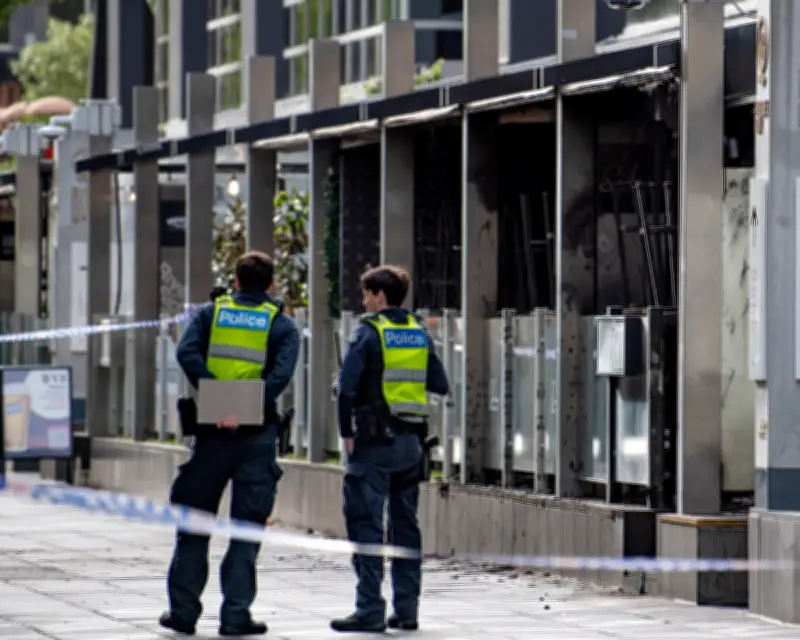
Victoria police have arrested a 20-year-old man they say orchestrated a wave of Melbourne arson attacks on behalf of a crime syndicate based in the Middle East, marking a major development in the city’s escalating hospitality wars.
Breakthrough in Operation Eclipse
Detectives claim the arrest is the most significant since an outfit known as “The Commission” – allegedly led by Kazem “Kaz” Hamad – started targeting Victorian tobacco stores three years ago. That spree of arson attacks more recently morphed into violence at licensed venues.
“This arrest is the most consequential we have made since the inception of Operation Eclipse,” Det Insp Graham Banks said on Tuesday. “These offences are significant examples of crime as a service – the alleged tasking of kidnapping, home invasion and arson. It’s a methodology we have seen play out previously over a number of years – organised crime tasking of offenders to commit intimidatory tactics.”

Overseas Links and Syndicate Members
Banks said while Hamad had been detained in Iraq earlier this year, “numerous other members of this syndicate” who were also based offshore were directing offending to further its ambitions in Victoria and other states. He said the “most problematic” of these members was a person based in the Middle East who had an outstanding arrest warrant in relation to the attempted murder of Sam Abdulrahim in 2022.
Banks claimed the Melbourne man arrested on Tuesday, who was allegedly known as “CommBank” on an encrypted app used to task offenders, was also considered a high-ranking member of the organised crime group. “Despite his relevant young age, there is intelligence that suggests he’s a very significant part of the organised crime group,” Banks alleged. “He self-described … as just an ordinary kid who goes to the gym and runs an empire from his home.”
Charges and Alleged Offences
The 20-year-old, Jesse Hadchiti, was arrested in the city’s north-west on Tuesday. He was charged with offences including aggravated home invasion with an offensive weapon, kidnapping, extortion with threats to kill, false imprisonment, attempting to commit arson and three counts of recruiting a child to engage in criminal activity. Hadchiti was expected to face court on Tuesday evening.
“It is believed he ‘tasked’ offenders via encrypted applications for numerous jobs, including a mistaken-identity kidnapping in Malvern,” a police spokesperson said. That kidnapping, which took place in the south-east Melbourne suburb, involved a number of men who assaulted a man inside his home before forcing him inside a car on 14 April. He was later dropped outside a hospital. Police believe the victim was not the intended target. Four males have been charged in relation to the assault.
Investigators also allege that Hadchiti had organised an attempted aggravated home invasion in Doncaster on 28 April. The man is allegedly behind a number of arson attacks that sparked a major investigation – Operation Eclipse – on 27 April, according to police.
Recruitment of Teenagers via Encrypted Apps
The majority of those charged with the fires on hospitality businesses have been teenagers, with police repeatedly saying they had been recruited via encrypted apps by organised crime figures they had not met, nor had previous involvement with. Many of those recruited had not been involved in any previous offending, and the arsons were sometimes rewarded with payments of less than $1,000.
In May, Det Supt Jason Kelly said the use of such young foot soldiers was a global trend, with encrypted phone applications used to recruit attackers. “It’s a worldwide issue in terms of how organised crime now are infiltrating children and others to do their dirty work,” Kelly said. “Organised crime are out there recruiting kids, we’re out there recruiting our law enforcement and government partners to work on this holistically.”

Broader Context: Iran and Synagogue Attack
Without naming Hamad, the Asio director-general Mike Burgess referenced him in his annual threat assessment last week, mentioning the attack Hamad allegedly directed on the Adass Israel Synagogue in Melbourne. “Iran recruited him through a complex web of Iraqi-based militia groups,” Burgess alleged. “Valuing his high wealth and criminal connections, the IRGC protected him and supported his illegal enterprises. That changed dramatically after Asio publicly named Iran’s involvement in the antisemitic arsons.” Burgess alleged: “This person’s Iranian backers lost their enthusiasm, and after further pressure from Australian and local law enforcement, they threw him in prison.”