Background of the Incident
On July 7, Ronaldo Salgado searched for his father, Lorenzo Salgado Araujo, after a shooting in Houston's East End. He found his father's work van behind police tape and later saw a video online of a man shot in the street. Ronaldo could not identify him by sight but recognized his father's voice crying for help. The video of Ronaldo recounting that realization and collapsing into grief has not left many who saw it.
Demands for Transparency
After federal immigration officers killed Renée Good and Alex Pretti, Senator Jon Ossoff questioned why 'roving gangs of masked men' were 'demanding papers, dragging people from their cars, and shooting people to death.' A federal court ordered immigration agents in Chicago to wear body cameras, and state and local lawmakers pursued measures requiring agents to unmask and identify themselves. However, Trump signed a $70bn immigration-enforcement bill funding ICE and border patrol through 2029 without requiring agents to unmask or wear body cameras. Less than a month after Salgado Araujo's killing, Representative Sylvia Garcia stated that ICE's acting director promised to equip all field officers with body cameras by the end of July.
The Victim's Story
Salgado Araujo, 52, was a husband and father of three American sons. He spent 35 years in the United States, built homes, ran a construction business, and put his children through college. A year and a half before his death, he submitted fingerprints while seeking permission to work legally. He was still waiting for one arm of the government to answer when another killed him.

Disputed Accounts
He was driving his crew to a job when ICE agents in unmarked vehicles mistook him for someone else. They wore no body cameras. The DHS claims he rammed an ICE vehicle and tried to run over an agent, who fired in self-defense. At least two of the surviving passengers dispute this, saying no agent stood in front of the van and that the shots came through its passenger side. No released footage supports the government's version.
Broader Implications
Uniforms, visible names, marked vehicles, and cameras are not cosmetic. They distinguish democratic lawful authority from armed strangers exercising force. A government that conceals its identity cannot demand perfect recognition from frightened civilians. ICE mistook Lorenzo Salgado Araujo for another man. He was expected to identify ICE instantly. Only one side was allowed to make an error.
Official Response and Community Reaction
No official told the family Lorenzo had died; Ronaldo learned it from social media, then called his mother so she would not learn it the same way. The three men who contradict ICE's version, including Lorenzo's brother, were detained. Interviewed separately, their attorney says they gave consistent accounts. Houston's district attorney says federal authorities have denied him access to the van.
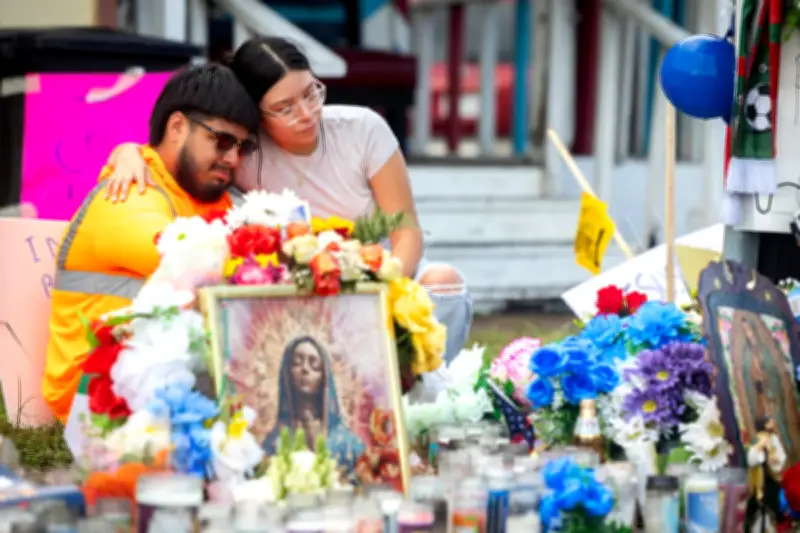
Salgado Araujo died in Magnolia Park, which has anchored Mexican American life in Houston for a century. Residents had learned to watch for unmarked cars before one stopped Lorenzo's van. His death did not introduce fear there; it confirmed it. Hundreds gathered there on Saturday to mourn him and resist a familiar cycle in which state silence follows state violence.
Pattern of Violence
Salgado Araujo's death was at least the 10th fatal shooting involving federal immigration officers since Donald Trump returned to office. The day after an ICE agent killed Good in Minneapolis, former acting ICE director John Sandweg called the rise in shootings a direct byproduct of the administration's shift toward arrests on public streets. Six months later, less than a week after Salgado Araujo was killed, an ICE officer fatally shot a 26-year-old Colombian man in Biddeford, Maine. The facts of that shooting are still emerging, but the pattern is clear.
Conclusion
If Americans want a government that commands trust rather than fear, they must demand more of those who exercise its power than of those who must live with what it does. A government confident in the legitimacy of its actions should never be afraid to show its face.