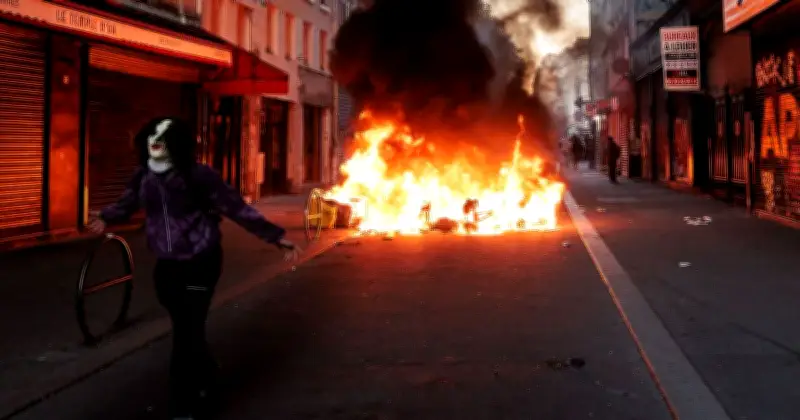
Armed police have been mobilised in Paris as the city braces for more protests and riots on Saturday. Interior Minister Laurent Nuñez said as many as 70,000 officers will be deployed nationwide, along with helicopters, armoured vehicles and water cannons.
In central Paris, a few dozen gendarmes have been stationed beneath the Arc de Triomphe and along the nearby avenues. Armed police and armoured vehicles have also been spotted in the city. Major museums have closed, and authorities deployed a sizeable police force for a round of new protests.
Arrests and weapons seized
French Interior Minister Laurent Nuñez said police have arrested 135 people and seized various weapons, including metal balls, lead pellets, fireworks, slingshots, steel balls, improvised weapons, a katana, and airsoft weapons.
Protesters from one of the main student groups have reported being "surrounded by dozens" of riot police and "prevented from reaching the metro". The UNEF wrote on X: "As UNEF activists, gathered as a national collective, left the Bourse du Travail to join the demonstration via the metro, we were surrounded by dozens of CRS officers preventing us from reaching the metro as we were leaving our meeting. Right now, dozens of UNEF activists are being issued citations and searched, for no other reason than walking down the street."
Protests and bans
Protest marches are scheduled in Paris and Marseille, but some other rallies, including in Lyon, Nice and Montpellier, have been banned by local authorities. In Lyon, French media reported that police used tear gas on Saturday morning. Trade unions have criticised the bans, calling them violations of freedom of expression, which is protected by the constitution.
Thousands of people gathered Saturday morning for an anti-far-right protest in the city of Orléans, about 70 miles south of Paris. It was organised on the sidelines of a two-day congress of Marine Le Pen's nationalist, anti-immigration party ahead of next spring's presidential election.
Businesses and cultural venues affected
Parisian shopkeepers have been barricading their stores all week. Near the Saint-Lazare train station, Akram Ahmed, a 34-year-old contractor, was boarding up an optician's shop. "I got the call last night," he told the Associated Press. "The owner seemed desperate. He said I was saving his life."
Following the unrest, Paris police prefect Patrice Faure urged Parisian shopkeepers to hire security guards. He later clarified that protecting business owners and their establishments is the government's responsibility.
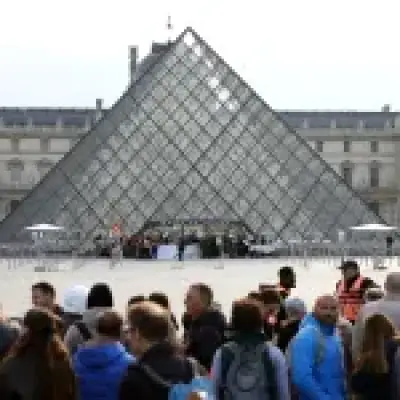
Major museums, including the Louvre, Orsay Museum, Picasso Museum and Grand Palais — where a major Cézanne exhibit is on display — are closed on Saturday. Art Basel, one of the world's most prestigious contemporary art fairs, opened to the public on Friday, but only for the day, as the threat of unrest prompted organisers to cancel the weekend programme.
In a last-minute change on Friday, police moved the route of the Paris march to the city's southeastern edges, away from central neighbourhoods such as Place de la Republique, where last Saturday's violence left shops ransacked and cars burned. Some 3,000 shops across France were damaged or looted last weekend.
Political reactions
Jean-Luc Mélenchon, the left-wing presidential candidate and leader of France Unbowed, urged Emmanuel Macron to "give in". He said: "After this, the only thing left for him will be the exit door... He will come to realise that this is going to happen every single week."
France's "Yellow Vest" movement has called for new demonstrations on October 31 during a sit-in outside parliament and city halls nationwide. Protesters condemned the "authoritarian drift" of President Emmanuel Macron and urged citizens to stand up for "public freedoms". A coordinator told journalists at Bastille Square that, next Saturday, "We will protest for the freedom to protest, and for all our freedoms".