North Dakota Highway Patrol Welcomes Bloodhound Puppy Beau to Elite Tracking Team
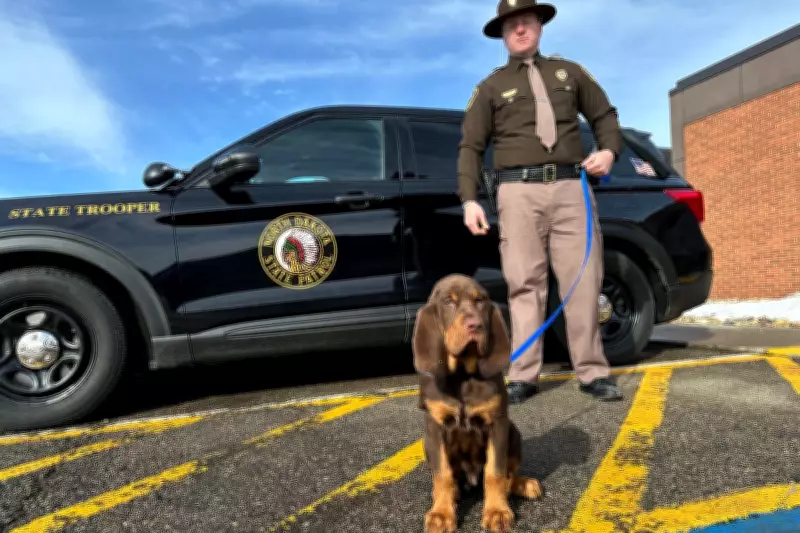
The North Dakota Highway Patrol has expanded its ranks with a unique new recruit: Beau, a 12-week-old bloodhound puppy with floppy ears, four legs, and an extraordinary talent for finding people. This addition strengthens a specialized unit of bloodhounds that has become indispensable for tackling challenging cases throughout the upper Midwest, from missing children and dementia patients to criminal suspects.
Age-Old Technology Meets Modern Policing
While the agency employs advanced tools such as drones and aircraft to aid in searches, bloodhounds remain a critical, low-tech solution. Trooper Steven Mayer, handler of another bloodhound named Bleu, emphasized that these dogs are specifically bred for tracking humans. Their effectiveness spans the United States, from Maine to Florida and Texas to California, according to Danny Jones, executive director of the U.S. Police Canine Association.
Jones noted that although drones and helicopters can cover ground quickly, bloodhounds are essential for initiating trails on the ground. "To actually get a direction and start moving, you need a dog on the ground to start that trail," he explained, highlighting the irreplaceable role of these canines in law enforcement.

Unmatched Olfactory Abilities
Bloodhounds possess approximately 300 million scent receptors in their noses, far surpassing humans and even other dog breeds. Their distinctive physical features—large, floppy ears and folds of skin—help capture and concentrate odors, enabling them to track individuals over extended periods, sometimes more than a week after a trail has gone cold.
Trooper Mayer detailed that these dogs can detect scents from minimal sources, such as a wall someone touched, disturbed dirt, or even vomit on a car door. This sensitivity makes them invaluable in complex investigations.
Busy Schedules and Training Regimens
The Highway Patrol initiated its bloodhound program about 14 years ago, transitioning from dual-purpose dogs to specialized units focused solely on tracking or drug detection. The force receives around 70 service requests annually, including interstate calls to states like Montana, South Dakota, and Utah.
One notable deployment involved a 10-hour drive to Montana to assist in locating a suspect linked to a quadruple homicide at an Anaconda bar. The dogs successfully narrowed down the search area, demonstrating their precision in high-stakes scenarios.
Beau, originally from Texas, now resides in Fargo, North Dakota's largest city. His early training, overseen by handler Trooper Dustin Pattengale, includes potty and kennel training, basic commands, and socialization in diverse environments. "He is a very energetic young pup. He's pretty relaxed for the most part, but he is eager. He likes to work and sniff," Pattengale said.
However, Beau will not be fully certified for tracking until he is about nine months old. His training will progressively introduce scent articles and more complex trails across various terrains.
Challenges and Charms of Bloodhound Handling
Bloodhounds are described as high-drive, loving, and caring animals, but they can also be stubborn, slobbery, and mischievous. Trooper Mayer cautioned that they are not suited for apartment living due to their active nature.
His partner, Bleu, exemplifies resilience; despite losing an eye in an injury from playing with another bloodhound, his tracking abilities remain unimpaired. Beau, meanwhile, is a growing puppy who enjoys beef liver treats and exploring snowy landscapes with his ears dragging on the ground.
Expanding Influence Beyond North Dakota
In addition to local operations, North Dakota's expertise has benefited other agencies. Last year, Trooper Mayer spent a week in Omaha, Nebraska, training Willow, the city police department's first bloodhound. Omaha Police Sgt. Scott Warner highlighted the value of having a local bloodhound, as they previously relied on dogs from the Chicago area for searches.

Willow has already proven effective, tracking missing persons through challenging conditions like darkness, steep hills, mud, and water. Warner emphasized the importance of mentorship in training, noting that the bloodhound community operates largely through word-of-mouth networks.
"I had no idea that North Dakota had a bloodhound program. There's not a directory that I can look at that tells me where dogs are," Warner admitted, underscoring the need for greater awareness and collaboration.
Dedicated Handlers and Community Engagement
Handlers like Mayer and his wife demonstrate exceptional commitment, traveling globally—to countries such as Hungary, Italy, South Africa, and Wales—to train dogs, often without charge. They are prepared to drop everything at a moment's notice to assist in searches, even during holidays.
Mayer described handlers as a special breed of people who prioritize helping strangers over personal commitments. The dogs have also become social media sensations for the Highway Patrol; Beau's name was selected through a Facebook vote, and videos of him and other bloodhounds like Lorace have garnered public affection.
"Everybody loves a dog, especially these floppy-eared ones," Mayer said, hoping that increased visibility will lead to earlier calls for assistance and enhance the program's impact. "The more word we can get out, the faster we can help people," he concluded.