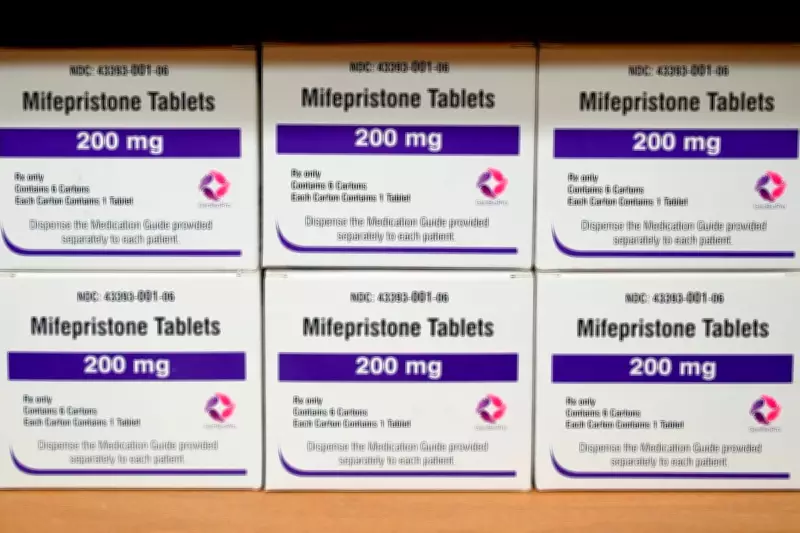
Abortion providers and advocates are making plans for future disruptions to reproductive care after the US Supreme Court temporarily continued nationwide access to mail-order mifepristone on Thursday while several legal challenges wind their way through the lower courts.
Legal Challenges Mount
Three lawsuits, including a suit brought by Louisiana against the US Food and Drug Administration (FDA), seek to limit access to mifepristone, one of two abortion medications. Limitations on abortion medication could have significant ripple effects throughout the pharmaceutical industry, allowing a single state to regulate medications for the entire country.
At the same time, the FDA is conducting a review of mifepristone; the agency just this week suffered major shake-ups with the ousters of commissioner Marty Makary and the acting director of the FDA’s Center for Drug Evaluation and Research (CDER), Dr Tracy Beth Hoeg, the fifth person to lead the center this year. Hoeg shared on X on Friday that she “was fired”.

After the decision on Thursday, “we can take a momentary sigh of relief, but there’s always 10 other threats on the horizon”, said Emily Steinert McDowell, associate director of federal policy at Reproductive Freedom for All.
Preparing for Worst-Case Scenarios
“We have to be prepared for the worst-case scenario,” said Bonyen Lee-Gilmore, chief external affairs officer at Patient Forward, an advocacy organization focused on later abortion care.
The Louisiana case is expected to come before the Supreme Court again in a future term.
“The Supreme Court has already heard a very similar case and said that there was no standing for the plaintiffs,” said David Cohen, professor of law at the Drexel University Kline School of Law. Yet legal and regulatory challenges are likely to be “a constant battle,” Cohen said. “Nothing’s ever settled. Everything is always contested. The attacks are going to keep coming, and providers are going to keep adapting, and patients are going to keep getting abortions.”
Impact on Rural and Vulnerable Populations
Telehealth for miscarriage management and abortion care has been a major step forward, said Melissa Bayne, an obstetrician-gynecologist and member of the reproductive freedom taskforce for the Committee to Protect Health Care. She works in rural Michigan, where people in the community remember a time before mifepristone, when miscarrying patients needed to go under anesthesia for midnight procedures to prevent complications like sepsis – and they’re worried about going back to that, Bayne said on a press call on Friday.
People can and should still get abortion care, she said, adding: “Michiganders have the right to abortion in our state, but we need our federal leaders to defend it for us.”
Patients who need reproductive care shouldn’t have to drive hundreds of miles, Jenna Beckham, an obstetrician-gynecologist in North Carolina, said on the Friday call. “People are struggling to get by, let alone get hundreds of miles away for basic health care.”
In Montana, the right to abortion is protected in the state constitution, “but that doesn’t mean that abortion care is accessible”, said Helen Weems, a family nurse practitioner and owner and founder of All Families Healthcare in Whitefish, Montana. The Rocky Mountains bisect the state, and there are expanses in the eastern half with no providers at all. A patient might need to drive 400 miles for about seven hours, sometimes over harrowing wintertime mountain passes, to access in-person care.
“Being able to mail abortion pills has revolutionized abortion access in Montana and throughout the country,” Weems said on a press call last week. “There are also people with disabilities or young people who can’t talk with an adult, or people trapped in violent and controlling relationships. We talk to people all the time who can’t leave their home for whatever reason, and getting pills mailed to them means they can have the essential care that they need.”

Ripple Effects on Vulnerable Groups
Survivors of intimate partner violence and human trafficking are especially at risk of losing the care they need if abortion medications are restricted, which would have “monumental, tragic consequences”, Julie Dahlstrom, director of the immigrants’ rights and human-trafficking program at Boston University School of Law, said on the call last week. Research from the National Bureau of Economic Research shows that restrictive abortion policies, after the Dobbs decision reversed national abortion rights, led to a 7% to 10% increase in intimate partner violence incidents in states with bans – more than 9,000 cases.
Later Abortion Care at Risk
With state-level restrictions following the Dobbs decision, more people are being pushed into accessing care later in pregnancy, Lee-Gilmore said. Forty states ban abortion at some point in pregnancy, and 30 of those states ban abortion after the most common period of time during which people use pills to manage abortion, which is up to 12 weeks or so. Only four states – Maryland, New Mexico, Colorado, Illinois – and Washington DC have all-trimester clinics offering later abortion care; some providers in other states may offer the care on a case-by-case basis.
“All-trimester clinics are few and far between in this country, and they’re already having a hard time managing the demand for later care, and this mifepristone court ruling could really have a devastating impact on that sustainability,” said Lee-Gilmore. “People will still need abortions. They’ll just become harder to access.”
Chaos and Confusion
On Thursday, the confusion and chaos around mifepristone access was encapsulated in the roughly 30-minute period when Justice Samuel Alito was late on the deadline he’d given himself to deliver a decision – allowing the stay to expire and temporarily creating a nationwide ban on mail-order mifepristone.
“The legal back-and-forth is already creating chaos and confusion,” Beckham said. It’s not just patients but also colleagues who are confused about the “whiplash” on what is and isn’t legal, she said.
Bayne said: “All physicians are worried all the time. I can’t take great care of my patients if I’m not working or if I’m in jail.”
“Not just physicians and not just [advanced practice clinicians], but also nurses are scared – everyone is afraid of touching and interacting with a patient,” Beckham echoed. “Because of the changing laws and requirements, there’s a constant fear of ‘Is this legal? Am I going to be prosecuted? Am I going to go to jail?’ It impacts our ability to provide care for our patients in that moment, and it adds to the ongoing stress.”
Fears of Criminalization
Justice Clarence Thomas wrote in his dissent on Thursday that mailing mifepristone to patients is a “criminal enterprise”, claiming that it ran afoul of the 1873 Comstock Act, an anti-obscenity law. Such statements “foreshadow a lot of concerns that we’ve been having” about possible criminal investigations, McDowell said.
Even so, providers are creating plans to counter future disruptions to mail-order medications – but they come with some complications. In rural Michigan, where three or four doctors see 40,000 people, staff shortages are one of the biggest barriers to providing care, and switching to more in-person care would be a challenge, Bayne said.
Alternative Treatments and Resilience
If mifepristone is restricted in the future, providers are ready to switch immediately to alternate treatments that are still evidence-based, like misoprostol only.
“Abortion care by mail will continue, and that care will be safe and effective,” said Weems. But it is “infuriating” to have politicians and judges attempt to dictate how evidence-based medicine is practiced, she added.
Cohen emphasized that people “should know that you can still get care” and that patients in the US “can get abortions safely and effectively, cheaply and widely available, despite what the court might say”.
“The irony here is that abortion could be cheaper and more available because misoprostol is cheaper than mifepristone. There are no restrictions on misoprostol like there are on mifepristone – any doctor can prescribe it and any pharmacy can dispense it,” he added.
Yet the temporary disruptions and ensuing confusion are reverberating across the country among patients, providers, pharmacists and others, McDowell said. “It really is a tangible impact on people’s healthcare across the country. It creates so much uncertainty for people in the times that they need as much certainty and support as they can get.”