They have proliferated across British high streets at a remarkable pace, yet behind the facade of many Turkish-style barber shops lies a disturbing truth. The craft of haircutting, with its roots in the Ottoman Empire and reliance on precision scissors and cut-throat razors, is a venerable tradition. While the majority of these establishments operate as legitimate businesses, a significant number are embroiled in illicit activities.
Police Investigations Uncover Criminal Networks
Law enforcement agencies have connected these barber shops to a spectrum of criminal enterprises, including drug trafficking, money laundering, and human trafficking. In some instances, rivalries have escalated into brutal turf wars, resulting in street fights and even homicide. Below are detailed accounts of some of the most hazardous barber shops in the United Kingdom.
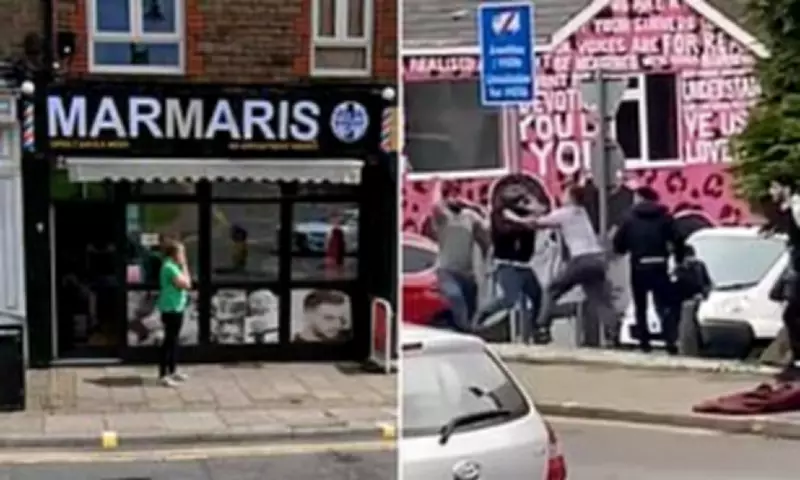
Marmaris Barbers in Blackwood, South Wales
Situated on the high street of Blackwood, a tranquil market town in the Welsh valleys, Marmaris Barbers appears innocuous. However, in February 2025, the pavement outside became the scene of a violent mass brawl that left a man with a fractured skull. The conflict erupted when Omed Pirot, a 31-year-old employee, announced plans to open a new shop in nearby Newbridge, angering staff from Kurds Barbers.

Employees from Marmaris confronted the rivals, leading to a frenzied altercation involving up to 25 men, with scissors and spanners used as weapons. One individual sustained a stab wound to the back, while Pirot suffered a shattered skull from a knuckle-duster attack. Pirot, who is from Iran, claimed self-defence but was convicted of affray alongside colleague Shabab Husseini. Five others from Kurds Barbers admitted affray, with all seven awaiting sentencing.
HB Barbers and K Barbers in Hove
In Hove, the fashionable neighbour of Brighton, tensions between K Barbers and HB Barbers culminated in violence on April 2, 2024. Men associated with both shops engaged in a brutal fight, wielding knives, tyre irons, and wooden clubs. Two men were critically injured, one with a deep arm cut and a stab wound reaching the bone.
Three Kurdish Iraqis from K Barbers—Ayob Mohammed, Sarbast Ibrahimi, and Sardam Qadir—were imprisoned for violent disorder and weapon possession. Court proceedings revealed a dispute between Mohammed and Hogr Banaee of HB Barbers, with threats exchanged. The shop has since rebranded as Bamo 1 Barber, while K Gentleman Barbers remains nearby, though some local barbers operate irregular hours.
SR Barbers in Somercotes, Derbyshire
The violence in Somercotes, Derbyshire, surpassed other incidents, resulting in a fatal stabbing on November 25, 2021. Peshang Sleman, a worker at SR Barbers, was killed, and his brother, Ibrahim Takmary, was seriously injured outside a Co-op store. The conflict involved a rivalry with Pro Barbers, located opposite the Co-op.
Herish Zandi, a local resident and Pro Barbers employee, pleaded guilty to manslaughter and received a nine-year sentence. Two other men, Danyaal Panah and Sam Mohazeri, admitted violent disorder and were jailed. The victim's family expressed dissatisfaction, alleging a cover-up. Local scepticism persists, with questions about why individuals from distant areas would open barber shops in a small village.
Traditional Barbers in Camden, North London
Some barber shops have direct ties to organised crime. Traditional Barbers in Camden, owned by Hewa Rahimpur, served as a front for human trafficking. Rahimpur, an Iranian who entered the UK illegally, facilitated the smuggling of 10,000 migrants via small boats from France to Dover, generating £13 million in profits.
He used the barber shop to launder money and was extradited to Belgium in 2024, where he is serving an 11-year sentence for people-trafficking. This case highlights how these businesses can mask serious criminal operations.
Boss Crew Barbers in Hammersmith, West London
Terrorism links have also emerged, as seen with Boss Crew Barbers in Hammersmith. Owner Tarek Namouz fraudulently obtained coronavirus relief grants from the local council and transferred approximately £11,280 to ISIS supporters in Syria. He boasted of sending additional funds for sniper rifles.

Namouz denied knowledge of the money's use for terrorism, claiming it was for humanitarian aid. However, in 2023, he was convicted on eight counts of funding terrorism, underscoring the diverse criminal activities associated with some barber shops.
These examples illustrate a troubling trend where Turkish-style barber shops, often perceived as benign community fixtures, can be entangled in severe criminality, from violent disputes to international trafficking networks.