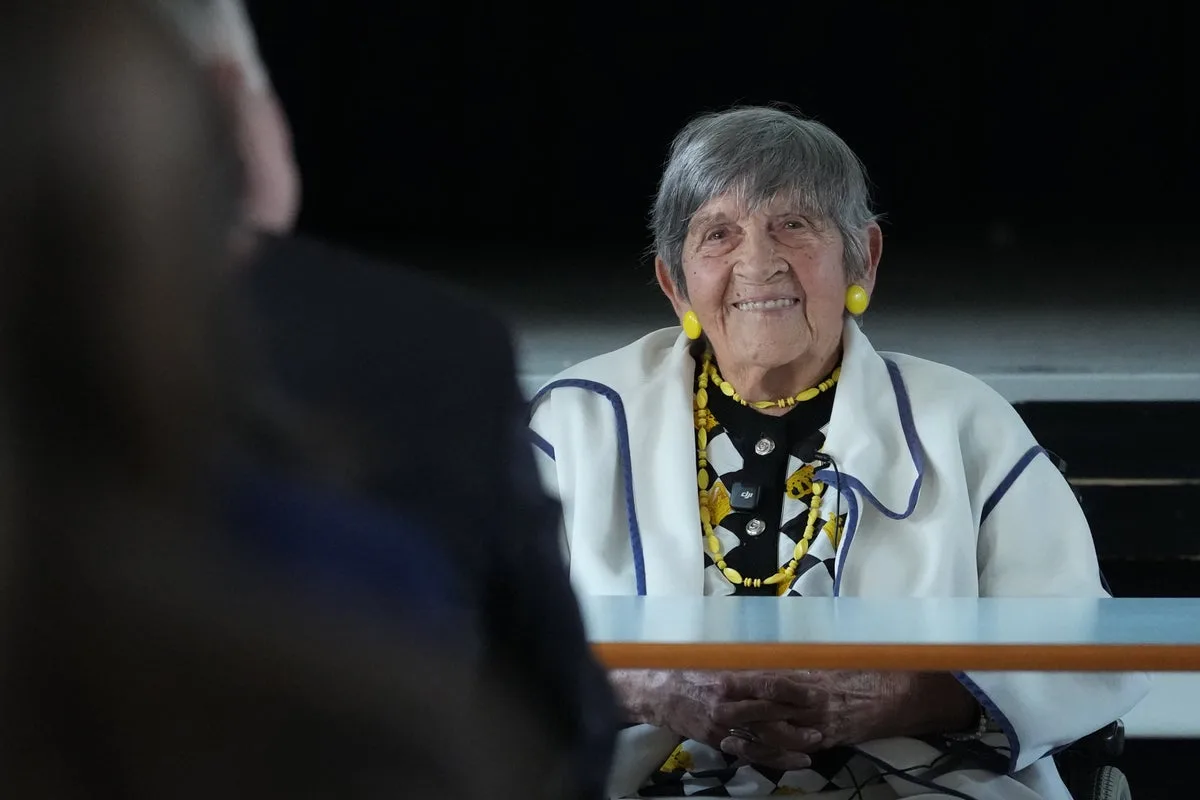
At 101, Auschwitz Survivor Fights Hate with Spielberg's Help
Ginette Kolinka, a 101-year-old survivor of Auschwitz-Birkenau, has transformed into a formidable warrior against antisemitism in France, with significant support from filmmaker Steven Spielberg. After decades of silence, Kolinka now dedicates her life to ensuring the horrors of the Holocaust are never forgotten.
A Life-Changing Decision
For years, Kolinka had a stock response to those inquiring about her experiences in the Nazi death camp. "If I had a child, well, I would prefer to strangle them with my own hands than make them go through what I went through," she would say. This stark answer, she explains, conveyed the depth of her trauma without delving into painful details.
However, a turning point came 30 years ago, spurred by Steven Spielberg's 1993 film "Schindler's List." Spielberg subsequently founded an organization to collect testimonies from Holocaust survivors. When the foundation contacted Kolinka, she was initially hesitant, fearing it would be a waste of time. But in 1997, she agreed to an interview, and for nearly three hours, memories and tears flowed freely.
"For the first time, I found myself compelled to think about it again," Kolinka recalls in her 2019 memoir, "Return to Birkenau." The foundation has since gathered over 60,000 testimonies, with more still being collected today.
Sharing the Unspeakable
Kolinka's story is one of immense suffering and resilience. During World War II, Nazi-occupied France deported 76,000 Jewish individuals, mostly to Auschwitz-Birkenau; only 2,500 survived. France's leadership took 50 years to officially acknowledge the state's involvement in the Holocaust, with then-President Jacques Chirac in 1995 describing French complicity as an indelible stain on the nation.
Now, through books, media appearances, and school visits, Kolinka has become the most prominent remaining French survivor of Auschwitz-Birkenau. According to the Paris-based Union of Auschwitz Deportees, only a few dozen survivors are still alive, perhaps fewer than 30.
Educating the Next Generation
Recently, Kolinka visited the Marcelin Berthelot high school east of Paris, where students listened in pin-drop silence as she recounted her ordeal. Even an abbreviated 90-minute version was tough to hear, covering her arrest in March 1944 to her skeletal return to France after Nazi Germany's surrender in May 1945.
She described being crammed into windowless animal-transport wagons in Paris and the violent arrival at Auschwitz-Birkenau three days later. "The Nazis' hatred of Jews was such that they hunted for every detail that could make us suffer, humiliate us," she told the students. Kolinka rolled up her sleeve to show her tattooed identification number—78599—explaining, "Some people’s numbers cover their entire arm. But I have a nice little number."
To spare the young listeners, she omitted that most of the 1,499 people in her convoy were killed on arrival. Kolinka was among a few hundred kept for forced labor, witnessing subsequent trains arrive, knowing their passengers would soon die. "I became a robot," she said, describing how she shut down her emotions to survive.
A Legacy of Remembrance
After her talk, students gathered around Kolinka, giving her rock-star treatment and asking more questions. Nour Benguella, 17, and Saratou Soumahoro, 19, were in awe, both describing her as "extraordinary." Benguella added, "An amazing woman. It’s wonderful to have her here in front of us. This strength of testimony, her mental fortitude. Keeping this history alive is the only thing that will permit us to not make the same mistakes."
Kolinka's mission is clear: to ensure that the lessons of the Holocaust endure. Her firsthand account of murderous hatred and inhumanity serves as a powerful tool against antisemitism, inspiring future generations to embrace the duty of remembrance.






