Arson Attack on Jewish Ambulances in London Heightens Community Fears
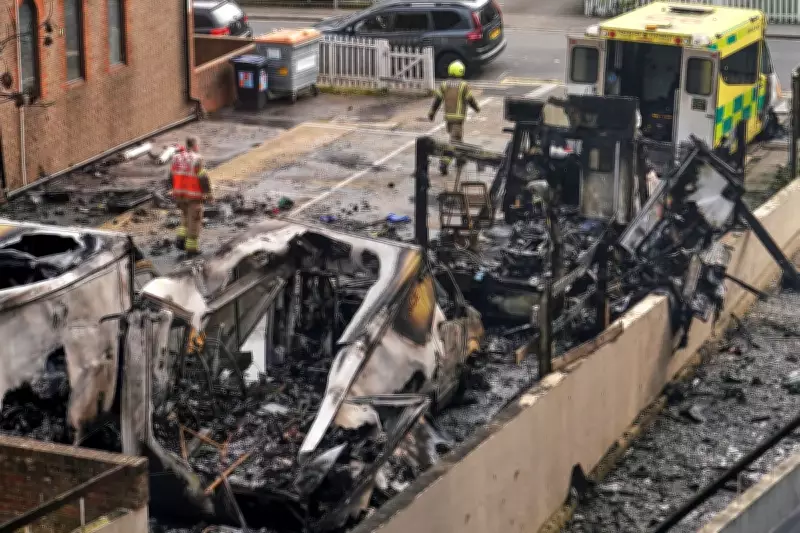
British police are actively pursuing three suspects following a deliberate arson attack on ambulances belonging to a Jewish charity, an incident that has intensified feelings of vulnerability within Britain's Jewish community. The blaze, which erupted in the Golders Green area of London—a neighbourhood with a significant Jewish population—completely destroyed four emergency vehicles operated by the volunteer organisation Hatzola Northwest.
Explosions and Escalating Tensions
The fire caused oxygen cylinders on the ambulances to explode, shattering windows in a nearby apartment block and damaging stained-glass windows at the adjacent Machzike Hadath Synagogue, where the vehicles were parked. Beyond the physical destruction, the attack has profoundly shaken the community's sense of security, already under strain due to ongoing conflicts in the Middle East and a reported surge in antisemitic sentiment across the United Kingdom.
"We're feeling vulnerable," stated Damon Hoff, president of the Machzike Hadath Synagogue. "We know what's going on. Nobody's eyes are closed. We're living through wars. There's multiple fronts, and Britain is a part of it, and our community is a tiny little part of a very, very big world."

Context of Rising Antisemitism
Britain's Jewish community, while long-established, constitutes a small minority, numbering approximately 300,000 people. Golders Green serves as one of its cultural hubs, featuring kosher restaurants, numerous Jewish schools, and several dozen synagogues. However, data from the Community Security Trust, an organisation dedicated to protecting Jewish people, indicates a sharp increase in antisemitic incidents since the Hamas attack on Israel on October 7, 2023, and the subsequent Gaza war.
The group recorded 3,700 incidents in 2025, a dramatic rise from 1,662 in 2022. This troubling trend was underscored by a deadly attack in October 2025, when an assailant drove a car into a crowd outside a Manchester synagogue on Yom Kippur, resulting in one stabbing death and another fatality from police gunfire.
Investigation and International Links
Counterterrorism police are leading the investigation into the ambulance arson and examining a claim of responsibility posted on social media by a group calling itself Harakat Ashab al-Yamin al-Islamia, translated as the Islamic Movement of the Companions of the Right. Israeli authorities have identified this as a recently formed group with suspected connections to pro-Iran networks, which has also claimed responsibility for synagogue attacks in Belgium and the Netherlands.
Mark Rowley, chief of London's Metropolitan Police, noted that detectives are investigating the claim but emphasised it is too early to attribute the attack directly to the Iranian state. The UK has previously accused Iran of using criminal proxies to conduct attacks on European soil, targeting both opposition media outlets and the Jewish community. Britain's MI5 domestic intelligence service reports that over twenty "potentially lethal" Iran-backed plots were disrupted in the year leading up to October.
Last week, two men in London were charged with conducting "hostile" surveillance of the UK's Jewish community on behalf of Iran, further highlighting these security concerns.
Domestic Political and Social Pressures
Many British Jews believe that hostility is also growing closer to home. Some community members have criticised Prime Minister Keir Starmer's centre-left Labour Party government for not preventing pro-Palestinian demonstrations, held since October 7, 2023, from escalating into anti-Jewish rhetoric and actions. While these protests have been largely peaceful, some politicians and religious leaders argue that chants such as "From the river to the sea, Palestine will be free" incite anti-Jewish hatred.
Additionally, some claim that the UK's recognition of a Palestinian state has emboldened antisemitism—an assertion the government firmly rejects. Pro-Palestinian demonstrators, including some Jewish participants, maintain that criticism of Israel's actions does not equate to antisemitism, though Israeli Prime Minister Benjamin Netanyahu and his supporters often conflate the two.

Enhanced Security Measures and Community Resilience
In response to the escalating threats, Chief Rowley announced that London's police force will increase security for Jewish schools, synagogues, and community centres ahead of Passover next month, including deploying "highly visible firearms patrols."
Jack Taub, a member of the Machzike Hadath Synagogue leadership team, argued that authorities "need to do a lot more" to protect the Jewish community. He described the attack as sad but unsurprising "given the sentiment that there is in the country, the hatred that is against Jewish people."
Jonathan Wittenberg, senior rabbi of Masorti Judaism, whose community is located just down the street from the attack site, observed a pervasive sense of encroaching danger. "People are definitely anxious," he told The Associated Press. "However, the other thing to say is there's a very, very strong determination to continue with Jewish life. Judaism is nothing if not deeply resilient."
Questions of Safety and Future
These repeated attacks have prompted some British Jews to consider relocating to safer environments, while simultaneously questioning whether such places truly exist. "Israel's not exactly the safest place in the world at this moment," Rabbi Wittenberg remarked. "There certainly are people thinking, you know, Israel is my safe space. But I think there's also a feeling, is there safe space anywhere?"
The incident underscores a broader climate of fear and uncertainty, as the community grapples with both international tensions and domestic challenges to its security and wellbeing.