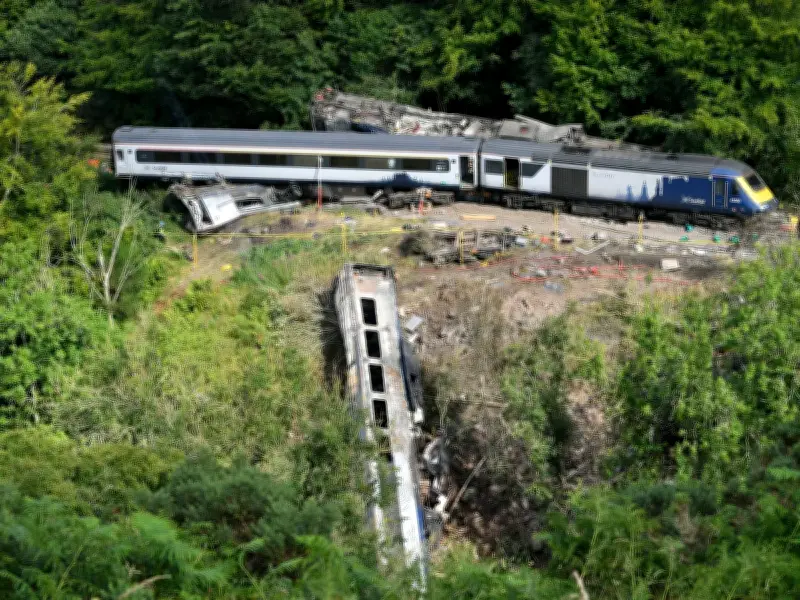
A Fatal Accident Inquiry has concluded that the deaths of three men in the Stonehaven rail disaster could have been prevented if a drain had been built correctly. Train driver Brett McCullough, 45, conductor Donald Dinnie, 58, and passenger Christopher Stuchbury, 62, died after the Aberdeen to Glasgow service derailed on the line between Dundee and Aberdeen, near Carmont, on August 12, 2020.
Failings identified by the inquiry
Sheriff Lesley Johnston said the derailment could have been avoided if now-collapsed construction firm Carillion had built the drain in accordance with the design it had been given. She also said failures in Network Rail's documentation of the drainage system contributed to the tragedy.
The FAI found the drain, built in two phases in 2011 and 2012, had deviated from the design in "a number of respects", including issues with piping and materials, and the addition of a "bund", or ridge, which prevented it from working properly. The sheriff said Network Rail had "failed to ensure" the drain was constructed correctly, while Carillion failed to prepare "as built" drawings and provide them to Network Rail.
The determination read: "The drain was not constructed/installed in accordance with the design. As a result, the drain was unable to accommodate the flow of surface water during the intense rainfall in the area on August 12 2020."
The crash and its victims
Train 1T08 left Aberdeen at 6.38am en route to Glasgow. It travelled just past the crash site before being halted for more than two hours due to a landslip further down the line. At about 9.28am the train was advised to return to Stonehaven and hit the "washout" from the drain at about 9.37am, travelling just below the normal speed for the line. The impact caused the train to derail and hit the parapet of a bridge, causing the train vehicles to "scatter".
Nine people were on board at the time of the crash: six passengers and three railway employees, one travelling as a passenger. The six survivors were all injured. The FAI heard the deaths of all three men were caused by "multiple non-survivable blunt force injuries".
Sheriff Johnston paid tribute to the victims, saying Mr McCullough's actions "cannot be faulted" on the day of the disaster. She said: "Brett McCullough was a cherished son, husband, father, brother, colleague and friend. From the evidence and information before the inquiry, it was clear that Mr McCullough was totally focussed on the execution of his duties as train driver on 12 August 2020 in challenging and unprecedented weather conditions. He responded to the signals and instructions provided to him appropriately. His actions as train driver on 12 August 2020 cannot be faulted and in no way caused or contributed to the accident. He is forever missed by his family."
Aftermath and industry response
Network Rail previously pled guilty to a contravention of the Health and Safety at Work Act and was fined £6.7 million in September 2023. It admitted a number of maintenance and inspection failures before the crash, as well as failing to warn the driver that part of the track was unsafe, or tell him to reduce his speed. The FAI heard that no routine inspection was carried out by Network Rail at the site for seven years prior to the crash, and that route control staff in Scotland were "not adequately trained" in relation to the national standard for managing extreme weather.
The Rail Accident Investigation Branch (RAIB) made 20 safety recommendations in a report in March 2022, including better management of civil engineering projects, improved response to extreme rainfall, and better understanding of the additional risk associated with older trains. Sheriff Johnston concluded that extensive work undertaken by Network Rail and the wider rail industry since the accident had addressed the safety issues identified and made no recommendations.
Train drivers' union ASLEF said the FAI had highlighted a "staggering level of governance and corporate failure that must never happen again". Kevin Lindsay, Scottish Organiser, said: "The pain they feel is always with them, and we know the publication of the FAI determination will only add to their grief and sense of loss. We have consistently said throughout this process that this tragedy should never have happened. The failings of Network Rail and their contractor Carillion, identified by the RAIB report and supported by the FAI determination, represent a staggering level of governance and corporate failure that must never happen again. We must learn from both sets of findings to ensure we never experience a tragedy like this again on our rail network."
Liam Sumpter, Network Rail Scotland managing director, said the tragedy was "a terrible day for our railway", adding: "Since August 2020, we have been working hard to make our railway safer for our passengers and colleagues, to deliver on the RAIB recommendations and to fully support the FAI process to reach its conclusion. We have made significant changes to how we manage the risk of severe weather since the accident and to increase the resilience of Scotland's railway."